President Donald Trump declared Thursday that the United States no longer needs an agreement with Iran, asserting that Tehran's regime is collapsing under mounting American economic and military pressure.
The post Trump: ‘We Don’t Need a Deal with Iran’ — ‘Regime Is Collapsing’ appeared first on Breitbart.
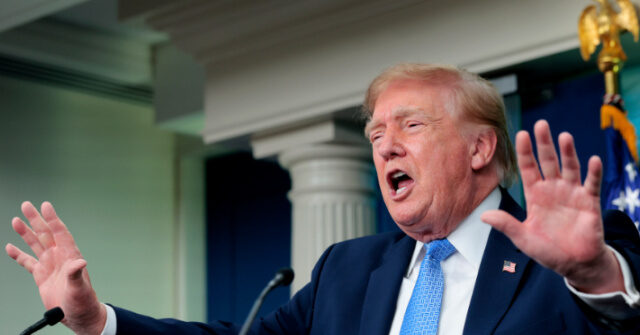
President Donald Trump declared Thursday that the United States no longer needs an agreement with Iran, asserting that Tehran’s regime is collapsing under mounting American economic and military pressure.
His remarks came amid reports of possible direct negotiations involving Vice President JD Vance, while Tehran continued demanding concessions Washington has repeatedly rejected and the administration maintained its sweeping economic pressure campaign against the Islamic Republic.
“We don’t need a deal with Iran. Those days have long since passed,” Trump wrote on Truth Social.
“We’ve got their money, Hundreds of Billions of Dollars, and we’ve got their Strait!” he added.
In the same post, Trump directed Vance to concentrate on domestic priorities, following reports Wednesday that the vice president was considering direct talks with a senior Iranian security official despite the lack of acceptable negotiating terms.
The Wall Street Journal reported that Vance had been weighing a meeting with Mohsen Rezaei, secretary of Iran’s powerful Supreme National Security Council, although no meeting had been scheduled.
The White House indicated that negotiations remained possible if Tehran presented acceptable terms, with the New York Post reporting that Vance participated in an Oval Office meeting on Iran Thursday morning alongside senior administration officials.
“If he ever sees a smart deal worth looking at, he’ll send the VP to get it done,” a U.S. official told the outlet.
For now, Tehran continues demanding that Washington accept seven conditions before substantive negotiations can proceed, including lifting the American blockade, easing sanctions, releasing frozen assets, and paying reparations.
Iranian officials reiterated those demands Thursday, despite the administration’s repeated rejection of the conditions. Secretary of State Marco Rubio dismissed them Tuesday as “absurd,” arguing that Iran should be paying reparations rather than receiving them.
Washington has continued tightening economic pressure through sanctions and its naval blockade, restricting Iranian oil exports while protecting commercial shipping through the Strait of Hormuz.
According to figures released Wednesday by U.S. Central Command (CENTCOM), American forces have redirected nearly 150 vessels attempting to violate the blockade since July, disabled five ships, and prevented an estimated $30 billion in Iranian crude oil exports.
CENTCOM also reported that nearly 4,000 commercial vessels have passed through the strait under American protection, transporting approximately 1.7 billion barrels of crude oil.
Trump reiterated American control of the Strait of Hormuz during Thursday’s interview with Hugh Hewitt, declaring, “We control the Gulf in terms of the Hormuz Strait. We control it. Totally control it.”
Asked whether he would maintain the blockade even if it took another 26 months to bring down the Iranian government, Trump suggested the regime was already nearing collapse.
“Well, the regime is collapsing,” he said.
Trump pointed to inflation exceeding 300 percent, the regime’s inability to pay its soldiers, and the destruction of much of Iran’s navy, air force, and air defenses as evidence of the mounting economic and military pressure on Tehran.
Secretary of State Marco Rubio explained the administration’s strategy during remarks Tuesday.
“The President has concluded that for the time being there is no need for major combat operations because we’re achieving the same objective by economic means,” Rubio said.
Trump elaborated on that approach in an interview released Thursday with Stephen A. Smith, explaining that several Gulf allies had urged him to maintain the current pressure campaign rather than immediately expand military operations.
The president said Saudi Arabia, Qatar, Kuwait, the United Arab Emirates, and Bahrain preferred giving the economic measures more time to weaken Tehran.
“Saudi Arabia has asked me to please just let it be the way it is now for a while because they’re disintegrating,” Trump said, referring to Iran.
Asked whether he would already have expanded military operations without the requests from regional allies, Trump answered, “Yes, I would.”
The president said American forces had largely spared Iran’s energy infrastructure, bridges, and manufacturing facilities, arguing that those targets could be destroyed within three days if he ordered a broader offensive.
His remarks followed Wednesday’s Veterans Day address at Arlington National Cemetery, where Trump said the United States had already achieved a decisive military victory over Iran but was determined to secure a complete victory before ending the conflict.
“We want to make sure we have a total victory, not a 93% victory. It’s going to be total,” Trump said.
Asked by Hewitt whether he would use military force again if Iran threatened American allies or vessels in the Strait of Hormuz, Trump said he would act without hesitation.
“If I saw things going the other way, I would do that,” Trump said, adding that he could order renewed strikes immediately.
Asked whether he might resume military operations against Iran’s remaining industrial infrastructure and the Pickaxe Mountain nuclear facility, Trump acknowledged that further strikes remained possible, responding, “It could happen.”
Trump’s warnings came as senior Iranian officials continued threatening American and Israeli forces, with Rezaei declaring Thursday that the Islamic Revolutionary Guard Corps Aerospace Force was prepared to deliver “new surprises on the battlefield.”
Iran’s Assembly of Experts, the body responsible for overseeing Supreme Leader Mojtaba Khamenei, also called Thursday for reconsidering the country’s membership in the Nuclear Non-Proliferation Treaty and revising its defense doctrine, describing the proposed changes as an “inevitable necessity.”
The Iranian threats have also extended to senior American officials, with Treasury Secretary Scott Bessent, a central architect of the administration’s economic pressure campaign, reportedly relocating with his family to a military installation following threats linked to Tehran.
Asked by Hewitt what would happen if Iran assassinated a senior American official, Trump issued a warning: “They will not exist very long any longer.”
Joshua Klein is a reporter for Breitbart News. Email him at [email protected]. Follow him on Twitter @JoshuaKlein.