President Donald Trump signaled Thursday that he intends to hold off on another major round of strikes against Iran until the new year, even as Israeli Prime Minister Benjamin Netanyahu presses for renewed military action and Washington continues evaluating potential targets and Iranian retaliation.
The post Trump Signals No More Major Iran Strikes in 2026 — Economic Pressure Mounts on Tehran appeared first on Breitbart.
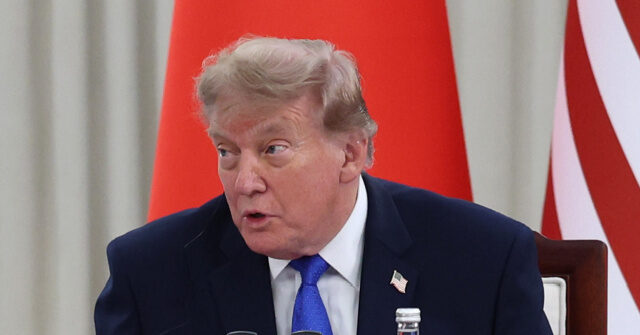
President Donald Trump signaled Thursday that he intends to hold off on another major round of strikes against Iran until the new year, even as Israeli Prime Minister Benjamin Netanyahu presses for renewed military action and Washington continues evaluating potential targets and Iranian retaliation.
Trump’s remarks come amid escalating attacks across the Persian Gulf, stalled negotiations with Tehran, and reports that Netanyahu is urging Washington to join Israel in a four-to-seven-day bombing campaign, while Gulf Arab governments warn that renewed strikes could provoke devastating retaliation against regional energy infrastructure.
“I am not rushing into any decision [on Iran]. We will see what happens after the beginning of the year,” Trump told Axios during a brief telephone interview aboard Air Force One as he returned from China.
Trump’s comments follow his assessment last week that another major round of strikes was “quite unlikely,” while Secretary of State Marco Rubio has argued that Washington is already achieving its objectives through economic pressure without the need for major combat operations.
Nevertheless, the White House has requested Pentagon and intelligence assessments of how Iran might retaliate against various U.S. strike scenarios, according to a separate report from the outlet. Officials are particularly concerned about whether another operation could trigger devastating Iranian attacks against Gulf countries’ oil and natural gas infrastructure.
Among the potential targets under consideration are Iran’s heavily fortified Pickaxe Mountain nuclear complex, buried deep beneath a mountain, as well as military installations, bridges, power plants, and Iranian leaders.
Trump has not authorized another major operation, and his stated preference to wait until the new year does not preclude a change in course should circumstances deteriorate.
The deliberations come as Netanyahu intensifies efforts to persuade Washington that another military campaign is necessary.
The New York Times reported that the Israeli prime minister is pushing for a joint operation lasting four to seven days, citing concerns that Iran is rebuilding its missile and drone capabilities while potentially advancing chemical and biological weapons programs.
The pressure on Washington has been substantial, with a senior Israeli official telling Ynet News that “Netanyahu is putting enormous pressure on the Americans, hoping to get to Trump and extract a green light from him.”
Netanyahu reportedly told Israeli security officials Wednesday evening that an operation against Iran was “unavoidable,” according to Israel’s Channel 13.
A senior Israeli military officer told the network that the two countries already have coordinated operational plans.
“There are shared and approved plans between the IDF and CENTCOM. The question is the timing,” the officer said.
The reports followed a Wednesday meeting in Israel between U.S. Central Command commander Adm. Brad Cooper, IDF Chief of Staff Lt. Gen. Eyal Zamir, and Mossad director Roman Gofman.
Cooper subsequently traveled to Saudi Arabia, where he met Crown Prince Mohammed bin Salman and Defense Minister Prince Khalid bin Salman amid escalating regional attacks.
Gofman also visited Washington and Miami last week for discussions with CIA Director John Ratcliffe and White House envoy Steve Witkoff.
During those meetings, the Mossad chief reportedly presented Israeli intelligence concerning Iranian chemical-weapons research and testing while urging renewed military action.
Trump publicly raised concerns about Iran’s potential pursuit of chemical and biological weapons during a Fox News interview Wednesday in Shenzhen, China, suggesting that Tehran was exploring alternatives after U.S. strikes severely damaged its nuclear program.
“There is indication that Iran is looking at gases, looking at bio, because we’ve shut them out with the nuclear,” Trump said.
Tehran rejected the allegations Thursday, with Foreign Ministry spokesman Esmaeil Baqaei comparing them to the intelligence controversy surrounding Iraq’s alleged weapons of mass destruction before the 2003 U.S. invasion.
“The allegations keep changing, but the underlying narrative remains disturbingly familiar,” Baqaei wrote on X.
“Now we find ourselves facing ominous new allegations and a narrative that appears to be following the same fraudulent script,” he wrote.
The competing claims come amid continued uncertainty over the whereabouts and condition of Iran’s highly enriched uranium, which international inspectors have been unable to independently verify following previous U.S. and Israeli strikes on Iranian nuclear facilities.
Iranian officials reiterated Thursday that Tehran would not grant the International Atomic Energy Agency unrestricted access to sensitive nuclear sites while facing the threat of additional military strikes.
The diplomatic and military deliberations unfold amid renewed attacks involving U.S. forces, Iranian military installations, and commercial shipping across the Persian Gulf.
Earlier Thursday, Bloomberg reported that Western officials believed the likelihood of renewed large-scale U.S. strikes had increased amid escalating regional attacks, although Trump subsequently signaled that he was in no rush to make a decision.
Iranian forces have targeted U.S. military facilities in Bahrain and Kuwait, while American forces struck an IRGC missile installation on Iran’s Qeshm Island earlier this week.
The confrontation has also spread to Saudi Arabia, where an attack by Iran-backed Houthi forces damaged several floors of a skyscraper in Riyadh’s King Abdullah Financial District on Thursday, according to Saudi authorities, who reported no injuries.
Gulf governments have urged Washington to avoid another major round of strikes, fearing Iranian retaliation against critical energy infrastructure and further disruption to commercial shipping through the Strait of Hormuz.
Even as military tensions mount, the Trump administration continues using its naval blockade and economic-pressure campaign to squeeze Tehran and force concessions without launching another major offensive.
Iran’s economy is buckling under the combined pressure of sanctions and the blockade, with inflation exceeding 90 percent and the rial plunging in value, according to the report.
Iranian President Masoud Pezeshkian warned Thursday that disruptions to domestic production could trigger rising unemployment, spreading poverty, and intensified social discontent as Tehran struggles to preserve its economic capacity under U.S. pressure.
“The goal is to manage the current situation while supporting production and maintaining the country’s economic capacities,” Pezeshkian said, according to Iranian state media.
Diplomatic efforts have meanwhile produced little progress, with Qatari representatives meeting Iranian Foreign Minister Abbas Araghchi in Oman earlier this week without a significant breakthrough.
Tehran continues demanding an end to the U.S. naval blockade, sanctions relief, and the release of frozen assets—conditions Washington has previously rejected—while the United States insists on concessions concerning Iran’s nuclear program.
Iran’s Islamic Revolutionary Guard Corps also warned Thursday that it would not accept the continuation of the blockade or the existing military standoff.
“We will not accept the continuation of the current status quo, a state of neither war nor peace, or a war of attrition,” IRGC spokesman Hossein Mohebbi warned Thursday.
Trump’s latest remarks signal that another major U.S. offensive against Iran is unlikely before the end of 2026, leaving Washington’s economic-pressure campaign at the center of its strategy even as military preparations continue and Tehran refuses to yield on its negotiating demands.
Joshua Klein is a reporter for Breitbart News. Email him at [email protected]. Follow him on Twitter @JoshuaKlein.