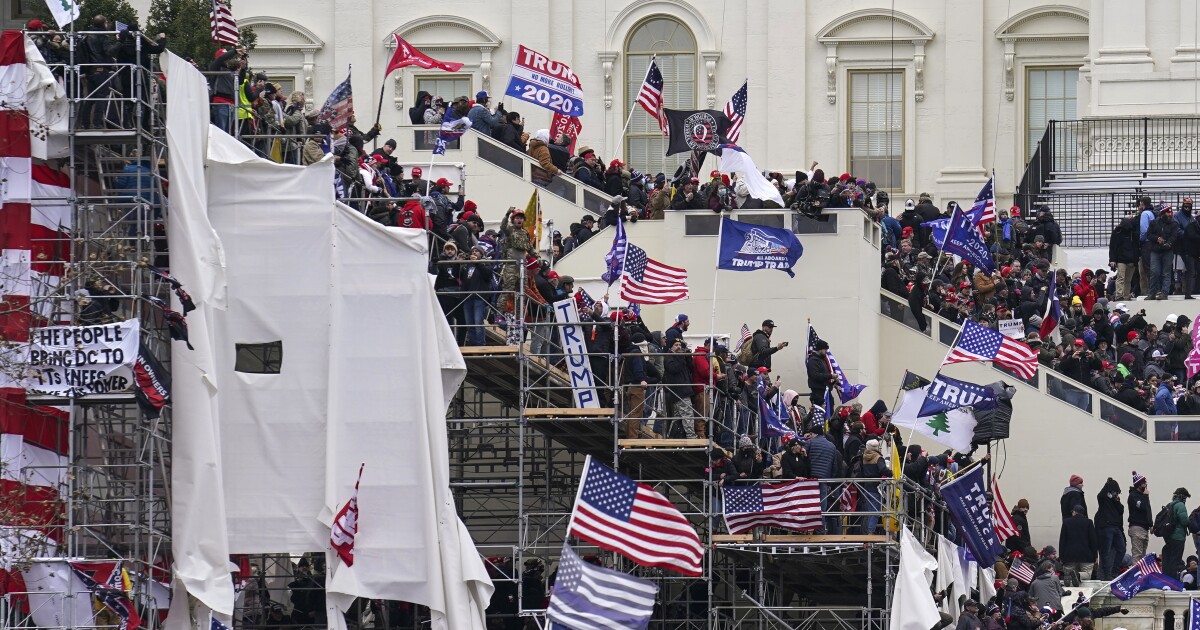
The FBI committed a host of violations of Foreign Intelligence Surveillance Act rules by improperly accessing foreign intelligence data while investigating people they believed were connected to the Jan. 6 Capitol riot.
The bureau’s wrongdoing was detailed in a heavily-redacted 127-page opinion from the Foreign Intelligence Surveillance Court, which was penned by FISC Judge Rudolph Contreras in April 2022 but was released by the Office of the Director of National Intelligence on Friday.
LIBERALS BLAME REPUBLICANS, NOT BIDEN, FOR THEIR PURSUIT OF DEBT CEILING ‘PLAN B’
The FISA Court’s 2022 opinion said the U.S. government told it about “significant violations” of the “querying standard” for properly accessing the raw FISA information, including “several related to the January 6, 2021 breach of the U.S. Capitol” as well as during protests in 2020 following the death of George Floyd.
The FISA abuse revelations come the same week as special counsel John Durham’s report on his investigation of the Trump-Russia investigators revealed further FISA wrongdoing related to the FBI’s reliance on Christopher Steele’s discredited and Democratic-funded dossier. It also comes a day after House Republicans released a report where FBI whistleblowers contended the Biden administration was using its Capitol riot cases to inflate the rise of domestic terrorism in the United States artificially.
It also comes as the Biden administration seeks to reauthorize FISA Section 702 powers, which are set to expire at the end of 2023. The reauthorization has already met opposition from some Republicans in the House and Senate because of FISA abuses that were unearthed related to the Steele dossier.
The portion of the FISA law relates to Section 702, which the ODNI describes as “a key provision” of FISA “that permits the government to conduct targeted surveillance of foreign persons located outside the United States.” It was that portion of the FISA law that the FISA Court exposed new FBI violations for conducting unfettered searches on people with no connection to foreign terrorism.
According to the newly released court order, one FBI analyst “ran 13 queries of individuals suspected of involvement” in the Capitol riot, with the analyst saying she ran the searches to determine if those individuals had any foreign ties and added that she had run “thousands of names within FBI systems in relation to the Capitol breach investigation.”
The Justice Department’s National Security Division was repeatedly cited by the FISA Court, saying the FBI’s use of FISA information against potential Capitol riot subjects was improper. In this case, it concluded the “queries were not reasonably likely to retrieve foreign intelligence information or evidence of a crime.”
An FBI officer also ran two searches for someone under investigation “for assaulting a federal officer in connection with the Capitol breach,” and he “could not recall why he had queried raw FISA information, but FBI field office personnel participating in the query audit stated that the FBI viewed ‘the situation in general’ at the time as a threat to national security.” The NSD “assessed that these queries were not reasonably likely to retrieve foreign intelligence information or evidence of a crime.”
Someone also “ran five queries of individuals involved in the Capitol breach” after they were instructed to provide a “full workup on terms related to Capitol Breach leads to verify whether individuals involved … were acting at the direction of a foreign power.” The NSD again “assessed that the queries were not reasonably likely to retrieve foreign intelligence information or evidence of a crime.”
Another person “conducted three batch queries consisting of approximately 23,132 separate queries, using presumed U.S.-person query terms.” The searches used FISA information “to find evidence of possible foreign influence, although the analyst conducting the queries had no indications of foreign influence.” The NSD again found there was “no specific factual basis to believe the queries were likely to retrieve foreign intelligence information or evidence of a crime.”
An FBI analyst in January 2021 “conducted a query using an identifier for a presumed U.S. person thought to have been present at the January 6 Capitol breach” and “reviewed the contents of an email retrieved by the query.” The FISA Court said the query also violated the “reasonably likely to retrieve” standard.
The bureau searched more Section 702 in June 2021 using the name of someone they believed was at the Capitol riot and who was the subject of an open criminal investigation. The FBI then “accessed” the information “without obtaining” a FISA Court order.
“Similar circumstances were reported for two other queries conducted in response to a lead sent by a field office that had a predicated criminal investigation opened related to the breach of the U.S. Capitol,” the FISA Court said. “These queries returned Section 702-acquired contents, which were accessed.”
The NSD then “assessed that these queries were not designed to find and extract foreign intelligence information, although each person running the queries believed that the U.S. Capitol breach implicated national security, and the field office that sent the leads also had a separate predicated investigation concerning foreign malign influence of the Capitol breach.”
The FISA Court said the NSD reported another Section 702 “violation” related to the Capitol riot just before its April 2022 opinion was released, and the NSD “has not yet advised whether any use was made of the information improperly accessed.”
Another redacted person also “conducted 360 queries in connection with domestic drug and gang investigations, domestic terrorism investigations, and the Capitol breach,” but the person “provided no information to support a reasonable basis to believe that foreign intelligence information or evidence of a crime would likely be returned.” The NSD yet again found the FBI violated search standards.
The FBI’s Office of Internal Auditing also uncovered “similar” violations, including those related to people associated with “civil unrest and protests” or with “suspected involvement” in the Capitol riot. The FISA Court said, “Several of these queries ran against Section 702-acquired information.” When the FBI conducted these searches, the FISA Court said, “they were not aware of any potential connections between the query subjects and terrorist or other national security threats.”
The Justice Department said this month that “more than 1,033 defendants have been arrested” in relation to the storming of the Capitol, including roughly 346 defendants charged with assaulting, resisting, or impeding law enforcement.
CLICK HERE TO READ MORE FROM THE WASHINGTON EXAMINER
The FISA Court also revealed FISA violations related to investigations into the protests and riots in the summer of 2020.
An unnamed person ran a “batch query” on FISA information in June 2020 by using identifiers of 133 people who had been arrested “in connection with civil unrest and protests” from late May to mid-June 2020. The search was run without “any specific potential connections to terrorist-related activity.” The NSD “assessed that the queries were not reasonably likely to retrieve foreign intelligence information or evidence of a crime.” The FBI defended its actions.