Many unforeseen conflicts broke out, escalated, and concluded in 2025. This year is set to follow that same pattern.
The previous year was marked by the tentative conclusion of the war in Gaza, a brief but dangerous war between Israel and Iran, a brief war between nuclear-armed India and Pakistan, and the continued onslaught of the Russia-Ukraine War. 2026 began with a bang, to boot, with the extraordinary capture of Venezuela’s Nicolas Maduro, and the future of the Latin American state is by no means a foregone conclusion.
While attention may be focused there, three major hot spots risk descending back into all-out civil wars or collapse. Here are three countries to monitor in 2026 where conflicts could escalate or break out.
Yemen
The Yemeni Civil War, beginning with the seizure of Sanaa by the Houthis in 2014, is one of the bloodiest conflicts of the 21st century, claiming nearly 400,000 lives and spilling over into multiple countries, not to mention jeopardizing global trade. Aside from the Houthis’ attacks on Red Sea shipping in connection with the war in Gaza, however, international attention has largely shifted elsewhere, after a U.N.-mediated ceasefire took effect in April 2022. Until December 2025, the conflict remained essentially frozen, with the Houthis and different rival factions consolidating their hold over different parts of the country.
Signs at the close of 2025 indicate that the war could explode once again in 2026.
While most expected any renewal of fighting to occur between the Houthis and the other belligerents, the latest developments haven’t involved the Shiite terrorist group at all.
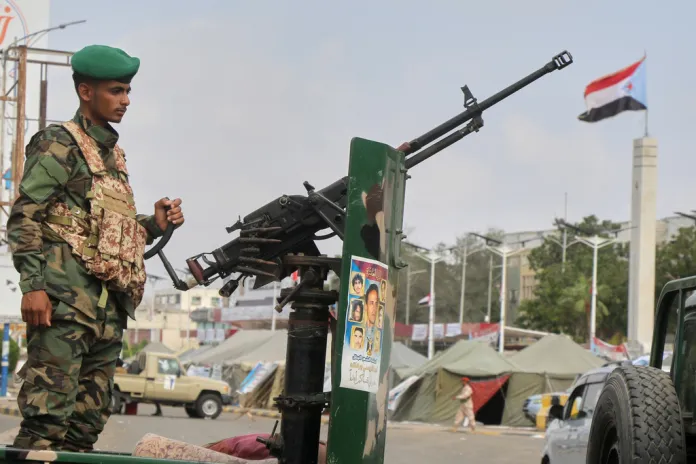
After years of being part of an uncomfortable national unity government, the separatist Southern Transition Council, backed by the United Arab Emirates, launched a sudden offensive on Dec. 2, sweeping aside forces loyal to the Saudi-backed Presidential Leadership Council. The PLC’s troops put up so little a fight that many spectators assumed a prior deal had been reached, the Washington Institute reported, but it became clear after the dust settled that no such deal had been made.
At the offensive’s conclusion, the STC forces had seized the regions of Hadramawt and al Mahra, the former bordering Saudi Arabia and the latter bordering Oman. Together, the two provinces constitute roughly half of Yemen’s landmass, but only around 5% of its population. The STC is now in control of over half of Yemen’s landmass and about a third of its population, marking the most sudden territorial shift of the entire 11-and-a-half-year-long civil war.
Aside from territorial concerns, the conquered territories are also rich in oil — the STC now has possession of nearly 80% of Yemen’s oil reserves.
The offensive puts two of the most powerful members of the anti-Houthi coalition on a crash course: Saudi Arabia and the UAE, two countries already on edge over opposing stances in the Sudanese Civil War. As in that conflict, Saudi Arabia has a vested interest in supporting the central government, while the UAE is supporting a rival faction to boost its own influence and economic ties. In another parallel to the civil war across the Red Sea, the STC’s offensive now means Yemen is essentially split in half, with the prospect of a partition looming ever closer.
Though the STC hasn’t declared independence, it has eyed the prospect of recreating the state of South Yemen, which occupied the same territory from 1967 to 1990.
Saudi Arabia, which views Hadramawt as important to its national security, immediately voiced outrage at the STC’s offensive and demanded its forces withdraw. The STC rejected the demand, inviting a Saudi airstrike in Hadramawt that an eyewitness said destroyed a military vehicle, according to the Times of Israel.
The Saudi military began amassing thousands of soldiers on the border after the success of the offensive, gearing up for a possible further escalation. Though Riyadh and Abu Dhabi both said they would work on de-escalation, the prospect of a revival of the civil war seems likely.
Clashes between members of the anti-Houthi coalition could invite the Shiite group to take advantage of the fracture. A key element will be the hand of Washington, with President Donald Trump likely to both boost his peacemaking abilities and resolve tensions between two of his closest allies in the Middle East.
Yemen goes into 2026 looking more fragile than ever, with several vectors of conflict ready to burst open.
South Sudan
The world’s youngest country is still experiencing growing pains, pains that experts fear could send the country back into a bloody civil war, after just emerging from one that lasted from 2013 to 2018.
The South Sudanese Civil War ended when the belligerents signed the Revitalized Agreement on the Resolution of the Conflict in South Sudan in 2018, but the agreement stalled in 2025. Making matters more difficult is the fact that, like its beleaguered northern neighbor and former overlord, South Sudan’s civil tensions are based around a personal power struggle rather than ideological tensions. In South Sudan’s case, the primary conflict is between President Salva Kiir and First Vice President Riek Machar.
Kiir was supposed to lead a transitional government alongside Machar until new elections were held, but this transitional period had been repeatedly delayed. Worse yet, Machar was arrested in March over an attack on a military base, posing perhaps the greatest challenge to the peace process yet.
While the arrest of Machar and most other opposition figures has allowed Kiir to further consolidate power, with his opponents unable to organize, it has also contributed to further instability in the young country. The United Nations Mission in South Sudan warned that Machar’s arrest could lead the country back to civil war.
Though outright civil war was prevented, 2025 saw the worst violence since the end of the civil war, with hundreds killed and hundreds of thousands displaced. The U.N. Mission in South Sudan recorded 635 civilians killed, 676 injured, 133 kidnapped, and 74 raped between April and June alone. Violence continued to escalate as the year came to a close, with outright armed conflict plaguing the Greater Upper Nile, Jonglei, and Western and Eastern Equatoria regions.
Nick Haysom, the U.N. Secretary General’s special representative for South Sudan, warned in late December that the country had reached a decisive moment that would determine whether it would achieve lasting peace or slide back into civil war.
“The violence itself has over the past few months spread,” he told PassBlue in an interview. “It’s become much more directly political, which means a conflict between the principal political players, as opposed to the intercommunal conflict which is part of the more regular picture. So that has to stop if they want to create an environment in which elections can be held.”
The Sudanese Civil War has also worsened the situation, with a massive influx of refugees contributing to the instability.
Elections are scheduled to be held in December 2026, though even the U.N. has warned that actually holding them might be unwise, as it could exacerbate rather than reduce violence.
This year is set to determine whether the world’s youngest country can begin to reverse course or collapse back into civil war.
Mozambique
While international focus on ISIS has waned since its main caliphate in Iraq and Syria collapsed in 2018, the group has seen a resurgence elsewhere, particularly in parts of Africa. One of its biggest footholds is in Mozambique, with a jihadist insurgency beginning in the province of Cabo Delgado in 2017. Islamic State-Mozambique has become one of the most effective branches of ISIS, fighting off a multinational counterinsurgency force and sustaining one of southern Africa’s costliest insurgencies.
Thousands of people have been killed and hundreds of thousands displaced, a trend that worsened in 2025. According to the International Organization for Migration, over 100,000 people were displaced in November alone, bringing the total number of displaced to 350,000.
Armed Conflict Location & Event Data recorded 549 deaths in 302 IS-M attacks this year, more than half of them civilians. This total is 56% higher than last year and is likely to worsen in 2026. Two major factors indicate a dramatic escalation in violence in 2026.
The IS-M insurgency previously peaked in 2021 when the group seized control of a port city and launched increasingly daring attacks, killing hundreds. In response, one of the most capable militaries in Africa, the Rwanda Defense Force, was deployed to push the jihadists back. This was largely successful, with IS-M forces being pushed back and degraded significantly.
New developments have changed this dynamic. Tomás Queface, a researcher for ACLED, noted that Rwandan and Mozambican forces were not as “effective as they used to be … The Rwandans are not doing patrols like they used to do.”
“And more importantly, the government wants the Mozambican forces to take the lead in the conflict and then Rwanda stays in the back,” he said.
The increasing reluctance of Rwandan forces is likely related to their adventure in the Democratic Republic of the Congo, where their allied M23 rebels seized control of significant swaths of the mineral-rich East. Though Kigali continues to deny as much, the U.N. and most international observers of the conflict have established that thousands of Rwandan Army regulars operate alongside M23 rebels. The resources and troops needed for the war have likely diverted the priorities of the tiny African nation.
Without the professionalism of the so-called African Prussia, the struggling Mozambique government could rapidly lose control of the IS-M insurgency.
HOT SPOTS WHERE WAR MAY BREAK OUT OR ESCALATE IN 2025
Mozambican President Daniel Chapo is operating with fragile legitimacy, taking office in January 2025 after disputed elections that culminated in security forces killing hundreds of civilians.
ACLED data has warned that the insurgency could spill south, possibly causing a cascading effect that could lead to the collapse of the government. The group has also noted attacks from nongovernmental forces across the country, something that could increase if the IS-M insurgency sees further success in 2026.