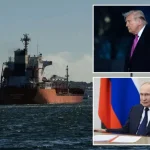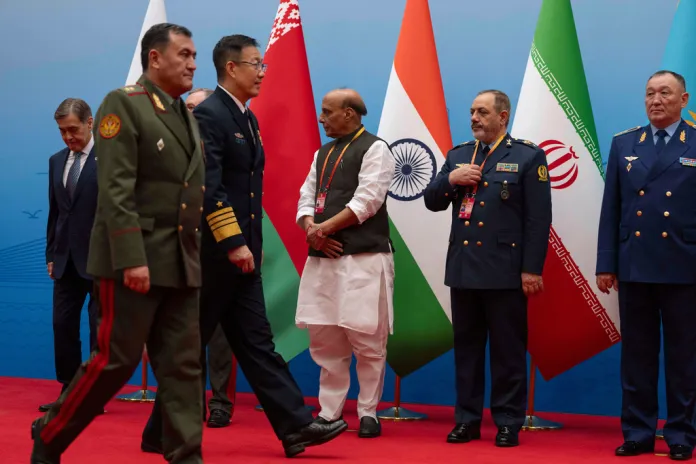
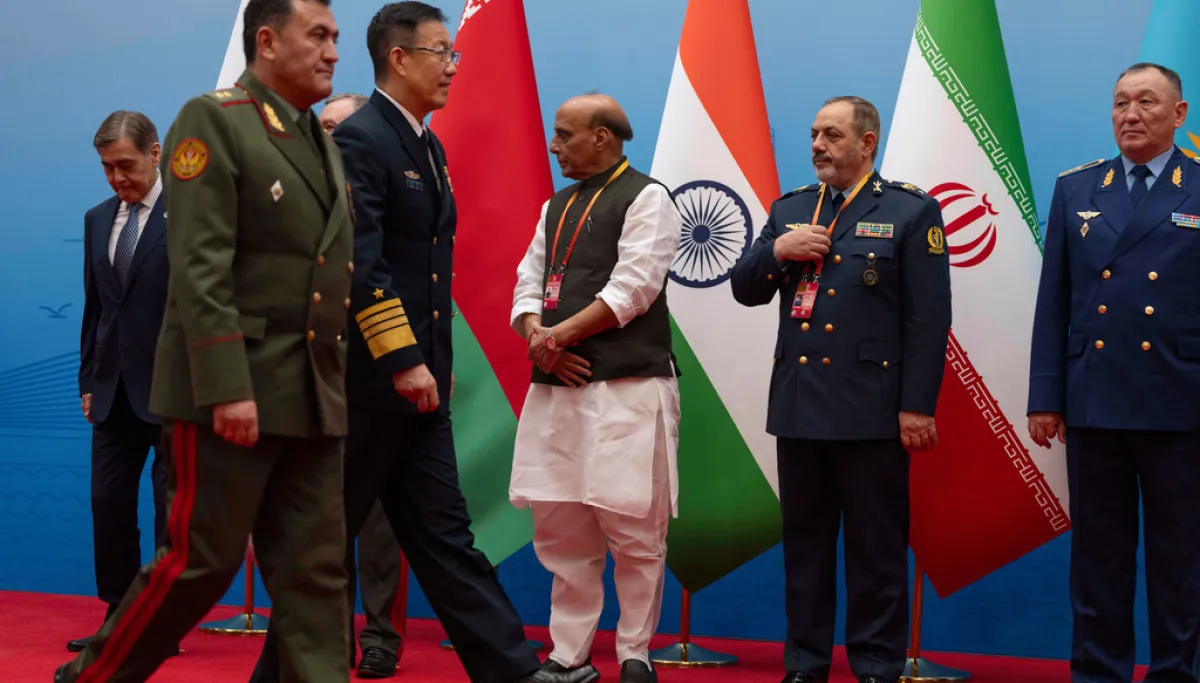
Iran cultivated a network of seemingly impressive friends ahead of its war with Israel and the United States, but once the bombs started falling, those friends were nowhere to be found.
Iran’s aggressive Shiite revolutionary ideology left it isolated for the first two decades of its existence, making enemies of virtually all its neighbors and regional players. The Islamic Republic slowly opened up, beginning with the presidency of Mohammad Khatami from 1997 to 2005, but closed off again under Mahmoud Ahmadinejad from 2005 to 2013. After a period of renewed isolation following the accession of President Donald Trump in 2017, Iran stood firm in courting the West’s traditional adversaries to strengthen its position and keep its economy afloat.
This strategy appeared to largely pay off for a while, with Iran weathering Western sanctions through deals with Russia, China, India, Venezuela, and other countries outside the Western sphere of influence. Though it formed close ties with many, the U.S.-Israeli war on Iran has exposed the limits of these ties, with none coming to Iran’s aid.
Russia
Russia was one of the most openly friendly countries toward Iran before the war. The two countries found common cause in supporting former Syrian President Bashar al Assad in his civil war, working closely on fighting ISIS and anti-government rebels together. Moscow further deepened its ties with Tehran after it was ostracized from the world community over its invasion of Ukraine, with the two sharing information and technologies and helping each other avoid Western sanctions. Iran gave Russia the blueprint of its cheap and effective Shahed drone, one of the few truly game-changing weapons of the Russia-Ukraine War.
Russia and Iran cemented their bond in January 2025 with the signing of a Comprehensive Strategic Partnership. The move deepened cooperation in military, economic, energy, technological, political, and trade spheres. Contrary to popular belief, the deal did not constitute an alliance, and neither party is obliged to come to the other’s assistance if attacked, in contrast to the deal signed by Russia and North Korea. The lack of a closer deal, according to some Russian sources, was due to Tehran’s desire for more strategic autonomy.
RUSSIA DISTANCES ITSELF FROM IRAN CONFLICT: ‘NOT OUR WAR’
Cracks in the relationship were already showing in 2019, as outright victory in the Syrian Civil War seemed more likely. The two countries were split on oil and gas rights in Syria and reconstruction projects, with two distinct pro-Iran and pro-Russia camps forming in the Syrian high command. Both jockeyed for more of a say in the postwar affairs of the country.
Bogged down in Ukraine and not under any obligation to come to Tehran’s rescue, Moscow has stood by as its strategic partner has been pummeled by U.S. and Israeli air and missile strikes. Its only support for Iran has been limited to rhetoric, with Russian President Vladimir Putin harshly condemning the assassination of former Ayatollah Ali Khamenei. However, even rhetorically, Russia hasn’t been as supportive as Tehran may have hoped, with Kremlin spokesman Dmitri Peskov largely voicing apathy about the conflict.
When asked by a Russian reporter on Thursday what Moscow should do in response to the war, Peskov was largely dismissive, saying the conflict was “not our war.”
“We must now minimize the consequences for our economy from the global shocks that we are already seeing begin,” he said. “We should probably secure benefits for ourselves where possible, as cynical as that may sound.”
Russia also has much to gain in an extended war between Iran and the U.S. — Iranian drone and missile strikes on Israeli and U.S. targets are eating up much-needed expensive interceptor missiles at a rate faster than they can be replaced. The U.S. and NATO will be forced to relegate their limited interceptor stockpiles to the U.S. missile defense systems in the Middle East, stripping Ukraine of vitally needed air defense ammunition. An extended conflict would also distract U.S. attention from Ukraine to deal with its own war.
China
China is Iran’s largest and most important ally, a partnership characterized by its transactional nature but vital in keeping Tehran afloat. Beijing has played a central role in building up Iran’s economy, especially in areas where Iran has been locked out of Western expertise, such as telecommunications. Zineb Riboua, an Iran expert with the Hudson Institute, wrote that Beijing had spent a massive amount of effort turning Iran into a “structural asset.” The importance of Iran in Beijing’s network is such that she argued “Operation Epic Fury” was more about China than anything else.
China was the largest buyer of Iranian oil by a long shot, purchasing as much as 80% of Iran’s crude oil at steeply discounted prices. Tehran and Beijing signed a 25-year Comprehensive Strategic Partnership in 2021, which involved an estimated $400 billion in investments across Iran’s energy, banking, telecommunications, and infrastructure sectors. The Iranian ballistic missile program was even largely reliant on Chinese chemicals.
IRAN’S SPRAY-AND-PRAY STRATEGY AIMS TO WIDEN THE BATTLEFIELD, SPREAD CONSEQUENCES
Riboua argued that China’s oil purchases and investments were the primary reason the Islamic Republic hadn’t gone bankrupt.
Despite having the most to lose, China has also refrained from assisting Tehran. Its reaction to Khamenei’s assassination was limited to a diplomatic complaint that it constituted “a grave violation of sovereignty.”
Its lack of a response can be attributed to fear of the Trump administration’s reaction and conflicting interests in the region. Ironically, the threat posed by Chinese-allied Iran allowed Beijing to integrate itself with Tehran’s rivals better, striking close relationships with the Gulf countries. The Gulf monarchies were struck with crippling doubt toward the U.S. over the Arab Spring, former President Barack Obama’s announced “Pivot to Asia,” and the 2015 Iran nuclear deal. All three gave Gulf leaders the suspicion that the U.S. was losing interest in the region and could no longer be trusted as their sole guarantor. The countries, therefore, sought to diversify their alliances, turning to China.
The connections facilitated by this change have become so extensive that China isn’t willing to risk outright taking Iran’s side, especially as the Gulf countries have been the primary target of Iranian missiles and drones beginning on Saturday.
“[Chinese President Xi Jinping’s] communications problem may be worse than his strategic one. If Beijing endorses the strikes, it loses the Arab world the moment China is seen applauding the killing of the supreme leader of a Muslim-majority country. If Beijing condemns the strikes, it attaches Chinese prestige to a dead man’s regime and risks provoking a Trump administration that has just demonstrated, through the act itself, that it does not bluff,” Riboua explained in another article.
The Iranian Royal Guard Corps’ decision to hold the Strait of Hormuz hostage may also prove to have been a critical mistake. Though China purchases an immense amount of Iranian oil, it purchases even more Gulf oil. Nearly half of China’s oil passes through the strait, so a blockade poses an economic risk Beijing isn’t willing to take.
India
Iran and India enjoyed remarkably friendly relations before the war, despite New Delhi’s close relations with Israel. The relationship was characterized mainly by economic cooperation — assistance from one of the largest countries on Earth was of vital help to Iran’s crumbling economy. India served as an important buyer of sanctioned Iranian oil.
Despite the friendly relations, New Delhi has remained completely neutral on the attack against Iran and the assassination of Khamenei, something criticized by Indian Prime Minister Narendra Modi’s domestic opposition. India’s only public statements have been a neutral urge to find a peaceful solution.
The silence has been widely interpreted as implicitly siding with the U.S. and Israel.
The sinking of the IRIS Dena by a U.S. submarine showcased the failure of India to aid Iran in any way. The ship was sailing home after taking part in a peaceful exercise with other nations off the coast of India, invited and addressed by Modi. Modi has boasted of India’s role as “guardian” of the Indian Ocean, a boast that was gutted when the Dena was sunk in that very ocean.
Adding insult to injury, Modi hasn’t immediately commented on the attack, let alone condemned it.
India is also more concerned with the war between neighboring Pakistan and Afghanistan, which began just days before the much larger war in the Gulf.
Turkey
Iran and Turkey have a relationship spanning hundreds of years, with their cultures deeply intertwined. After the Islamic Revolution, Turkey was one of the few countries willing to deal directly with Iran during its war with Iraq, selling it a considerable amount of weapons despite also giving weapons to Iraq. Though the two have clashed with competing interests in places such as Syria and the Caucasus, they have united over common interests in the Palestinian territories, the issue of the Kurds, and economic interdependence.
Iran has reportedly viewed Turkey as a potential ally as recently as 2019. Syrian columnist Rif’at Ibrahim Al-Badawi wrote in the then-pro-Assad Syrian newspaper Al-Watan that Iran was trying to boost a rapprochement between Damascus and Ankara, after which the three could form a regional alliance consisting of Iran, Syria, and Turkey.
After Saturday’s opening attacks that killed Khamenei, Turkish President Recep Tayyip Erdogan condemned the strikes and said he was “saddened” by the former ayatollah’s death. This was the extent of Turkish support, however, with Ankara further turning against Iran after becoming one of a dozen countries targeted by Guard drone or missile strikes.
IRAN WIDENS REGIONAL WAR WITH FIRST STRIKE INTO AZERBAIJAN
Though the missile was shot down by NATO air defenses and Iran denied being behind the attack, the incident soured relations between Ankara and Tehran. Turkish Foreign Minister Hakan Fidan discussed the missile attack with Iranian Foreign Minister Abbas Araghchi shortly after, and the foreign ministry conveyed its “concern and strong protest” after summoning Iran’s ambassador.
The targeting of one of Turkey’s closest allies, Azerbaijan, on Thursday is likely to worsen relations further. Turkey is the one country on the list that could go beyond not helping Iran and drift toward outright hostility.