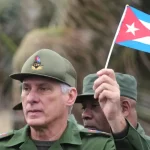
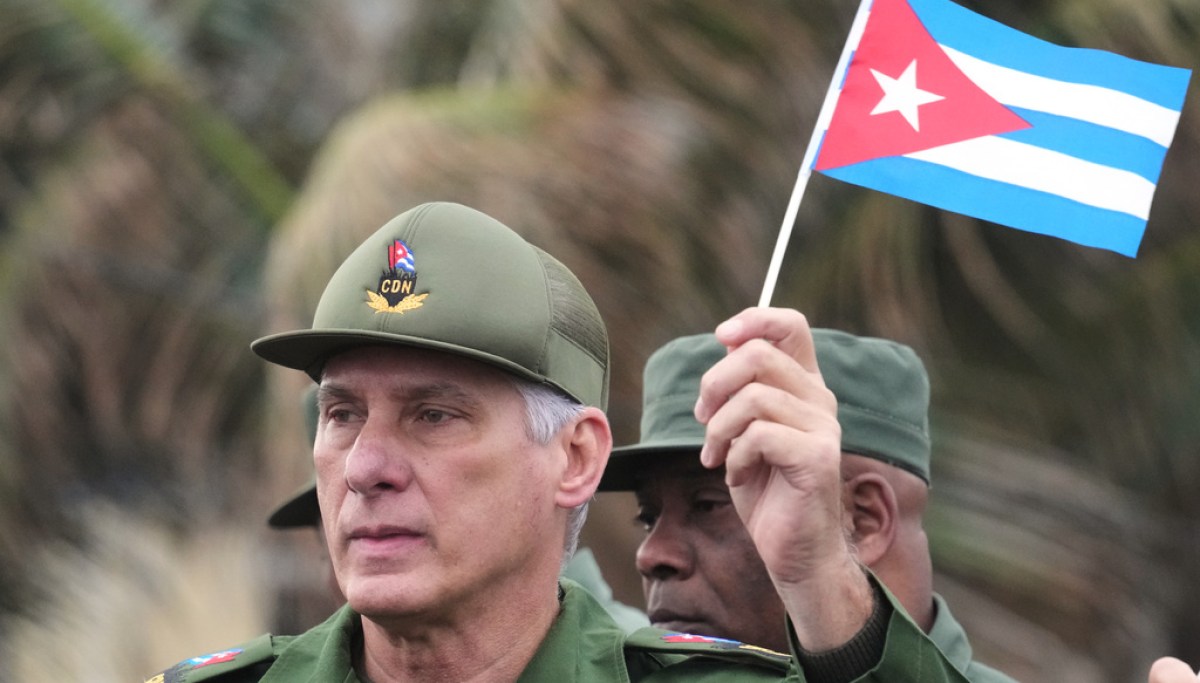
Cuban President Miguel Díaz-Canel on Sunday reiterated a pledge to fight against a hypothetical U.S. invasion, saying he is prepared to “give my life for the revolution.”
“It is evident that there are threats out there. It is part of the rhetoric of the U.S. government,” Díaz-Canel said in his first-ever interview on American television, on NBC’s Meet the Press. “If that happens, there will be fighting, and there will be a struggle, and we’ll defend ourselves. And if we need to die, we’ll die because, as our national anthem says, ‘Dying for the homeland is to live.’”
The communist leader embraced a similarly tough rhetoric against the United States in an interview with Newsweek published last Tuesday, in which he stated that “the loss of life and material destruction would be incalculable” should President Donald Trump decide to invade Cuba. The Cuban president was responding to Trump’s threats to mount a “friendly takeover” of Cuba earlier this year after the U.S. took over Venezuela.
Díaz-Canel said this week that it would be a mistake for Washington to believe that Communism would end in Cuba should the U.S. attempt to kill or arrest him, as it did with former Iranian Ayatollah Ali Khamenei and former Venezuelan dictator Nicolas Maduro.
“Sometimes they try to personalize the leadership of the Cuban revolution with a single person…but the thing is, we have a collegiate leadership, and we have a unity, cohesion, ideological unity,” he said. “Therefore, removing one person within the structures of the institutions of the revolution will not solve any problem. Quite the contrary, there will be hundreds of people who are in a position to take that responsibility and collectively make decisions.”
“I don’t think there would be any justification for the United States to launch a military action, or for the U.S. to undertake a surgical operation or the kidnapping of a president,” he added. “If that happens, there will be fighting.”
The U.S. has had sanctions against Cuba in place for years, designed as pushback against the island’s communist leadership and policies. In his second term, Trump has escalated pressure on Cuba to make democratic reforms.
When Trump took over Venezuela in January, he cut off the country’s oil supply to Cuba, marking a blow to the island due to its heavy reliance on the South American energy market. The same month, he sought to make the oil embargo global, releasing an executive order that leveled tariffs against any countries that supply the island with oil. The move has prompted Russia to tighten its relationship with its communist ally that lies just 90 miles from the U.S., with Moscow sending Díaz-Canel shipments of oil to blunt the blockade’s impact.
TRUMP CLAIMS HE WILL HAVE THE ‘HONOR’ OF TAKING CUBA
When pressed on whether the U.S. would directly seek to topple Diaz-Canel and establish another government in Cuba, Secretary of State Marco Rubio deflected during a congressional hearing in late January, saying the Helms-Burton Act, which placed some long-standing sanctions on Cuba, could not be legally lifted until there is new leadership in the country.
“I think we would love to see the regime there change. We would like to — that doesn’t mean that we’re going to make a change, but we would love to see a change. There’s no doubt about the fact that it would be a great benefit to the United States if Cuba was no longer governed by an autocratic regime,” Rubio said during an appearance before the Senate Foreign Relations Committee. “The Helms-Burton Act, the U.S. embargo on Cuba, is codified. It was codified in law, and it requires regime change in order for us to lift the embargo.”