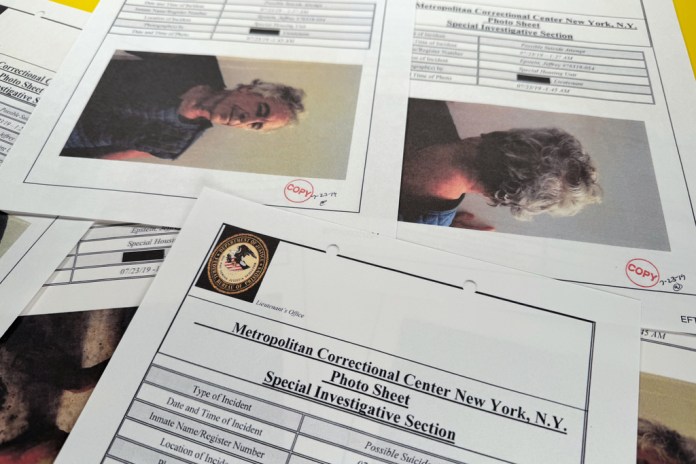
Democrats are experimenting with a new message casting President Donald Trump’s Cabinet and wealthy allies as the “Epstein class,” an attempt to channel anti-elite anger and recast the president’s inner circle as the very establishment he once ran against.
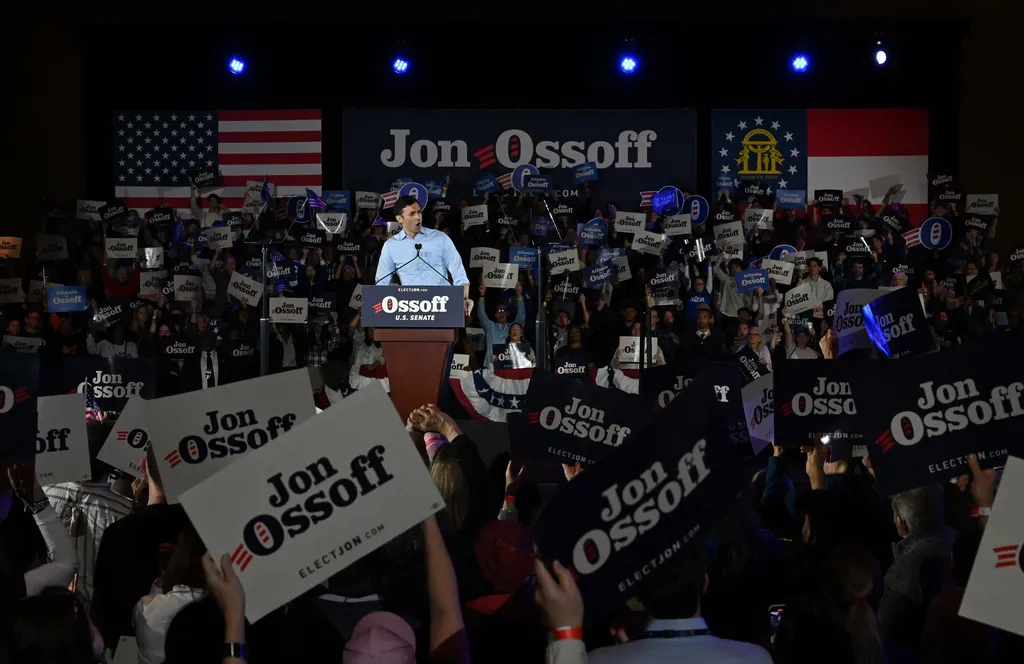
The phrase has quickly spread among Democratic lawmakers, with Sen. Jon Ossoff (D-GA) amplifying it at a rally on Feb. 7 in Atlanta as his reelection campaign ramps up. Ossoff is one of the most vulnerable Democrats on the 2026 map, defending a seat in a state Trump carried in 2024.
“This is the Epstein class, ruling our country,” Ossoff said. “They are the elites they pretend to hate.”
He added, “We were told that MAGA was for working-class Americans. Do you remember that? But this is a government of, by, and for the ultra-rich.”
Democrats’ argument hinges on the political symbolism of the Epstein files, a sprawling set of court records and investigative materials that map Jeffrey Epstein’s relationships with wealthy and powerful figures across politics, business, and media.
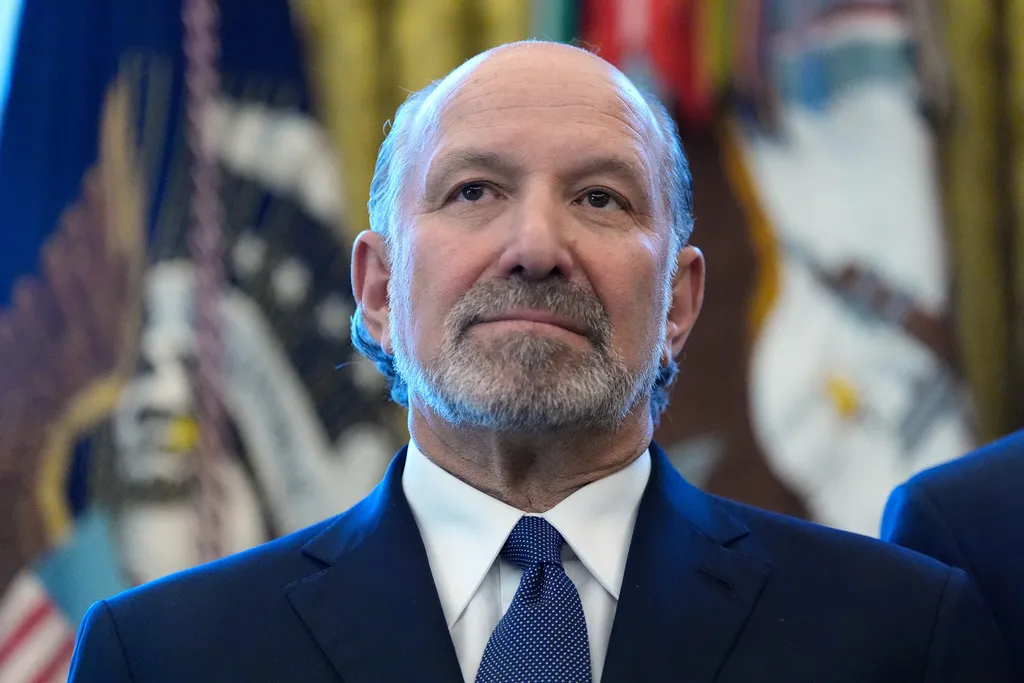
Several figures connected to Trump appear in those records, including Commerce Secretary Howard Lutnick, former strategist Steve Bannon, and political ally Elon Musk. There is no evidence in the materials showing criminal wrongdoing by them or by Trump.
Still, Democrats are leaning into the files rhetorically, arguing they represent a two-tiered justice system that shields elites from accountability.
Rep. Ro Khanna (D-CA), a progressive lawmaker widely credited with helping introduce the phrase, pressed that argument on the House floor this week while accusing the FBI of improperly redacting records tied to the late convicted sex offender.
“Who are they protecting?” Khanna said. “Why are they protecting these rich and powerful men, people I call part of the Epstein class? Why are we in a country where there is no elite accountability for people who do the most heinous things?”
Khanna and Rep. Thomas Massie (R-KY) have pushed the Justice Department to release additional unredacted material after reviewing Epstein documents. Khanna framed the controversy as larger than one criminal case, arguing it speaks to whether powerful figures face the same scrutiny as ordinary citizens.
“It’s not just about the 1,200 survivors,” he said. “It’s about two tiers of justice in America.”
Other Democrats have described the unfolding disclosures in sweeping terms. Speaking at a press conference alongside survivors on Wednesday, Rep. Pramila Jayapal (D-WA) said, “The earth is shaking because every single one of them now is becoming known … and here in America that needs to happen too, and until it does, we are here to say we will not stop.”
Cross-party risk
The strategy carries political risk for Democrats because Epstein’s social and donor network spanned both parties, ensnaring figures tied to Democratic politics as well as Republicans.
Former President Bill Clinton, a central figure in the party’s modern history, is among the high-profile names documented as having flown on Epstein’s plane. Clinton has repeatedly denied wrongdoing, and there is no evidence he engaged in illegal conduct. He and former Secretary of State Hillary Clinton are expected to appear for congressional depositions about Epstein later this month.
The latest document releases have also renewed scrutiny of several influential Democratic-linked donors, underscoring the cross-party nature of Epstein’s circle. Venture capitalist Reid Hoffman, a major Democratic donor and LinkedIn co-founder, appears thousands of times in the Epstein documents, while sports and media executive Casey Wasserman, another high-profile political donor whose giving has largely favored Democrats, was named in the most recent tranche of records. Neither has been accused of criminal wrongdoing.
Commerce Secretary Howard Lutnick has faced renewed questions after emails surfaced showing discussions about travel to Epstein’s private Caribbean island in 2012. Lutnick acknowledged Tuesday before the Senate Appropriations Committee that he had lunch with Epstein there, a shift from his earlier statement that he spent “zero time” with him. He has not been accused of wrongdoing.
The breadth of Epstein’s connections complicates Democrats’ effort to frame the scandal as a one-sided political liability.
Jon Reinish, a Democratic strategist, argued the message can resonate if it is framed around accountability rather than partisan score-settling.
“If it’s handled properly, it can really resonate with anti-elite, fed-up voters who believe the system is rigged for rich, powerful insiders,” Reinish said. “Crusading for the Epstein survivors and for the truth, no matter what is uncovered, feeds into a populist movement.”
But he acknowledged uncertainty about where future revelations could lead.
“There is no way of knowing how many directions this is going to lead in,” he said.
GOP skepticism
Republican strategists argue the message risks looking disconnected from voters’ daily concerns.
“Democrats continue to beclown themselves with the Epstein files,” Florida-based GOP strategist Ford O’Connell said. “It may fire up their base, but the Epstein files are not going to put food on your table. They’re not going to put gas in your car.”
O’Connell argued the focus diverts attention from economic and security issues voters prioritize and could boomerang as more Democratic-aligned figures face scrutiny.
Matthew Bartlett, a Republican strategist and former Trump administration appointee, called the phrase “a banger of a line” but questioned its staying power.
“It resonates because so many high-profile people are connected to Epstein,” Bartlett said. “But I’m not sure the midterms are going to be fought along Epstein lines. It’s highly sensationalized, but I’m not sure it actually moves voters long term.”
Bartlett noted the scandal cuts across party lines.
“Epstein is apolitical,” he said. “It has tentacles across party, across politics, across so many different sectors of power.”
That bipartisan reach, strategists say, makes the controversy harder to weaponize cleanly but also feeds a wider distrust of elites that both parties are trying to harness.
DEMOCRATS WANT PROBE OF BONDI’S ‘SPYING’ ON LAWMAKERS’ EPSTEIN SEARCH HISTORY
The clash reflects a broader competition over which party can claim the anti-elite energy that has shaped recent elections.
“The populist mantle is really up for grabs now,” Reinish said.