The House is expected to take up bipartisan aviation safety legislation responding to the January 2025 midair collision near Washington, even as the Pentagon raises late objections and victims’ families push lawmakers to act.
The Rotorcraft Operations Transparency and Oversight Reform Act would require civilian and military aircraft operating in congested airspace to use Automatic Dependent Surveillance-Broadcast technology, which allows pilots to broadcast and track aircraft positions in real time. The National Transportation Safety Board has said the technology could have prevented the crash between American Airlines Flight 5342 and an Army Black Hawk helicopter that killed 67 people.
The bill would also narrow the definition of a “sensitive government mission,” a designation that currently allows military helicopters to operate without broadcasting their position in certain circumstances.
Hours ahead of an expected House vote, the War Department warned the Senate-passed legislation could create operational and budgetary risks.
In a statement, Pentagon spokesman Sean Parnell said the department supported the intent of the legislation but argued the Senate version failed to include several updates discussed with lawmakers.
“As currently drafted, enactment would create significant unresolved budgetary burdens and operational security risks affecting national defense activities,” Parnell said, adding that the Pentagon remained ready to work with Congress to ensure safety goals were met while protecting military operations.
The War Department’s relatively brief statement did not detail specific points of disagreement with the ROTOR Act.
Supporters of the bill said the legislation already includes language requested by the Pentagon and safeguards for classified flights.
Rep. Don Beyer (D-VA), one of the House sponsors, said lawmakers were surprised by the last-minute opposition after months of collaboration.
“We’re very disappointed,” Beyer said during a Capitol Hill press conference on Tuesday. “There was no reason for the helicopter that night not to have ADS-B out and on. They were just practicing.”
Beyer dismissed arguments that broadcasting aircraft locations during training flights posed a meaningful security risk, saying exemptions already exist for truly sensitive missions.
Senate Commerce Committee Chairman Ted Cruz (R-TX) and ranking member Maria Cantwell (D-WA) echoed that point, saying the bill includes language negotiated with the Pentagon.
“The ROTOR Act includes specific language at the Pentagon’s behest to best protect classified flights,” they said in a joint statement. “Proficiency flights, like the one that killed 67 people last January, should have to broadcast their position using ADS-B Out in busy airspace like every other military and civilian flight.”
Rep. Tom Barrett (R-MI), a retired Army helicopter pilot who spoke to the Washington Examiner ahead of the vote, said he plans to support the legislation despite ongoing debate over how the military should implement the technology.
“I flew helicopters in the Army. I flew night vision goggles in the Army,” Barrett said, noting he logged more than 1,000 hours flying similar aircraft. “The ROTOR Act is not a perfect solution, but it is a measurable step in the right direction.”
Barrett said one of the biggest hurdles is forcing the Pentagon to accept procedural changes involving when military aircraft broadcast their positions.
“The military doesn’t want to use it when they’re conducting sensitive operations, and that makes sense,” he said. “But what they’ve come back with is a solution that would basically give them blanket authority not to use it at all. I don’t think that’s the right answer.”
He added that lawmakers have struggled to get cooperation from the Pentagon on alternative proposals.
“We’ve been completely stonewalled,” Barrett said. “At the end of the day, Congress has a responsibility to make laws that hold the military accountable.”
The legislation has drawn bipartisan support, with lawmakers framing it as a first step toward broader aviation safety reforms recommended by the NTSB.
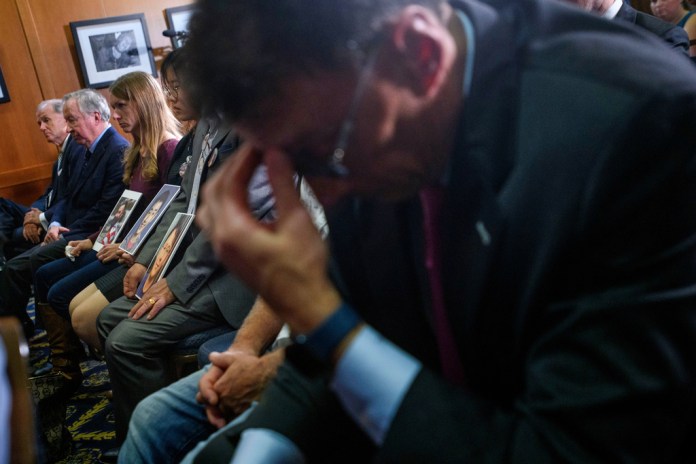
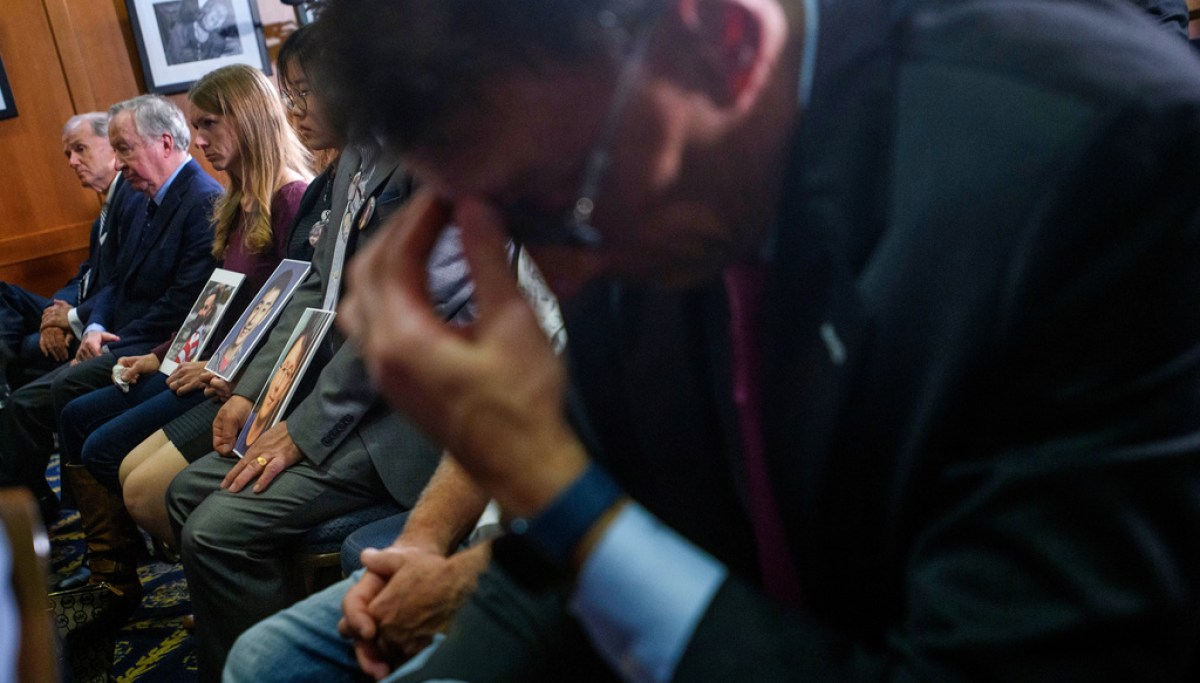
But the strongest push for passage came from families of those killed in the crash, many of whom traveled to Capitol Hill to urge lawmakers to move forward.
Rachel Feres, who lost her cousin, Peter Livingston; his wife, Donna; and their daughters, Everly and Alydia, said the technology at the center of the bill has existed for years and could have given pilots enough warning to avoid the collision.
“Their lives were precious, and their deaths were 100% preventable,” Feres said. “It would have given both crews almost a full minute of warning, time enough to move, time enough to live.”
For Audrey Patel, who lost her husband, Vieksh Patel, and was six weeks pregnant at the time of the crash, the debate is deeply personal.
“My husband should have been here for his 34th and 35th birthdays,” Patel said. “He should have been here for our first wedding anniversary. He should have been here for the birth of our son.”
She said the collision exposed a fatal gap in situational awareness.
“The crews didn’t have a fighting chance,” Patel said. “We know why this happened and how to prevent it. The ROTOR Act is ready now.”
Douglas Lane, who lost his wife, Christine Lane, and son Spencer Lane, said lawmakers should not underestimate the timeline for implementation.
“Even if the ROTOR Act passes today, this ADS-B technology will not make its way through the entire airspace until 2031,” Lane said. “Just getting this passed today is a starting point.”
Delays, he warned, could push safety improvements even further into the future.
“If it doesn’t get written into law, it’s just going to go to a black hole,” Lane said.
Amy Hunter, a cousin of the Livingston family, said families feel urgency because the risk remains for the flying public.
“It is unconscionable that we are happy to be here right now,” Hunter said. “If we wait, everyone flying runs exactly the same risk.”
The bill is being considered under suspension of the rules, a fast-track process that requires a two-thirds majority for passage. Supporters have argued that the overwhelming Senate vote and broad backing from aviation labor and industry groups justify moving it that way, but the high threshold also leaves little margin for defections.
“Do not let the promise of something more or something perfect be the reason you do nothing now,” Feres said. “We ask you to vote yes on ROTOR.”
David Sivak contributed to this report.