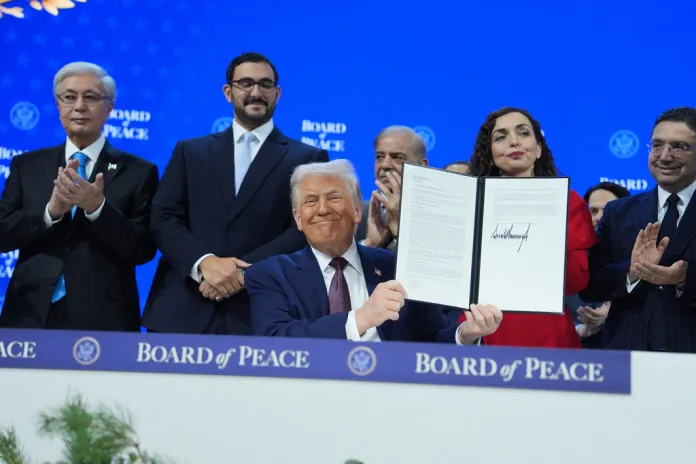
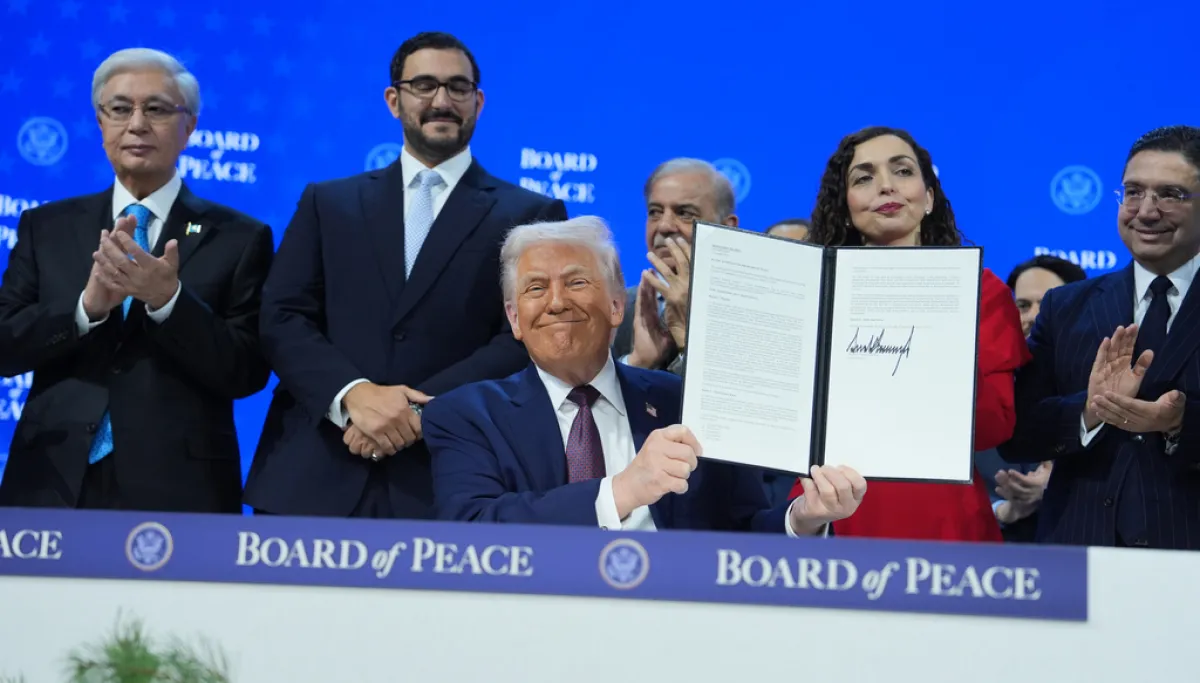
After extending 60 invitations to join the new body focused on resolving geopolitical issues, 22 member states accepted the invitation to what Trump calls “one of the most consequential bodies ever created.” A total of 19 world leaders attended the signing, and nearly all members had representatives present. Israel, notably, did not have a representative at the signing.
The gathering of leaders was noted for its eclectic nature, with little in common among them. Notably, Muslim-majority countries were heavily overrepresented, making up nearly half of the countries represented onstage.
Here are the international leaders who stood beside the president in solidifying the Board of Peace:
Viktor Orbán
Viktor Orbán is the prime minister of Hungary, who embraced Trump’s election in 2016 after facing mounting criticism from the Obama administration.
Trump has referred to Orbán as a “tough guy”, and Orbán expressed his gratitude for Trump’s new United Nations-esque body in a Facebook post following the signing. Orbán’s government is commonly cited as the most straightforwardly pro-Trump in Europe, forging close political connections with his supporters.
“Hungary, however, does not want to go backwards, but wants to move forward. It is for this reason that we support and reinforce through our participation all international initiatives that prevent and restrain wars and guarantee the security and peace of nations and families,” Orbán said.
During the start of Trump’s second term, Orbán called the president “the only man who can save Western civilization.”
While most of Europe has shown discomfort with Trump’s lean toward neutrality in peace negotiations between Ukraine and Russia, Orbán has fully aligned Budapest with the position, having advocated it since the beginning of the war in February 2022.
Orbán and Trump agreed in November on a one-year exemption from sanctions on Russian oil and gas.
Javier Milei
Javier Milei is the president of Argentina and is viewed as Trump’s leading ally in Latin America.
At the 2024 WEF, Milei shared that he considered the Western Hemisphere to be “in danger” — a sentiment Trump has echoed in his desire to acquire Greenland.
Trump has referred to Milei as his “favorite president,” and the leaders have formed a “special bond” based on shared anti-big government rhetoric and opposition to “woke ideology.” Milei was the first world leader to meet with Trump after his 2024 victory.
Milei has supported Trump’s Greenland ambitions and said, “America will be the beacon of light that reignites the whole of the West” in the years to come.
Vjosa Osmani-Sadriu
Kosovo President Vjosa Osmani-Sadriu has praised Trump’s new board, calling it a “historic initiative.” Osmani sat to the right of Trump at the signing in Davos.
The Balkan nation is known as one of the most pro-American places on Earth, after U.S.-led NATO forces bombed Serbia to support its armed independence movement in 1999, a move that still invites controversy. While just slightly over half of the world’s countries recognize the Balkan nation as a country, the U.S. support for its independence in 2008 granted it key legitimacy.
“True leadership doesn’t just talk about peace, it delivers it. That is exactly what @POTUS Trump is doing,” Osmani said in an X post.
Osmani has credited the Trump administration with having an “increased interest” in stabilizing relations between Kosovo and Serbia to prevent conflict. Trump includes this on his list of eight wars he’s halted.
The presence of Kosovo on the board is likely to have angered and alienated Serbia, which considers the former province an integral part of its identity. Belgrade didn’t respond to Trump’s offer.
Prabowo Subianto
Indonesian President Prabowo Subianto has become one of Trump’s closest allies in Southeast Asia, with their relationship characterized by significant trade negotiations.
In July 2025, Trump signed a reciprocal trade agreement with Indonesia that eliminated 99% of its tariff barriers for U.S. industrial and agricultural goods. The United States reduced its reciprocal tariffs on Indonesian goods to 19%.
The U.S. has been a key backer of Indonesia since its pre-democracy days, handing Washington one of its greatest Cold War victories when the military junta annihilated the world’s then-third-largest communist party with CIA assistance in 1965.
Prabowo has been a consistent supporter of Trump’s Middle East initiatives, having previously attended the Gaza peace summit in Sharm el Sheikh in October. The spirited backing of the world’s largest Muslim country bodes well for the U.S. efforts in Gaza and throughout the Muslim world.
Trump has referred to Prabowo as his “new friend” and an “incredible man,” praising his leadership in promoting peace in conflict areas such as Gaza.
Ilham Aliyev
Trump frequently highlights his relationship with Azerbaijani President Ilham Aliyev as a prime example of his administration’s ability to resolve long-standing international conflicts. His presence on the board gives the president a living reference to the effectiveness of his peace efforts.
Trump’s relationship with Aliyev goes back to before his presidential days, when he starred in a 2013 music video from the Azerbaijani president’s then-son-in-law. His pre-presidential business connections helped facilitate a personal relationship with Aliyev, culminating in an Aug. 8, 2025, agreement to try and bring an end to the decades-old Armenia-Azerbaijan conflict over the Nagorno-Karabakh region. His photo op joining together Aliyev and his longtime rival, Armenian Prime Minister Nikol Pashinyan, in the White House was a major public relations victory for Trump’s first year back in office.
The agreement aimed to resolve one of the biggest barriers to peace by establishing a U.S.-managed corridor linking Azerbaijan with its Nakchivan exclave, named the “Trump Route for International Peace and Prosperity.”
The agreement hasn’t fully resolved the Armenia-Azerbaijan conflict, however, as Baku maintains that the only way to ensure a lasting peace is for Armenia to amend its constitution to remove language referring to Nagorno-Karabakh. Such a move would require a referendum, which is unlikely to pass, leaving the two nations in limbo. Nevertheless, Trump’s agreement has helped ease tensions between Yerevan and Baku.
Aliyev’s presence on the Board of Peace also holds significant importance for wider peace efforts outside the Caucasus, as Azerbaijan enjoys the warmest relationship of a Muslim country with Israel by far.
Aliyev has seemed unbothered by Trump’s repeated mispronunciation of his country, even laughing along to a joking reference to the confusion from Albanian Prime Minister Edi Rama.
Rosen Zhelyazkov
Former Bulgarian Prime Minister Zhelyazkov’s participation in the board of peace has been a subject of intense domestic debate, with political rivals seeking a parliamentary vote on the invitation.
Despite domestic friction, Zhelyazkov has aligned Bulgaria with the Trump administration’s goals for regional security in the Balkans and the Black Sea.
Trump has praised the Bulgarian leadership for its willingness to “shoulder the noble responsibility” of building a lasting global peace architecture.
Bulgaria’s role on the board is expected to focus on energy security and stabilizing trade routes in Eastern Europe.
Other attendees
Turkish President Recep Tayyip Erdoğan was represented by Foreign Minister Hakan Fidan. Erdoğan accepted membership after being assured that the first three years would be free.
Turkey’s inclusion is intended to leverage its relations with Hamas to facilitate the group’s disarmament.
Crown Prince of Saudi Arabia Mohammed bin Salman, represented in Davos by Foreign Minister Faisal bin Farhan al Saud, has significantly deepened security ties with the Trump administration. Saudi Arabia is a central pillar of the board’s efforts to mobilize international resources.
Several additional world leaders and senior officials joined the initiative as founding partners during the Davos summit.
Within the Gulf Bloc, Moroccan Foreign Minister Nasser Bourita and Bahrain’s Sheikh Salman bin Hamad Al Khalifa were the first to join Trump for the signing.
Central Asian representation included Kassym-Jomart Tokayev, the president of Kazakhstan, and Shavkat Mirziyoyev, the president of Uzbekistan.
WHO WAS INVITED TO BE ON TRUMP’S ‘BOARD OF PEACE’?
From South Asia and other regions, Pakistani Prime Minister Shehbaz Sharif became a signatory alongside representatives from Mongolia, Paraguay, and Vietnam. Sharif has positioned himself as a close ally of Trump, steering Pakistan back into U.S. orbit after previously falling out of favor. His liberal praise of Trump for his role in resolving the brief war between Pakistan and India last year, in contrast to India’s hesitancy, has helped to shape Trump’s favorable view of the country.
Finally, in Eurasia, Armenia’s Pashinyan joined Aliyev onstage to confirm their status as partners.