The Trump administration determined the best way to achieve its goals in Venezuela following the arrest of former dictator Nicolas Maduro was by backing his vice president, instead of the leaders of his opposition.
U.S. forces carried out the dangerous operation last weekend to arrest Maduro and his wife, Cilia Flores, but opted not to target any other member of his inner circle, military leaders, or government officials. Instead, the United States is focused on continuing its pressure campaign to force the remaining members of the Maduro regime to cooperate with the U.S. or risk becoming a future target in a possible subsequent U.S. mission, which the president has already threatened.
THE MAIN PLAYERS IN VENEZUELA’S GOVERNMENT AND WHO COULD BE TARGETED NEXT
Had the U.S. tried to oust the entire Maduro regime, it could have been met with military opposition, creating a larger conflict, one that could have included a drawn-out ground invasion, than the U.S. mission to capture him and his wife.
However, the U.S.’s footprint in the region suggested the administration’s ultimate decision to carry out a targeted raid, rather than a full-blown invasion. While there has been a large buildup of navy ships in the greater Caribbean area, it’s unclear whether the number of troops would have been sufficient to capture and hold the capital of Caracas.
“It’s very clear based on the military footprint from the U.S. and the buildup over the last four months or so, that there was no intention by the United States to ever send in a big ground force into Venezuela,” Alex Plitsas, an expert with the Atlantic Council, told the Washington Examiner.
He also noted that the U.S. special operators who were able to carry out practice raids on a mock version of Maduro’s compound in the United States also indicated that the administration had decided months ago that their most likely course of action would be a targeted raid.
“What it suggests is that at least the preferred course of action the administration was pursuing was a targeted raid to arrest and extradite Maduro from the beginning, going back at least several months, because that decision would have been undertaken as the preferred course of action prior to the muck up of the facility being built,” Plitsas said.
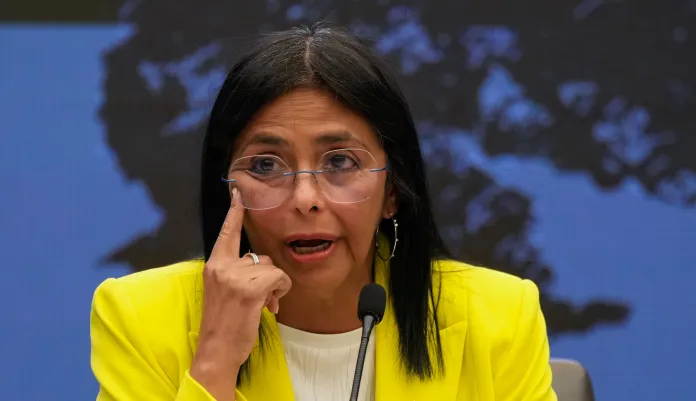
Following the capture, the administration has decided to try to work with Maduro’s vice president, Delcy Rodríguez, who has since been sworn in as Maduro’s successor. Some U.S. politicians admitted concern that keeping parts of the Maduro regime in place doesn’t go far enough.
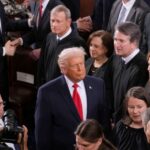
President Donald Trump, in an interview with the New York Times, said “[T]hey’re treating us with great respect,” in reference to the government, which is now led by Delcy Rodríguez. “As you know, we’re getting along very well with the administration that is there right now.”
The comments from the president underscore the difficult balance going on in Venezuela, where they have opted to recognize Rodríguez as the de facto leader, even though the U.S. called Maduro an illegitimate leader who stole the country’s 2024 election that they lost together.
However, the hard part now, according to Elliott Abrams, who served as Trump’s special representative for Venezuela during Trump’s first term, is convincing “a bunch of criminals to drive themselves from power willingly,” he told the New York Times.
“So I think this is the fundamental problem with the way the administration has set this up,” he explained. “Our interests do not coincide with the interests of the people in this regime still running the country — unless we are perfectly happy with endless dictatorship, brutal dictatorship in Venezuela, which, by the way, will only increase the flow of migrants out of Venezuela.”
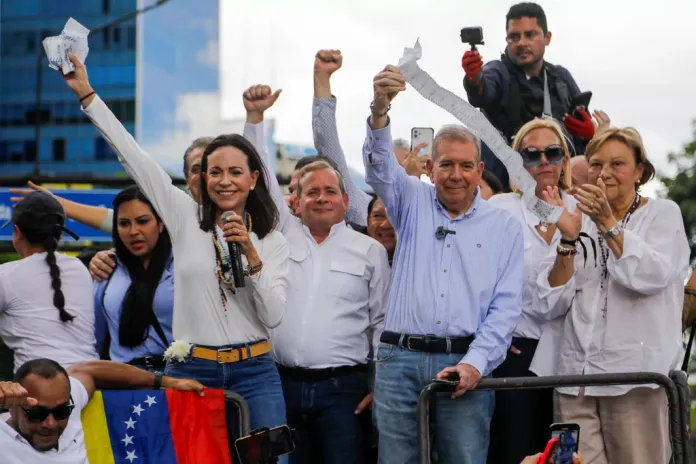
The U.S. could have tried, but did not, to forcibly install María Corina Machado, the opposition leader, or Edmundo González Urrutia, who ran and is widely regarded as the winner of the 2024 Venezuelan presidential election, despite Maduro’s claim of victory.
But, the president decided not to back either of them, at least in part, due to an intelligence community assessment on how Venezuela would react to Maduro’s ouster. It found that the country’s short-term stability would hinge on whether the new leader would have the public backing of senior military officials and other Venezuelan elites.
“I think it would be very tough for her to be the leader,” Trump said of Machado after the Maduro capture mission. “She doesn’t have the support within, or the respect within, the country. She’s a very nice woman, but she doesn’t have the respect.”
Secretary of State Marco Rubio said a day after the operation, “The immediate reality is that, unfortunately and sadly, but unfortunately, the vast majority of the opposition is no longer present inside of Venezuela. We have short-term things that have to be addressed right away.”
HOW TRUMP’S OIL TANKER SEIZURES FIT IN THE US-VENEZUELA STRATEGY
He added on Wednesday that the final stage of the U.S. strategy toward Venezuela would involve a “transition.” However, it’s unclear what time frame the U.S. expects Caracas to hold new elections. Trump denied answering similar questions during his interview with The New York Times.
Abrams argued that the administration should emphasize its support for the democratically elected officials, even while acknowledging that their ascension to power would not happen overnight and could take several months before the Chavista party, named for former Venezuelan leader Hugo Chavez, the military, and the opposition come to a formal agreement.
“We don’t want it descending into chaos,” Rubio said. “Part of that stabilization and the reason why we understand and believe that we have the strongest leverage possible is our quarantine.”