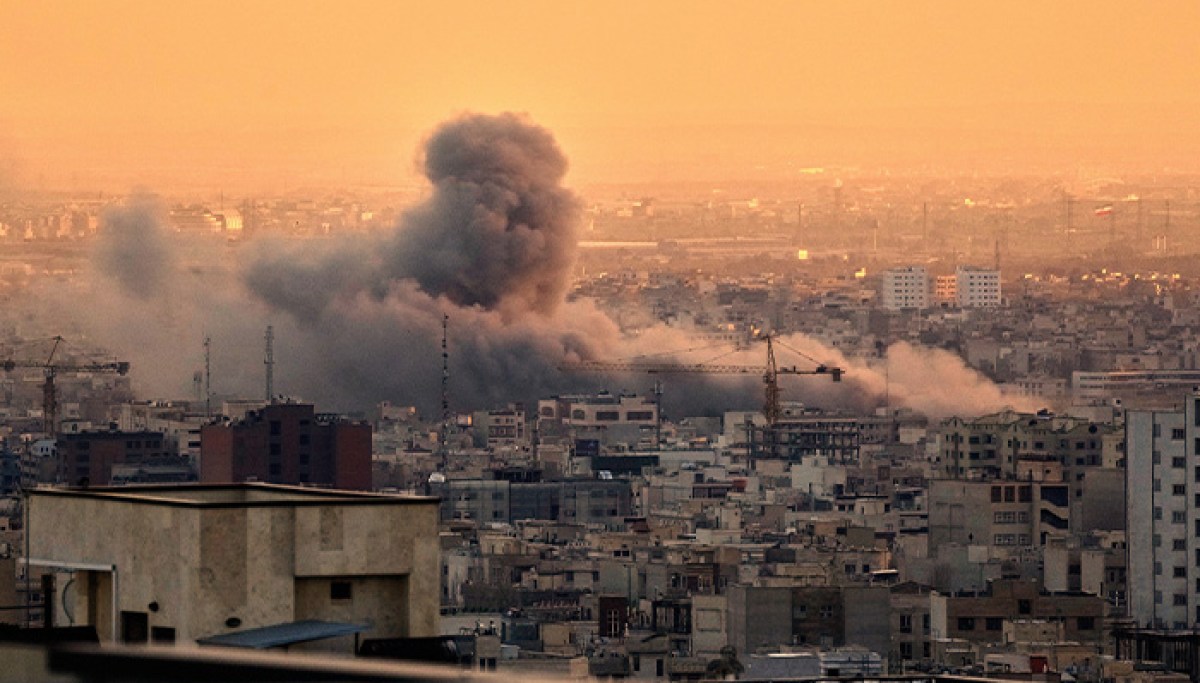
Within hours of Israeli and American attacks on the government and military infrastructure of Iran, President Donald Trump made it clear the United States’ goal was not to enforce its view of Iran’s future. Instead, Trump insisted the joint military operation offered the people of Iran seeking a secular government an opportunity to establish their own, self-determined path forward.
“Finally, to the great proud people of Iran, I say tonight that the hour of your freedom is at hand,” Trump said in a speech posted on Truth Social. “When we are finished, take over your government. It will be yours to take. This will probably be your only chance for generations.”
While the U.S. military continues to rack up considerable combat success, experts are working to predict what the Iranian government could look like following the death of Ayatollah Ali Khamenei and the potential collapse of the Islamic Republic. The theocracy that thousands of Iranians died protesting has lines of succession in place, thought it’s still unclear who would officially step forward should the door open to a new, more democratic administration.
Gerard Filitti is senior counsel for The Lawfare Project and studies the Islamic Republic, the Islamic Revolutionary Guard Corps, and Iran’s terror networks as a fellow of the University of London’s Royal Asiatic Society. He says it’s in the best interest of both the U.S. and the Iranian people for a new government to come forward as soon as possible.
“Iran has been responsible for more than 5,000 Americans injured and more than 1,000 killed,” Filitti said. “Now, [the U.S.] is in a position of doing something about it. The fact that [Iran’s] people are out there on the streets as America and Israel are bombing tells you that they want regime change.”
Filitti sees Iran developing into a successful and burgeoning Gulf State, with wealth flooding in to build up the infrastructure, if its citizenry can finally throw off the Shia Islamic theocracy that has ruled since 1979. He believes the success of the U.S. and Israeli strategies paves the way for that transition.
“The succession structure that the Khamenei government built is largely irrelevant,” he proposed. “It was designed for a managed, orderly transition, not for an armed conflict in which the United States has made clear it will eliminate as many leaders as necessary to get the results it wants.”
Filitti currently finds the Iranian government structure sufficient to continue fighting, but not stable enough to govern.
“It’s increasingly likely that a people’s largely secular revolution will push the remnants of the Islamic Republic aside, since the U.S. and Israel are systematically destroying the regime’s ability to project force internally,” Filitti said. “By destroying IRGC bases, weapons depots, and the Basij infrastructure, the U.S. and Israel are dismantling the apparatus of domestic control and oppression.”
Juan Carlos Lascurain Grosvenor is CEO of Grosvenor Square Consulting Group, which specializes in geopolitics, commerce, and trade. He finds the mullahs’ past reliance on military strength over popular support is dooming them now.
“Public support for the regime has been in freefall for years,” Grosvenor said. “The last publicly available poll I’m aware of puts support at around 20%, which is remarkably low for any government claiming legitimacy.”
Now, with the military and security architecture that kept the regime in place fundamentally crippled, Grosvenor suggests the U.S. and Israeli-led strikes signal to internal movements and local figures inside Iran that the regime is more vulnerable than it appears.
The man both Grosvenor and Filitti predict could step forward to fill a post-Islamic State vacuum is Reza Pahlavi, a native Iranian political activist in exile in the U.S. The eldest son of Mohammad Reza Pahlavi, the last Shah of Iran, he unofficially led resistance against Khamenei for years.
“The support for [Pahlavi] has been growing immensely as he represents one of the few figures who can unite the dissidents both at home and abroad to form a legitimate government capable of gaining backing from the U.S. and its regional allies in the Gulf,” Grosvenor explained. “The secular movement inside Iran has also been growing steadily over the last two years. The elimination of Khamenei and his allies is exactly the kind of opening these movements [have been] waiting for during that time.”
If the Islamic government should somehow outlast both the military attacks and the internal revolution, Grosvenor sees a clearer line of successors – if they survive the ongoing bombing.
“The 88 senior clerics who will select Khamenei’s replacement are likely considering figures like Alireza Arafi (cleric and member of the Interim Leadership Council of Iran); Khamenei’s son, Mojtaba Khamenei; [former supreme leader Ruhollah] Khomeini’s grandson, Hassan Khomeini; Gholam-Hossein Mohseni-Ejei (current head of Iran’s judiciary system); and Mohammad Mehdi Mirbagheri (Shia cleric and Islamic philosopher),” Grosvenor said. “The internal struggle between reformists and hardliners has always been there, with the latter consistently winning that battle.”
Aside from the Islamic clerics, Iran’s surviving political structure includes current President Masoud Pezeshkian, Supreme Court Chief Justice Gholam-Hossein Mohseni-Ejei, and Ayatollah Alireza Arafi. Grosvenor reports that the three formed a caretaker council as mandated by Article 111 of Iran’s constitution.
“The most plausible scenario now is that the regime will collapse entirely in the coming weeks due to internal struggles, a lack of foreign aid from its allies, no popular support, and U.S.-Israeli-led attacks,” he said. “A caretaker government formed by the moderate and reformist wings of the Islamic Revolutionary Guard Corps would then transition power to a government led by Shah Reza Pahlavi during a stabilizing period.”
Filitti agrees that Pahlavi already built a network inside Iran to position himself as a rallying point for a broad coalition toward a transitional government, but he stresses this wouldn’t necessarily make Iran stable.
“Whether this coalition succeeds will depend on how effectively it embraces and includes moderate religious leaders,” he said. “The realistic scenario isn’t a clean revolutionary overthrow. Most likely, it will involve continued U.S. strikes to push the IRGC past its breaking point, with popular uprisings seizing key institutions, and pragmatic regime insiders switching sides.”
TRUMP SAYS REGIME INSIDER ‘MORE APPROPRIATE’ TO LEAD IRAN THAN REZA PAHLAVI
It’s the possibility of current loyalists joining the secular revolution that Filitti believes will push the Islamic Republic over the edge.
“Revolutions succeed not because the revolutionaries are perfectly organized, but because the regime’s enforcers stop enforcing,” he said. “At some point, the rational calculation for regime insiders shifts from, ‘…How do I preserve the Islamic Republic?’ to ‘…How do I survive personally?’ We’re closer to that point with every day that passes.”
John Scott Lewinski (@johnlewinski) is a writer based in Milwaukee.