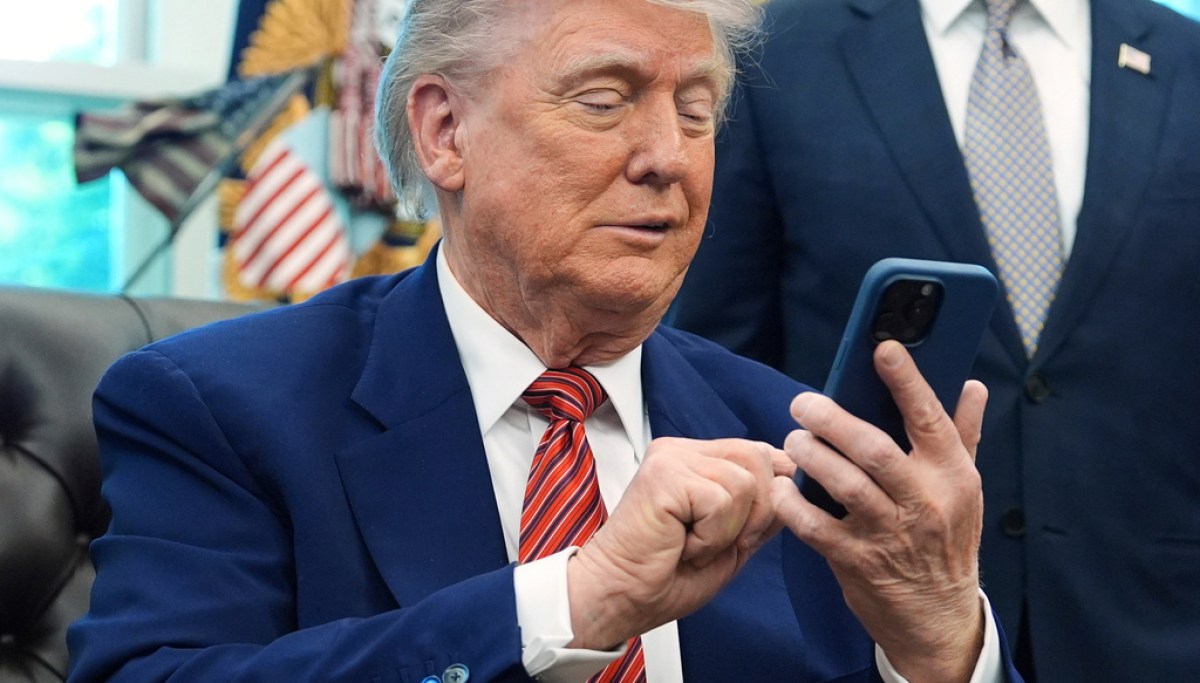
President Donald Trump has adopted a new strategy for shaping coverage of the war in Iran — a rapid-fire blitz of short phone interviews with reporters that allows him to drive the narrative while limiting real-time pushback
Across his first term and the first quarter of his second, Trump has solidified himself as one of — if not the absolute — most media-friendly presidents in history. Trump routinely holds marathon press conferences at the White House and on the road, both in stand-alone formats or pegged onto the back-end of other public appearances.
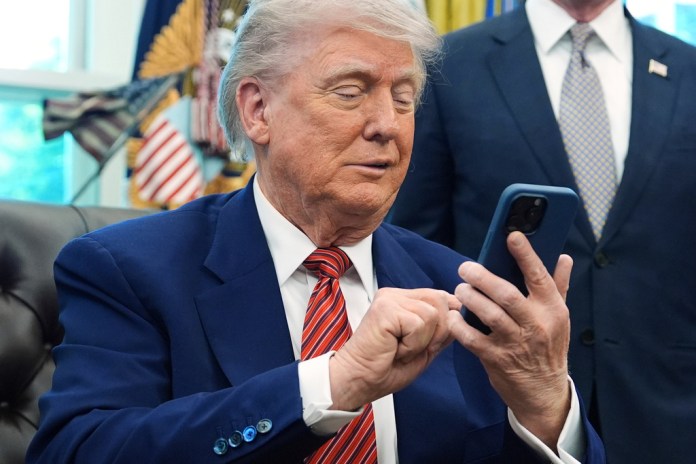
But over the past several weeks, even before he gave the go-ahead for military operations in Iran, Trump had scaled back these events, and in the 12 days since the first bombs fell on Tehran, he’s moved onto a new strategy for controlling the narrative: Conducting dozens of interviews by phone with reporters across the media landscape.
Most of the calls are brief, lasting between 5-10 minutes, but Trumpworld insiders tell the Washington Examiner that these quick conversations are giving Trump another lever to pull when it comes to filtering news about the war, not to mention public perceptions and sentiment.
One longtime, out-of-government adviser to the president called Trump’s phone strategy a “stroke of genius.”
“What you’re seeing now is President Trump understanding the media even more than the reporters themselves do,” that person assessed. “These interviews aren’t in an extended setting, so there isn’t real time to push back on the president’s claims. Reporters [and] outlets will publish his words because who wouldn’t publish an interview with the president? And it’s giving the president a direct line to message around the war to audiences who might not be tuning into every single White House event, or audiences who don’t consume so-called friendly media.”
‘TOO MANY COOKS’: IS FLOODING THE ZONE HURTING TRUMP’S IRAN MESSAGE?
A former Trump White House official told the Washington Examiner that Trump’s specific choice of words is particularly effective in discussing the strategy and fallout from the war.
“Most people aren’t experts on military policy or foreign relations, or anything remotely political, really. Critics will say that President Trump speaks critically, or even un-presidentially, but I would say he speaks in a relatable way that all Americans can easily understand,” the former official claimed. “That’s especially important while discussing events thousands of miles away, in a country most people have never and will never visit, with a lengthy cast of characters. [Trump] is able to easily explain to people why we’re fighting in Iran, and roughly how long we’ll stay there.”
But it’s not just voters who are influenced by Trump’s choice of words. Wall Street also listens, as evidenced by huge swings in oil prices and the domestic markets over the past 48 hours.
U.S. stocks have gradually slipped since Trump first launched strikes last Saturday, and over the weekend, crude futures skyrocketed to more than $120 per barrel, a nearly 50% jump since the Iran war began, before settling back around $100 per barrel Monday morning.
However, Trump conducted a phone interview with CBS on Monday afternoon, where he announced that the war would end “very soon.” The statement that appeared to clash with War Secretary Pete Hegseth’s claim to 60 Minutes that America would soon ramp up operations in Iran. Still, Trump’s words drove oil prices back down to roughly $80 per barrel and allowed American stocks to rally before the markets closed.
White House officials declined to offer insight into Trump’s phone interview strategy, especially as it related to Monday’s oil price movement, and said that “any policy announcement” on the issue “will come directly from the president.”
“The White House is in constant coordination with the relevant agencies on this important issue, as it is a top priority to the President. President Trump and his entire energy team have had a strong game plan to keep the energy markets stable well before Operation Epic Fury began, and they will continue to review all credible options,” White House spokeswoman Taylor Rogers told the Washington Examiner. “This is a short-term change in oil prices, which will drop dramatically once the objectives of Operation Epic Fury are achieved.”
Peter Loge, a professor at George Washington University’s School of Media and Public Affairs and the director of the Project on Ethics in Political Communication, suggested to the Washington Examiner that Trump’s phone strategy may have diminishing returns.
WHITE HOUSE SAYS TRUMP COULD END IRAN WAR WITHOUT TEHRAN’S ‘UNCONDITIONAL SURRENDER’
“President Trump built a career as a salesman and hustler. He talked people into buying his deals. Sometimes those deals worked well, sometimes they failed spectacularly,” he claimed. “When a deal fails, some people lose money, sometimes go bankrupt, and everyone moves on to the next deal. The challenge is that you can’t walk away from a war the way you can from a failed casino.”
Loge said that Trump’s comments in recent days “sound like someone trying to hold a high-stakes deal together,” and “he could be engaged in three-dimensional chess, or he could just be trying to keep all the pieces on the board however he can.”