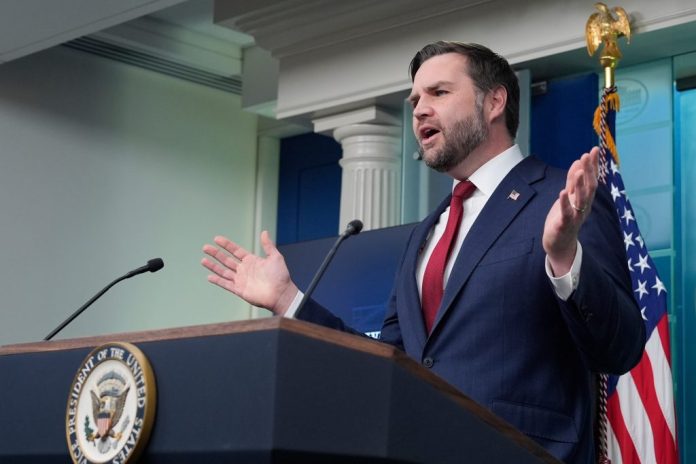
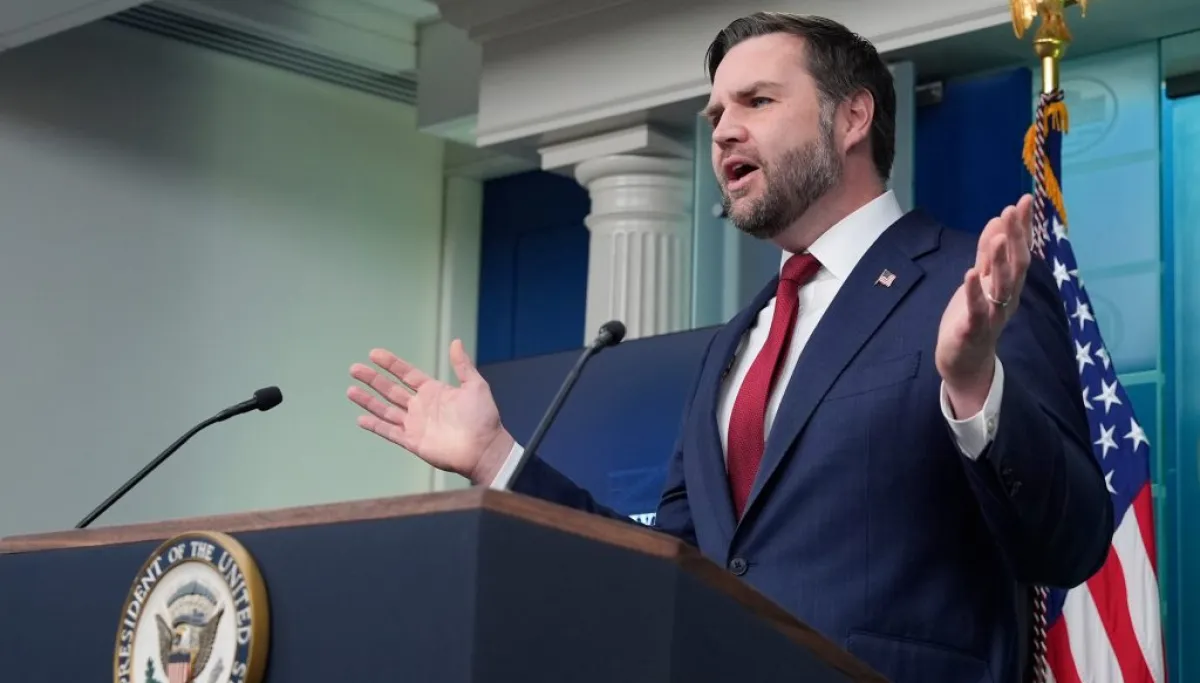
Vice President JD Vance helped spare President Donald Trump another embarrassing defeat on the Senate floor Wednesday, casting a tiebreaking vote to kill a resolution reining in his ability to conduct military operations in Venezuela.
The Senate voted 51-50 to table the measure, reflecting the White House’s continued but wavering sway over a Republican Congress. Just days earlier, five Republicans joined Democrats in a test vote that invited the wrath of the president, but Senate Majority Leader John Thune (R-SD) was able to peel off two of those senators using a GOP “point of order” that rendered it ineligible for a floor vote.
Sens. Todd Young (R-IN) and Josh Hawley (R-MO) flipped their votes on Wednesday afternoon, giving Thune just enough support and ending, for now, Trump’s clash with lawmakers over his military interventions abroad. Vance then arrived at the Capitol to cast the eighth tiebreaker of his tenure as vice president.
The vote came after Trump authorized a risky operation to depose ex-dictator Nicolas Maduro, sparking upset over the lack of congressional notification and Trump’s subsequent claims that the United States could be “running” Venezuela for years.
THE FIVE SENATE REPUBLICANS WHO BROKE RANK WITH TRUMP ON VENEZUELA WAR POWERS
Defeating the resolution took a flurry of outreach from the administration, including a letter directly from Secretary of State Marco Rubio stating that no troops were currently in Venezuela and that Congress would be notified in writing “should there be any new military operations that introduce U.S. Armed Forces into hostilities.”
Thune also leaned on the persuadable Republicans personally, noting a conversation he had with Sen. Todd Young (R-IN) and explaining that the White House had offered “assurances” of its own.
“These are consequential, big decisions, and people want to feel like they’re honoring their obligations to the people that they represent and to their own views on some of these issues,” Thune said ahead of the vote.
Three other Republicans, Sens. Rand Paul (R-KY), Lisa Murkowski (R-AK), and Susan Collins (R-ME), refused to budge, ignoring Trump’s angry tirade against the senators a week earlier.
Paul was a co-sponsor of the war powers resolution, while Collins and Murkowski have voiced growing concern with Trump’s military threats.
Democrats have teased future votes on Trump’s war powers, with the president’s refusal to rule out an invasion of Greenland, a member of NATO, stoking particular concern. On Wednesday, Sen. Mitch McConnell (R-KY), the former Senate GOP leader, delivered a speech warning against any steps that would degrade the alliance.
Yet Republicans have managed to put the issue to rest for this week, using a creative maneuver that sidestepped the question of Trump’s authority directly.
The “point of order” Republicans offered on Wednesday allowed Republicans to vote on whether it was “germane” under the War Powers Act, and not whether Trump needs Congress’s approval for future strikes inside Venezuela.
Thune and other Republicans argued that the war powers resolution was ineligible for a vote because there aren’t active hostilities in Venezuela, a rationale Democrats used to defeat a different war powers vote when they were in the majority in 2024.
If Republicans had failed to defeat the resolution, the Senate would have then proceeded to a “vote-a-rama” and final vote.
DOUG JONES FOLLOWS DEMOCRATS’ HEALTHCARE PLAYBOOK IN TUBERVILLE REMATCH BID
Speaking to reporters outside the Senate chamber, both Hawley and Young cited the outreach from Rubio, a former Senate colleague, as having been decisive in their votes.
“This has been an incremental process,” Young said. “To have the Secretary of State be at my disposal — really, I mean, countless phone conversations and text exchanges — was very reassuring to me.”
“It’s one thing to work through an assistant secretary or an undersecretary and receive secondhand assurances and reassurances,” he added. “It’s another thing to hear directly from the secretary of state, somebody with whom I’ve had a long-standing professional relationship and have a strong measure of trust in. So that was very helpful.”