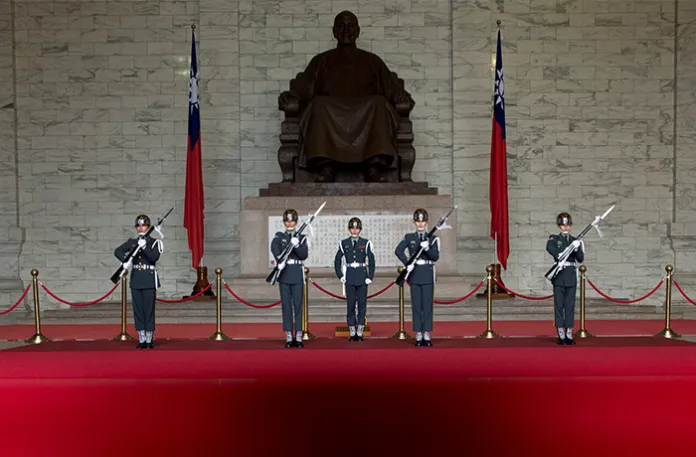
Chiang Kai-shek Memorial Hall could easily be mistaken by the unfamiliar tourist for a religious shrine of preeminent sanctity.
Massive and tastefully ornate, it sits within a sprawling square of stone and is flanked by two temple-like assembly halls. Within its main chamber sits a 10-meter statue of the titular Chiang, Taiwan‘s first president.
I saw the hall in all its glory for the first time when I was flown to Taipei on a press junket alongside journalists from 12 other nations. We were there to learn about every facet of the island, from military preparedness to diplomatic relations, historical origins to visions of the future.
The other journalists and I had been brought to the memorial hall by our government handlers to witness the famous changing of the guard ceremony that has been conducted at the monument since 1980.
If we had arrived before last year, we would have been led to see the event in the hall itself, directly in front of Chiang’s towering statue. The soldiers would have stayed as sentries before and after the performance, symbolically guarding the legacy of Taiwan’s founder.
But the Ministry of Culture had decided that such displays were “worshipping a cult of personality” and “worshipping authoritarianism.” They moved the honor guard out of the hall and abolished the sentries as part of their broader, national project aimed at “promoting transitional justice.”
So without even seeing the Chiang statue, we stood behind ropes on the small boulevard outside the memorial. My group watched two sets of soldiers march in, twirl their guns, click their heels, and then retreat out of sight.
“Why are we here?” I thought to myself. “Outside a memorial to a founding father the ruling government despises, watching an honor guard perform in no one’s honor?”
The Taiwan that I observed on my trip was a friendly and refined nation with a dazzling cultural legacy. I walked through Taipei and observed the endless streams of disciplined scooter drivers zipping about their clean streets. I felt the tropical heat and sat in the shade of traditional gardens. I ate piping hot, hand-rolled dumplings and drank in soft, secluded bars safe enough to leave your wallet on the table.
Taiwan captured my heart. But throughout the week, I found the island to be at war with the most beautiful parts of itself, condemning its heritage and fighting against its own identity.
When writing about Taiwan, it is necessary to establish some key names and historical facts for those not familiar with the island’s history.
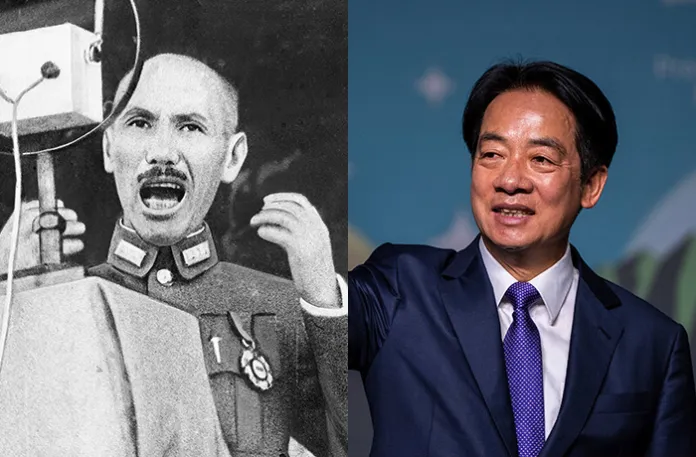
The Republic of China, Taiwan’s official name, was founded by revolutionary statesman Sun Yat-sen and his Nationalist movement on the mainland in 1912. Over the course of decades, the Nationalists clashed with the Communist Party led by future dictator Mao Zedong, the Japanese Empire (which controlled the formerly Chinese island of Taiwan), and various warlords seeking to carve out their own kingdoms amid the chaos. When Sun died in 1925, his protege, Chiang, took the reins of the Nationalist movement.
The Nationalists and Communists worked together to overthrow the Japanese at the end of World War II. This victory, incidentally, liberated the island of Taiwan and returned it to Chinese jurisdiction.
After losing the Chinese Civil War to Mao and his Communist forces, the Nationalist government and its supporters fled in 1949 to the island of Taiwan and continued to rule as the Republic of China’s government in exile.
The territory was intended to serve as a temporary base of operations until the Nationalist government could retake the mainland and dissolve the newly formed People’s Republic of China. There is only one China, both sides agreed, and the only question was which government was legitimate.
But that dream of unification, peaceful or otherwise, never came to be. And soon, the Republic of China and the island of Taiwan became interchangeable in common parlance.
Now, Taiwan is caught in geopolitical limbo. It is officially recognized as sovereign by only 11 other nations, but is treated as de facto independent by Western powers such as the United States.
The Chinese Communist Party is unequivocal in its demands to bring Taiwan back under mainland control. Beijing claims it will be prepared to invade the island by 2027. The People’s Liberation Army already dwarfs the Republic of China Armed Forces in both manpower and resources.
Year after year, the Taiwanese public is becoming increasingly disconnected from their original Republic of China mentality. Some of this is inevitable — the original cadre of settlers who remember fleeing to the island with the hope of retaking the mainland has all but died off. With each passing generation, the personal connection to pre-communist China becomes thinner and less direct.
Other movements away from Chinese identity are more conscious.
Over the last 20 years or so, the curriculum of Taiwanese students has shifted away from a China-centric program, as teachers began to complain that they were teaching youngsters about a country they had never even visited. Why teach so much about the Yangtze River to children who might never even see its waters? Why learn about the Romance of the Three Kingdoms or Journey to the West when you don’t feel connected to the society that produced those epics?
The ruling Democratic Progressive Party, which has won three consecutive elections to stay in power since 2016, is at the forefront of efforts to accelerate the severance of its nation’s Chinese connection. The party is seeking to replace it with a modern, progressive, and multicultural society unconstrained by its Chinese past.
One Taiwanese professional that I befriended during my trip showed me a truly absurd example from recent weeks that had drawn attention in local newspapers: how the executive branch reports their citizens’ race. The Executive Yuan’s official website lists the demographic breakdown of Taiwanese society as 2.6% indigenous groups, 1.2% individuals of “foreign origin,” and “the rest of the population” — a strange way to refer to the 96.2% who are ethnically Han Chinese.
The greatest target of this campaign to reimagine Taiwanese identity and history is Chiang. Throughout my time in Taiwan, no less than half a dozen government officials went out of their way to tell me how controversial Chiang is considered today. Taiwan is in the process of removing hundreds of statues dedicated to him throughout the island.
It is not an exaggeration to say that the Taiwanese government reflects on Chiang and his legacy with more contempt than the Japanese Empire that occupied the island for decades.
When a high-ranking official in the Ministry of Foreign Affairs sat down for lunch with my press group, I asked her the same question I ask every diplomat: What book best captures your nation’s character and soul? She struggled for an uncomfortably long time, so I suggested maybe she could offer a movie that serves the same purpose. Still struggling, she told the group that Taiwan is undergoing a cultural transformation, reevaluating its founding and history, which makes the question nearly impossible.
After consulting with a member of her staff, she recommended A City of Sadness, a 1989 film about the White Terror — the multiple decades of martial law overseen by Chiang and his successors after a failed attempt to overthrow the government.
What will replace Chiang and Chinese heritage in defining the island? In my limited experience, it appeared the answer is left-wing populism, multiculturalism, and environmental fanaticism.
The majority of nights out in Taipei, my group was driven to distinctly non-Taiwanese restaurants — a Moroccan joint, a Japanese buffet, a Persian eatery, etc. Delicious food all around, but perhaps not coherent enough to build a nation on.
Meanwhile, countless government entities emphasized Taiwan’s commitment to green energy and a carbon net-zero future. Government officials noted the island’s drift away from Confucian values. The Women’s Center explained to us the succession of victories that led to Taiwan’s feminist present, though, as always, there is more work to be done. Representatives of the United Nations Alliance told us, verbatim, “No justice, no peace!” concerning Taiwan’s long oppression by the Chinese mainland.
In his 2024 National Day address, President William Lai championed Taiwanese independence and the new generation of “Made in Taiwan youth” who are trailblazing the promotion of the island’s culture on the global stage. The first name out of his mouth was Nymphia Wind, a Taiwanese-American drag queen performer.
I did not live through the White Terror and am therefore unqualified to tell the Taiwanese how to feel about the legacy of Chiang. I cannot tell them if the White Terror was necessary, overblown, or nightmarish. I cannot tell them how to feel about the Han Chinese ancestry that flows in their veins, or what cuisine to advertise to foreigners. I cannot tell them whether their past is worth celebrating or if they are an island of victims.
But I know America’s fingerprints when I see them. Statue removals? Empty odes to “diversity” and minority-first politics? Drag queens? Green energy? It could have all been drafted in a White House document circa 2020.
Perhaps that is the reason I found myself, an American largely unfamiliar with Chiang, internally resenting his derision throughout my time in Taiwan. I was not so much attracted to him, but repelled by the monomaniacal obsession with ridding the country of his image. The man is the reason Taiwan exists at all, and there was an instinct of justice that cried out in my heart: “Are you not at least a little grateful you’re not living in the People’s Republic? Would you rather Mao and Xi Jinping?”
I do not think the progressive revolution of Taiwan is malicious or even cynical. I believe the ruling government and its supporters desire the best for their home country. And they are, after all, reliant on the West, the U.S. in particular, to defend them against the communist menace across the strait.
So why would politicians not promote more Western sensibilities like “transitional justice” and diversity? Why wouldn’t they mimic the cause celebs of North America and Europe, selecting drag queens and bureaucratic environmentalism to be their new cultural anchors?
But Taiwan may be embracing these trends as the U.S., and perhaps the West as a whole, are beginning to abandon them.
In America, deconstructing our national mythology and recasting early Puritan settlers as bloodthirsty conquerors helped zero American Indians. It did succeed in ruining Thanksgiving dinners across the country for over a decade. Rejecting “whiteness” and adopting race-centric identity politics did not solve racial tensions. It only inflamed them. Tearing down statues of Robert E. Lee, Thomas Jefferson, and George Washington did not pave the way to a new, morally pure national identity. It only incinerated the last unifying figures we had left.
President Donald Trump spoke at the United Nations General Assembly last September. Taiwan, as a non-country in the eyes of most member states, was not in attendance.
Trump, who Lai recently claimed has only strengthened the U.S. ties with Taiwan in his second administration, delivered a winding manifesto against multiculturalism and historical revisionism.
“Each of us inherits the deeds and the myths, the triumphs, the legacies of our own heroes and founders who so bravely showed us the way. Our ancestors gave everything for their homelands that they defended with pride, with sweat, with blood, with life, and with death,” the president told the crowd.
Trump railed against green energy, he lambasted faux diversity, and he rejected those who would forsake their inheritance in the name of progress.
“You’re doing it because you want to be nice, you want to be politically correct, and you’re destroying your heritage,” Trump said.
Westerners have begun to understand that we cannot choose our origins. We cannot tinker with history to correct the moral wrongs of the past, nor can we unshackle ourselves from our connections to ages gone by. Taiwan, it seems, is not quite there yet. We brought them in on a scam and slipped out the back door without telling them.
On the final day of our tour, my group was given a brief tour of the Grand Taiwan Hotel, a massive five-star luxury establishment near the banks of the Keelung River.
A 12-story rectangular box dripping with the distinctly Chinese beauty of red lacquer and gold, it looked to me as if it were lifted from the center of Beijing’s Forbidden City. When one steps through its doors, they are transported into an ornate palace that seems to exist outside of time. Chinese-style chandeliers, towers of fresh flowers, and an exquisite pianist enthrall the senses as guests marvel at murals of long-gone dynasties and engraved dragons flying across overhead balconies.
EUROPE FLAILS IN RESPONSE TO IRAN CONFLICT
Chiang established the hotel in 1973 as the Republic of China’s first accommodations for foreign dignitaries. It is a temple to the founding mythology of Taiwan, the idea that this island is the last bulwark of authentic China left after the corrosive acid of communism washed across the mainland.
“This,” I thought to myself as I slowly spun in place and let myself be overwhelmed by the lobby, “is a monument to a great civilization.”
Timothy Nerozzi is the foreign affairs reporter for the Washington Examiner.