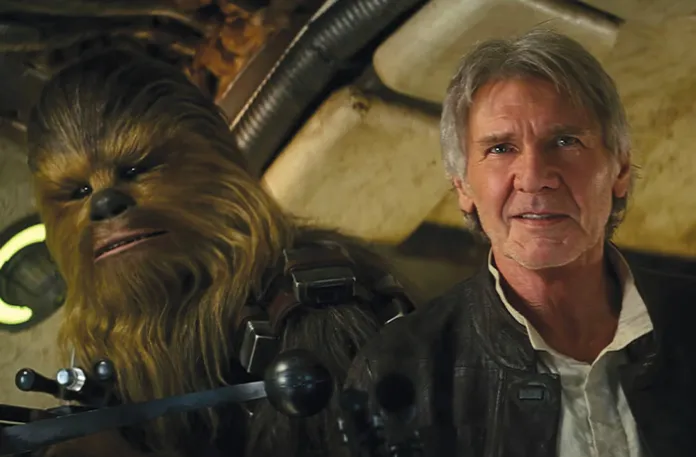
Looking back at it now, 10 years later, the warning signs were clear from the start — from the first trailer, in fact. Its initial image was a shot of a speeder zooming past the wreckage of a long-forgotten battle, an X-wing in the foreground dwarfed by a Star Destroyer in the background. Following it is a close-up of the melted, twisted husk of Darth Vader’s helmet. It ends with a wistful Han Solo (Harrison Ford) telling his wookiee comrade, “Chewie, we’re home.”
Which was the problem. Disney took us back home. To the Star Wars we thought we had lost. Together, we’ve been scavenging the ruins ever since. Contrary to critics and fans who believe “Disney Wars” only went awry later, the issues which have come to plague the franchise — from its inconsistent, contradictory plotting and endless recycling of itself, to its overall lack of vision — are present not merely in incipient but in fully mature form in Star Wars: Episode VII – The Force Awakens (2015).
Episode VII felt off as soon as the lights went down. For the first time, a film in the series opened without the 20th Century Fox logo and its accompanying fanfare. Evidently, this would not be your father’s — or, if you’re my age, your own — Star Wars. But it so desperately wanted to be. From the opening scenes of the First Order’s raid on the Jakku village mirroring the Empire’s seizure of Princess Leia’s (Carrie Fisher) ship, to the climactic attack on Starkiller Base recapitulating the assault on the Death Star, the parallels to the original are so numerous that calling them copies or ripoffs might be more accurate. There are so many that a side-by-side comparison video compiled at the time couldn’t capture them all.
If being a rehash weren’t bad enough, The Force Awakens is marred by one dubious storytelling beat after another. Oscar Isaac’s character, Poe Dameron, disappears for the middle act. The First Order tries to destroy BB-8, although it needs him intact to get the map he’s carrying to Luke Skywalker (Mark Hamill). Han Solo is shoehorned into the movie without any logical reason for him to show up how or when he does. The neophyte Rey (Daisy Ridley), who just learned of the Force an hour ago, should not best the far more accomplished Kylo Ren (Adam Driver) in combat. Ren’s identity is revealed midway through the movie, when it should’ve been saved for his final confrontation with his father. And so on.
The blame for the failure of The Force Awakens belongs primarily to J.J. Abrams, who, besides cowriting its screenplay, also directed it. Even if he understood the difference between homage and imitation, Abrams’s mediocrity as a filmmaker rendered him incapable of acting upon it. Thus, whereas George Lucas fashioned a pastiche which, inspired by fairy tale and myth, transmuted sources as diverse as Westerns, 1930s Flash Gordon serials, and Akira Kurosawa’s samurai epics into something revolutionary, Abrams crafted a derivative work inspired solely by itself.
This fundamental flaw besets the entire sequel trilogy. Worse still, it is compounded by a profusion of bizarre, inexplicable, befuddling, and plain idiotic narrative choices across all three movies. On occasion, these choices are at odds with each other. In The Last Jedi (2017), writer-director Rian Johnson has a scene reminiscent of Luke’s vision of himself as Darth Vader in The Empire Strikes Back (1980). Rey dives into a submerged cave and sees a vision of infinite versions of herself. The moral is that Rey is a nobody without a family or past; all she has is herself. Perhaps repaying Johnson for killing off Supreme Leader Snoke in The Rise of Skywalker (2019), the third film in the sequel trilogy, Abrams takes his own crack at the scene. This time, in the rubble of the second Death Star, Rey fights a dark side manifestation of herself as Palpatine’s granddaughter, which it turns out she is. So much for being a nobody.
Rey spurns her heritage and, instead, as Rise of Skywalker ends, anoints herself “Rey Skywalker.” The groundwork for this self-reinvention is laid in The Force Awakens when Anakin’s and Luke’s lightsaber calls out to her. It chooses her to inherit their legacy. Yet Abrams overlooks, as though he forgot, his own foreshadowing. As a result, Rey’s decision to take the Skywalker surname (she had none before this) feels arbitrary, even though it could have been justified on the terms presented in the earlier film. Rey the Nobody and Rey (Palpatine) Skywalker are antithetical interpretations. It’s as if Johnson and Abrams were undoing what the other did, unity and cohesion of the plot be damned, and no one from Lucasfilm would or could stop them.
There is no greater testament to how misbegotten the entire endeavor was than the fact that not once in the sequels do the heroes from the original trilogy appear in the same movie, let alone on screen together. The whole point of the sequels, and the justification for much of the anticipation for them, was seeing the old gang back in action. Yet it seems never to have occurred to anyone at Disney — not CEO Bob Iger, not Lucasfilm President Kathleen Kennedy, no one — that this might be a problem. Luke, Leia, Han, Chewie, and Lando share zero seconds of screen time. How could that happen? It’s the plot equivalent of leaving an exposed thermal exhaust port in the Death Star design: something which makes much more sense as the result of carelessness, incompetence, and bureaucratic inertia than as the purposeful act of sabotage it was retconned into in Rogue One: A Star Wars Story (2016).
The original trilogy is a classic saga of a hero’s journey set against the backdrop of a fight between good and evil, dressed up in futuristic, science-fiction garb. The prequels are an allegory for the unraveling of the postwar American political order, a tale of institutional decadence and collapse. Can anyone say what the sequels are about? There’s no overarching storyline because it was never planned out; the switch of writers and directors produced dramatic, often contradictory narrative shifts. Say what you will about Lucas’s vision, he had one. There is no vision to the sequels. It is questionable whether a corporate writer’s room can even have a vision, though it did give us the hopelessly dated presence of Lin-Manuel Miranda. And Space Monaco. Seriously, what the hell? That Mickey and Co. have managed to release just five movies, and none since 2019, is indicative of its struggles. A sixth, based on the Disney+ series The Mandalorian, is scheduled for May. We’ll see how that goes.
REVIEW: YOU SAY YOU WANT A REVOLUTION
The Force Awakens was made to cater to fans who hated the prequels. It was the answer to a million cries that “George Lucas ruined my childhood.” Like Bane returning Gotham to the people, Disney was handing Star Wars back to the fans. The irony is that today the prequels are more beloved than ever, while the sequels are lucky to be disregarded with polite indifference. Things got so bad that some fans even clamored for Lucas to reclaim custody of his brainchild. Alas, he is otherwise engaged completing his long-gestating “Museum of Narrative Art” in Los Angeles.
What the sequels lacked above all is the sense of adventure and daring that thrilled movie audiences in 1977 and years thereafter. “Disney Wars” has become staid, dull, predictable, commodified — in a word, just one more intellectual property in Mickey’s portfolio. I have a T-shirt, purchased in 2006, but based on a design from the late ’70s. Emblazoned across Darth Vader’s face are the words “DARTH VADER LIVES.” Underneath is this message: “Star Wars Is Forever.” Indeed, it is. But now, as we approach its 50th anniversary in 2027, it is not, as it seemed in 2015, because of Disney that it will live forever, but despite it. Ten years ago, the House of Mouse tried to awaken the Star Wars franchise. Instead, it has spent the last decade adrift.
Varad Mehta (@varadmehta) started down the Star Wars path in 1977. Forever has it dominated his destiny. Consume him, it did.