A wave of new state laws taking effect in 2026 covers everything from wages and workplace protections to gender-neutral bathrooms in public schools, firing squads, and taxes.
Forty-three states will ring in the new year with notable tax changes, according to the Tax Foundation. Eight states will lower their individual income tax rates, while Ohio will transition to a single-rate income tax.
In California, lawmakers and Gov. Gavin Newsom (D) signed off on more than 900 laws, including measures to counter the Trump administration, lower drug costs, and ban cat declawing. In Illinois, more than 250 new state laws will take effect on Jan. 1, 2026, including one that weakens squatters’ rights. In New York, laws going into effect in 2026 will reshape everyday life, from upping the minimum wage to new rules for delivery workers, tipping, and pay transparency.
Here’s a closer look at laws some states are ushering in in the new year.
California
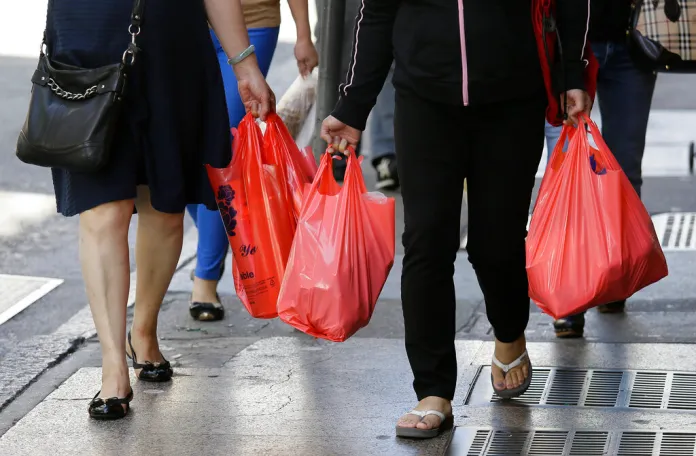
One law passed this year banned stores from providing customers with plastic shopping bags.
If it sounds familiar, it’s because California tried something similar a few years ago. In 2014, the West Coast state tried to ban plastic shopping bags, but grocery stores found a loophole that allowed them to provide customers with thicker, reusable plastic bags.
The problem was that not everyone reused the bags, resulting in more plastic waste. The new law outlaws the thicker bags, too. Grocery stores will only be allowed to offer customers who forgot their bags at home recycled paper bags.
Lawmakers also passed a bill that would allow agencies to reduce or waive parking penalties if a person can show they are unable to pay in full due to financial hardship or homelessness.
Starting in July, all California public schools must have at least one general-neutral restroom available.
There will also be restrictions on artificial intelligence chatbots and child users. Senate Bill 243 requires companies that make chatbots to report safety concerns, especially if a user expresses thoughts or wants to self-harm. They must also clearly tell users that they are talking to a computer, not a person.
The adult victims of sexual assault will get more time to file lawsuits against their perpetrators in California. Assembly Bill 250 gives survivors from Jan. 1, 2026, through Dec. 31, 2027, the option to file lawsuits if they allege a cover-up.
And it’s going to be a big year for Thamnophis gigas, also known as the giant garter snake. The rare, semiaquatic snake typically inhabits the wetlands of central California and has been chosen as the state snake. Its reign begins in January.
Illinois
More than 250 new state laws will take effect in Illinois on Jan. 1, 2026, covering consumer rights, workplace protections, and public safety.
Illinois’s “Squatter Bill”, SB 1563, will make it easier for authorities to remove squatters from someone’s home, bypassing an eviction process that can take months. Previously, squatters were allowed to remain on the premises while the case played out in court. The new law allows police to enforce criminal trespass charges against a squatter.
“Squatters are a problem, and no one should have to get an eviction notice to remove squatters from their home,” bill sponsor Sen. Lakesia Collins (D-IL) said in a statement. “Law enforcement need to be able to do their job and return homes to their rightful owners.” The bill passed through the General Assembly nearly unanimously, with one Republican holdout.
In another housing change, a University of Illinois Chicago professor and her students from a domestic violence law course helped create legislation that will require landlords to include a summary of special housing rights for domestic abuse survivors on the first page of each residential lease or renewal.
A new Illinois law prohibits public schools from disclosing or threatening to disclose information about a student’s immigration status or the immigration status of a person associated with the child. The new law also requires schools to create procedures for authorizing requests from federal, state, and local law enforcement agents attempting to enter a school. The law also guarantees that every child, regardless of immigration status, has access to free public K-12 education.
Florida
Beginning Jan. 1, 2026, the Florida Department of Law Enforcement will start listing people found guilty of, or who have pleaded guilty to, animal cruelty on its website. The new rule is part of “Dexter’s Law,” which was named after the dog that was found decapitated in Pinellas County.
Another new law will force pet insurance companies to clearly explain to holders or would-be holders how they decide on claim payment.
Moving on to humans, SB 1808 requires healthcare facilities and practitioners to refund any overpayments made by patients within 30 days. If a facility fails to issue the refund on time, it can be fined up to $500 per violation. If a doctor or nurse practitioner fails to refund the money, they could be subject to disciplinary action.
Another law going into effect is SB 158, which mandates that Florida state employee health insurance covers diagnostic and supplemental breast exams with $0 out-of-pocket costs.
New York
In New York, laws set to take effect in 2026 cover everything from a minimum wage increase to new rules for delivery workers, tipping, and pay transparency.
Starting Jan. 1, 2026, workers in New York City, Long Island, and Westchester County will earn $17 per hour, while workers in the rest of the state will see their wages increase to $16 per hour.
A new immigration-fraud outreach measure directs the Department of Consumer and Worker Protection to expand public education on common scams and strengthen safeguards against so-called “notario fraud.” Complementary state laws restrict the disclosure of immigration status and stiffen penalties for fraud.
And canceling subscriptions just got easier for New Yorkers. A new law is forcing companies to make cancellations as easy as signing up. Businesses will no longer be able to hide or make cancellation steps confusing.
Ohio
Ohio is boosting its minimum wage again by $0.30 an hour to $11 for non-tipped employees. Workers who receive tips will get a wage increase from $5.35 to $5.50. The current federal minimum wage is $7.25 per hour.
Another new law prohibits students in public schools from using cellphones during the day.
Another education-related law, House Bill 57, clarifies the rules for students leaving school to attend religious classes and limits the time they can miss. It also sets up detailed rules for any school that chooses to keep overdose reversal drugs, such as Narcan, on hand, including reporting and parent notification.
Idaho
In 2026, Idaho will change its primary method of execution from lethal injection to firing squad. HB 37 was passed after the state had problems with purchasing chemicals needed for lethal injections. Lethal injection will remain as a secondary option. The new law was pitched and passed as a quicker and more humane way of executing a prisoner. The law also introduces a mechanized firing squad, requiring renovations to the facility.
Another new law will give eligible Idaho farmers a 20% refundable investment tax credit on qualifying machinery and equipment purchased on or after Jan. 1, 2026.
Georgia
Several new state laws will also take effect in Georgia next year, including one that requires health insurance companies to offer online appointment scheduling or a callback system for patients who need to see the doctor.
Another new law allows dentists to provide teledentistry under new state guidelines. Public schools will see significant changes, but those laws won’t take effect until July 2026. They include prohibiting personal internet-connected devices during school hours in all public K-8 schools. Another law mandates that public school athletic programs designate teams by sex. The law explicitly prohibits biological males from competing in female sports categories.
When it comes to politics, the State Ethics Commission will no longer accept complaints about a candidate or their campaign within 60 days of an election.
Virginia
Virginia is another state that will raise its minimum wage to $12.77 an hour in the new year.
The state will also mandate that baby food manufacturers test their products for toxic heavy metals and display the results on the label or via a QR code.
Minors under 16 will be limited to one hour of social media per platform per day.
The state will also implement Malcolm’s Law, which requires hospitals to test for fentanyl. The law was named in honor of Malcolm Kent, a Fairfax County teenager who died from fentanyl poisoning.
Maryland
Rideshare drivers in Maryland will receive weekly earnings summaries, and transportation network companies will have to report annual trip and earnings data to the Public Service Commission starting in the new year.
Another significant change is HB 1086, which requires medical insurers that cover anesthesia to cover the entire procedure and care related to anesthesia delivery immediately before and after the procedure. Last year, the American Society of Anesthesiologists condemned a proposal from Anthem Blue Cross Blue Shield that would set a time limit per procedure for anaesthesia coverage.
Other new Maryland laws cover strengthening housing protections and employment rules.
TRUMP ADMINISTRATION COMPLETES PERMITTING FOR ALASKA LNG PIPELINE
Hawaii
Hawaii is also raising its minimum wages by $2, from $14 to $16 per hour. This is the third scheduled increase for the Aloha State, which will eventually see its minimum wage hit $18 on Jan. 1, 2028. The Hawaiian legislature also established a civil penalty of $500 this year for employers who violate the Wage and House Law.
Hawaii will also be implementing a new tourist tax starting in the new year. The “Hawaii Green Fee” is a 0.75% increase to the state’s Transient Accommodations Tax and applies to hotels, vacation rentals, short-term rentals, and cruise ship cabins. The money collected will go toward environmental projects in the state.