The nine defendants charged as co-conspirators in the federal church occupation case are rebutting the Justice Department’s claims that their takeover of a Christian parish in Minnesota last month was the culmination of a sprawling conspiracy, and accordingly, requires an extensive review of the evidence against them.
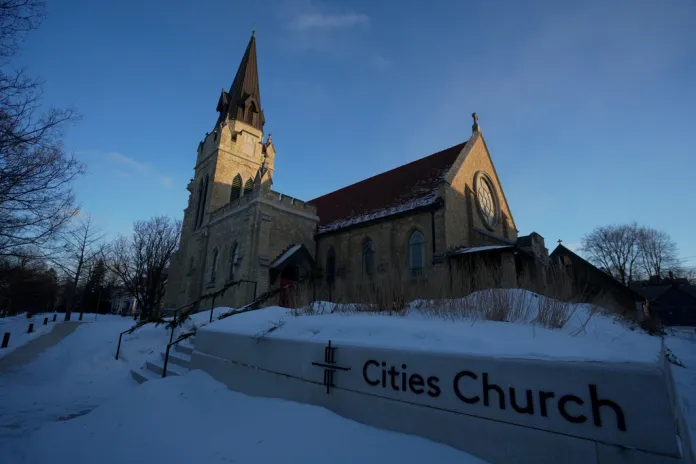
On Jan. 18, dozens of activists stormed Cities Church, a congregation in St. Paul, during a Sunday sermon in protest of Immigration and Customs Enforcement. Organizers of the protest, which was led by a broad Black Lives Matter coalition, claimed that one of the pastors is also an ICE official.
At their behest, a mob of anti-ICE agitators mobilized to carry out the “clandestine mission,” a so-called “secret operation” involving various activist organizations in the Minneapolis area barging into the sanctuary together to shut down church services.
In a Thursday court filing, the defense opposed a recent prosecution motion to treat the case as a grand conspiracy rather than a simple snap protest.
Prosecutors told the court earlier this week that they expect the case to be a large-scale undertaking due to the massive volume of records, victim interviews, communications data tied to the defendant, and incident footage to sort through.
“The indictment arises from a single incident lasting approximately one hour at one location,” the defense attorneys collectively wrote in response. “It alleges no multi-year scheme, no enterprise spanning jurisdictions, [and] no extraordinary evidentiary scope.”
DON LEMON PLEADS NOT GUILTY TO CHARGES FOR STORMING MINNESOTA CHURCH
Federal officials are seeking to classify the case as a “complex” prosecution, one that necessitates a time-consuming examination of all the evidence, “given the volume, complexity, and scope of the investigative materials.”
A “complex case” designation is a formal classification indicating that a case is too intricate to proceed within the normal 70-day timeline of the Speedy Trial Act, which mandates that a trial must commence within 70 days after a defendant is criminally charged or makes an initial courtroom appearance, whichever date is more recent.
Alternatively, the DOJ’s civil rights division is requesting that the court at least extend the discovery deadline so prosecutors can adequately prepare for trial.
Investigators estimate that the discovery process will entail prosecutors poring over approximately 2,000 pages of reports, multiple videos of the incident, social media posts, data collected from seized cellphones, and body-worn camera footage of St. Paul Police Department interviews with parishioners.
In a motion filed on Tuesday, prosecutors also pointed to the large number of co-defendants as well as witnesses and church members victimized that morning. According to court documents, about 300 worshippers and parish staff were present at Cities Church on the day of the protest. Authorities suspect that around 40 individuals were participants in the charged conspiracy.
“As the investigation remains active, the number of defendants could increase,” prosecutors added.
The Speedy Trial Act says a continuance in a case may be based on “[w]hether the case is so unusual or so complex, due to the number of defendants, the nature of the prosecution, or the existence of novel questions of fact or law, that it is unreasonable to expect adequate preparation for pretrial proceedings or for the trial itself within the time limits.”
Prosecutors also cited novel legal issues that defense counsel plans to raise, including constitutional challenges under the First Amendment.
In its opposition filing, the defense said the government’s motion did not explain why the amount of evidence “exceeds the norm in multi-defendant federal prosecutions.”
As examples of “appropriately designated” complex cases, the defense lawyers referenced an 86-count retrial, a Racketeer Influenced and Corrupt Organizations Act prosecution of a major organized crime family, and an eight-defendant, 470-count indictment resulting in a three-month trial and more than 2,500 separate offenses. The defense countered that there is “no comparable circumstance here.”
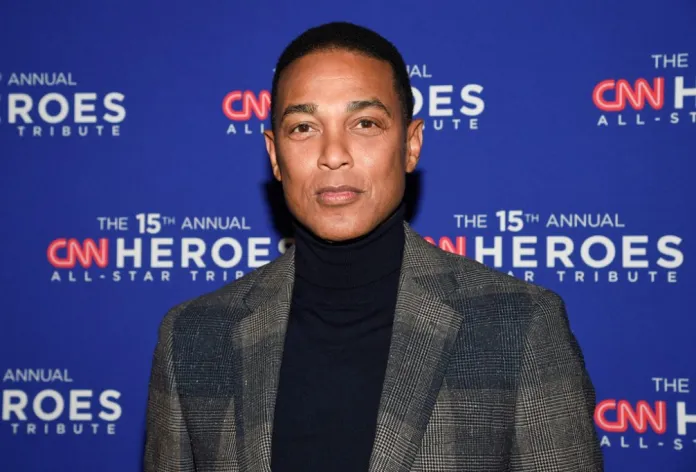
The jointly charged defendants include former CNN host Don Lemon, who filmed himself with the anti-ICE activists before, during, and after the planned protest; William Kelly, a traveling left-wing provocateur paid to “agitate Nazis” at sites of political conflict across the country; BLM Twin Cities founder Chauntyll Allen, an elected member of the St. Paul Board of Education; and alleged ringleader Nekima Levy Armstrong, head of the Minnesota-based Racial Justice Network.
BLM COALITION BEHIND ANTI-ICE SHUTDOWN OF MINNEAPOLIS CHURCH SERVICE
Late last month, a grand jury indicted Lemon, Kelly, Allen, Armstrong, and five others allegedly involved in the occupation of Cities Church on conspiracy charges. They are accused of conspiring to infringe on the religious rights of the Christian congregants in violation of the FACE Act, a federal law protecting both houses of worship and abortion clinics from political acts of intimidation, and 18 U.S.C. § 241, a Reconstruction-era civil rights conspiracy statute closely associated with the Ku Klux Klan Act.
Armstrong, in a separate submission to the court on Wednesday, asking for the judge to modify her conditions of release, similarly disputed the DOJ’s characterization of events.
“It is critical to recognize that, unlike a more typical federal case, Ms. Levy Armstrong is not accused of being a leader of a drug trafficking conspiracy, a gang, a fraud ring, a terrorism plot, or anything that would normally be considered criminal activity or dangerous,” Armstrong’s defense attorney wrote. “She was the leader of a nonviolent political protest.”
The court had imposed additional conditions of release on Armstrong, treating her differently from the other co-defendants, as the self-identified architect of the “#ICEOut” protest that she and other organizers dubbed Operation Pull Up.
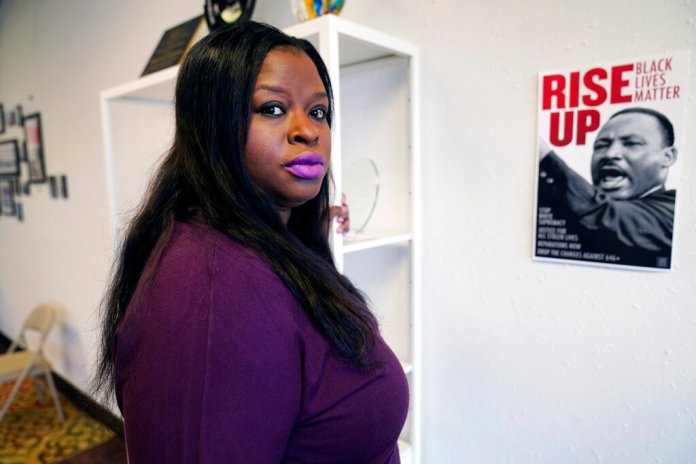
Armstrong’s attorney, Jordan S. Kushner, argued that “her leadership of the action is irrelevant to whether she poses any danger to the community or risk of flight.”
“There is no dangerousness or risk of flight demonstrated by leading a non-violent political protest,” Kushner, a prominent Minnesota activist known to assist anti-police protesters, continued. “It is fundamentally wrong and a constitutional affront to label her as dangerous for exercising her First Amendment rights. To the contrary, Ms. Levy Armstrong’s status as a respected community leader lessens any concerns about danger or risk of flight.”
Although she was quickly released from federal custody, Armstrong is subject to probation officer supervision while awaiting trial.
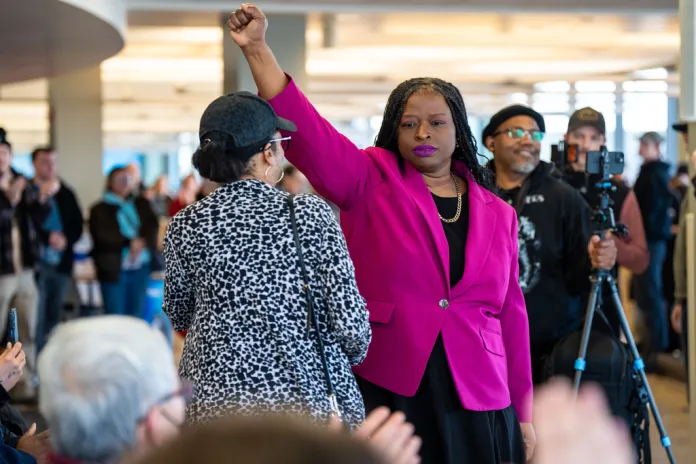
In previous petitions to the court, Kushner called the pretrial release conditions “unduly burdensome” and “degrading” to Armstrong.
“Her dignity is undermined by having to be actively supervised by a probation officer, required to get permission to travel, and report to a probation officer any contact with law enforcement regardless of whether the contact has any relevance to the case,” he wrote.
Kushner mentioned that Armstrong intends to continue protesting against what he described as “the current federally imposed police state” in Minnesota, noting that these demonstrations will likely lead to law enforcement encounters.
“Incidental contact with law enforcement officers is very common at such actions,” Kushner claimed.
The reporting requirement, according to Kushner, “effectively compels Ms. Levy Armstrong to report to probation her political activities, further violating her First Amendment rights as this prosecution itself does.”