
The House passed a bipartisan housing bill that would enact new policies to boost housing supply and ease the affordability crisis plaguing the nation.
The highly anticipated housing legislation, the Housing for the 21st Century Act, passed the House in an overwhelming 390-9 vote on Monday. The bill would ease some federal housing regulations to boost supply and would also nudge state and local governments to loosen land-use rules that make it difficult to build housing.
The legislative package could prove to be one of the most significant economic measures passed this Congress. However, it faces a complicated path in the Senate. Furthermore, President Donald Trump has recently appeared skeptical of efforts to lower housing prices.
WARSHACH TEST: TRUMP’S FED CHAIRMAN PICK KEEPS MONETARY ANALYSTS GUESSING
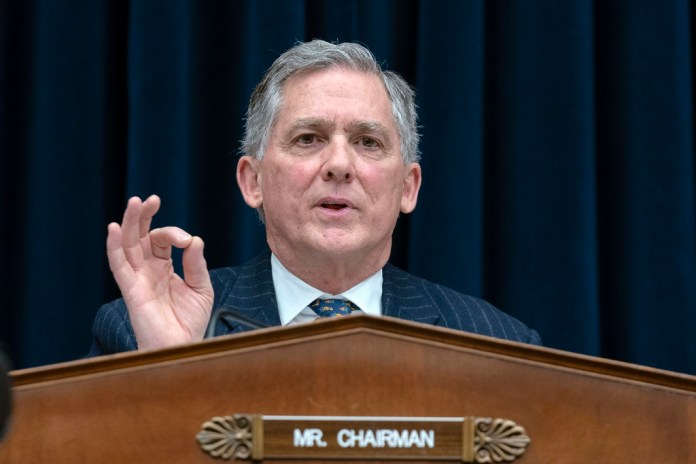
“This bill represents that consensus of both Democrat and Republican members in the House who want at the federal level to take some steps that we believe will lower the marginal cost of constructing housing, making [Department of Housing and Urban Development] programs more efficient, more effective, more accountable to taxpayers,” House Financial Services Committee chairman Rep. French Hill (R-AR) told a group of reporters on Monday ahead of the vote.
Housing costs have been a major component of the affordability problems facing consumers. Home prices and mortgage rates have soared over the past several years, pushing home ownership out of reach for many Americans. The median age of a first-time homebuyer has risen to 40, according to one account.
Rep. Marlin Stutzman (R-IN), another member of the committee, told the Washington Examiner that the bill is “our best hope of getting housing legislation passed this Congress for Americans in need of a home” and called on the Senate to take up the legislation.
But the Monday passage tees up questions about next steps and whether the Senate will take up the House legislation after previously passing its version, the Road to Housing Act. Or perhaps whether there will be a conference about the various provisions that differ in the two pieces of legislation, and a final bill crafted between the two chambers.
The Housing for the 21st Century Act is designed to modernize local development and rural housing programs, further expand financing opportunities for manufactured and affordable housing, and protect borrowers and assisted families. It also enhances oversight of housing providers.
One significant difference in the House bill is a provision that would overhaul the HOME Investment Partnerships Program, a major housing program administered by the Department of Housing and Urban Development.
“This compromise that came out of our committee 50-1 is the first meaningful reform of the HOME partnership program since it was authorized in 1993,” Rep. Mike Flood (R-NE), the chairman of the housing subcommittee, told reporters on Monday.
The provision’s authors, Flood and Emanuel Cleaver (D-MO), say it would modernize and strengthen the program, which provides about $1.25 billion a year in block grants to states and cities to provide affordable housing.
The legislation would provide greater flexibility for governments in allocating funding under the program, which was created in 1990 as part of a broader shift in housing policy toward greater responsibility for states and cities. It would also provide relief from federal environmental rules that slow down projects.
The legislation also involves zoning.
It has a provision, similar to one in the Senate bill, that would have HUD create zoning guidelines and then essentially grade every locality on how its rules stacked up against the prescriptions.
It also contains provisions for HUD to change its building codes for modular construction techniques and manufactured housing.
Hill said the changes to modular housing are the culmination of a 40-year effort.
“There were some modest changes, I think, during the Clinton and George W. Bush days, but this is a way, I think, that benefits both rural and urban marginal cost of housing,” he added.
Some experts have highlighted a specific provision of existing law that requires manufactured homes to have a permanent chassis, meaning they can be moved even if there is no intention to relocate the home. Both bills would repeal that section of the law to lower costs.
The House bill would also direct HUD to promote “point-access block” buildings, meaning buildings accessible by just one stairwell — a reform sought by many urbanists.
Such buildings are popular in many parts of the world and some U.S. neighborhoods, but are effectively prohibited throughout much of the country because of model building codes that most cities use. Generally, apartment buildings in the United States are required to have two stairwells for egress in case of fire, which some designers have blamed for forcing awkward construction choices and making it harder to build small-scale multifamily.
The House legislative package, however, excludes some of the most ambitious reforms in the Senate version, such as a pilot program to incentivize localities to liberalize land-use rules using Community Development Block Grant funding. It also leaves out one new grant program for localities that increase housing supply, and another one that would steer more funding to cities that make it easier to build near transit.
Trump has also sought to reassure voters about housing costs, but more recently, he has suggested he would like to see prices rise, not fall.
“I don’t want to drive housing prices down,” he said at a meeting of his Cabinet in late January. “I want to drive housing prices up for people [who] own their homes, and they can be assured that’s what’s going to happen.”
Trump has steered clear of talking about the kinds of measures included in the bipartisan bills.
To address fears about affordability, he did sign an executive order designed to curb purchases of single-family homes by institutional investors. He called on Congress to ban the practice, but no such provision is included in either housing bill.
Hill said Monday that Congress needs to hear the Treasury’s definitions for what constitutes large institutional investors and single-family homes before making a determination.
He also said that the committee will discuss some bills related to limiting institutional investors from purchasing single-family homes during a Tuesday hearing on affordability, “so that we can continue to see how that drafting could proceed, and see if there’s a consensus on that in the House and Senate.”
“I don’t want to say that it will or won’t be, but it certainly could conceivably be if there’s a consensus in the House and Senate to pursue an idea like that,” said about such a provision being later added into the bipartisan housing legislation.
Adding such a measure would be politically difficult, though. The idea has garnered skepticism from many in the industry and among free-market economists.
Proponents of banning firms such as Blackstone from buying single-family homes, many of whom are on the Left and populist Right, argue that those investors are crowding out the market for homebuyers. Others in the housing space, though, say that is not the case and that the policy could backfire by making housing more expensive for some.
BESSENT TAKES FLAK FROM DEMOCRATS OVER AFFORDABILITY IN SENATE HEARING
Critics also argue that these institutional investors only purchase a tiny percentage of the total housing stock and that they might make it easier for people to rent homes they might not have been able to buy with a mortgage.