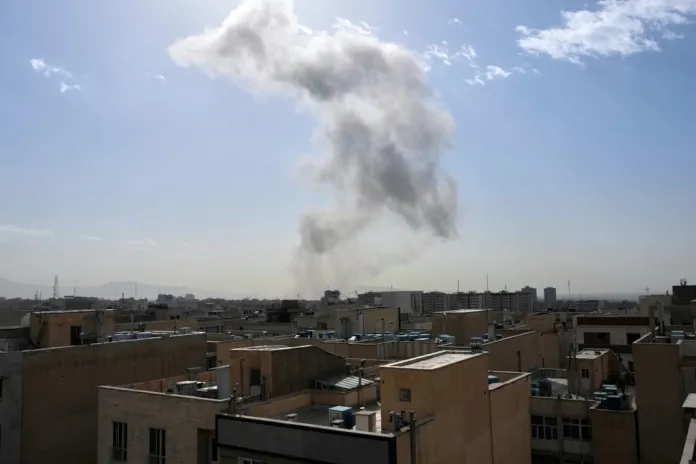
The U.S. and Israel have launched a joint wave of strikes against Iran, with the first wave targeting Tehran.
Israeli Defense Minister Israel Katz announced the attacks on Saturday, saying it was a “preemptive strike against Iran to remove threats to the State of Israel.” He warned of an “immediate state of emergency throughout the entire country.”
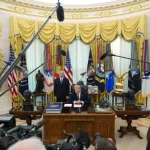
In a video address on Truth Social posted around 2.30 a.m. on Saturday morning, President Donald Trump announced the U.S. participation in the strikes, saying the purpose of the strikes was to “defend the American people by eliminating imminent threats from the Iranian regime,” which he described as “a vicious group of very hard, terrible people.”
“Its menacing activities directly endanger the United States, our troops, our bases overseas, and our allies throughout the world,” Trump added.
The Department of War subsequently revealed the operation’s name in a post on X: Operation Epic Fury.
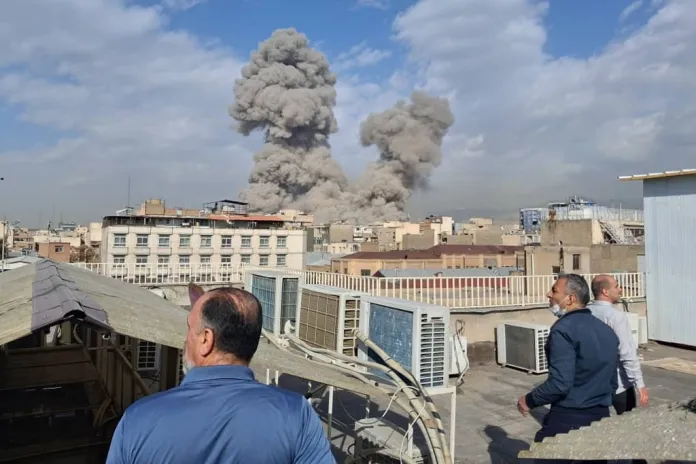
Videos posted on social media showed plumes of smoke rising across Tehran. Channel 12 reported that among the targets of the opening strikes were the homes of ministers and military heads, Defense and Intelligence Ministry installations, and a presidential facility. Pasteur Street, a compound home to the office of the Iranian president, the center of the Islamic Revolutionary Guard Corps’s intelligence leadership, and the Supreme National Security Council, was noted as a target by the Wall Street Journal.
Israeli Prime Minister Benjamin Netanyahu said in the aftermath of the first strikes: “My brothers and sisters, citizens of Israel, just an hour ago, Israel and the United States embarked on an operation to remove the existential threat posed by the terrorist regime in Iran.”
TRUMP ANNOUNCES ‘MASSIVE AND ONGOING OPERATION’ AGAINST IRAN
Unlike the 12 Day War, which began with a predawn series of strikes, Saturday’s strikes occurred in broad daylight. This was no coincidence — a security source told Channel 12 that a daylight strike was chosen to surprise Tehran, which was expecting any strike to occur at night.
An Israeli official told the outlet that the “initial phase” of strikes will last four days, and will be much larger than the 12 Day War. Israel is going “all out” in the operation, they said, and the U.S. is “on the same page.” An Israeli official told the Times of Israel that the opening strikes were targeting Iranian regime sites and military facilities, likely indicating decapitation strikes.
Two senior Israeli defense officials familiar with the planning told the New York Times that the attack began at 8:10 a.m. local time, and included direct strikes against high-ranking figures. The plan presented to Trump had Israel focusing its strikes on missile storage sites, production facilities, and launchers, while the U.S. will focus on nuclear, IRGC, and government targets.Sirens initially sounded across Israel, but a statement from the Israeli Air Force clarified that there was no immediate danger yet, and the sirens were a drill to prepare for expected retaliation. Shortly thereafter, the Israel Defense Forces identified “missiles launched from Iran toward Israel.“
Sirens initially sounded across Israel, but a statement from the Israeli Air Force clarified that there was no immediate danger, and the sirens were a drill to prepare for expected retaliation. Shortly thereafter, the Israel Defense Forces identified “missiles launched from Iran toward Israel.”
So far, Iran’s proxies have not carried out retaliatory attacks tied to the strikes against Iran, though that could change. Similarly, the U.S. and Israel could carry out attacks against those proxies, which are located in Gaza, Lebanon, Yemen, Syria, and Iraq.
Concurrent with the opening strikes, Israel’s Mossad also went to work. Its Persian-language Telegram channel called on Iranians to help in the coming operations, urging citizens to “share photos and videos of your just struggle against the regime with us.”
“Our Iranian brothers and sisters, you are not alone! We have launched a highly secure and dedicated Telegram channel especially for you. Together we will return Iran to its glorious days,” the message read.
The U.S. embassy in Qatar implemented a shelter-in-place order for all citizens. The main U.S. military base in Qatar was attacked by Iran during June’s 12 Day War. Other embassies have made similar announcements.
In Trump’s address, he laid out an extensive list of grievances against Iran, going back to the Iranian hostage crisis of 1979.
“It’s been mass terror, and we’re not going to put up with it any longer,” he said of the Islamic regime’s activities across the Middle East.
Trump swore to “raze Iran’s missile industry to the ground,” and “annihilate” its Navy.
He concluded by making clear he was aiming for regime change, calling on the Iranian people to “seize control of your destiny” and take over the government.
Help on the way
The mission was the culmination of weeks of speculation, fueled mostly by President Donald Trump himself, as to whether he would approve a military operation targeting Iranian senior leaders after they killed thousands of protesters who took to the streets in December and January in opposition of the regime. In January, Trump said, “Help is on the way” in a message directed to the protesters.
There is now the chance for an Iranian retaliatory response, which officials in Tehran have threatened if they were attacked by America. Israel has begun taking extensive precautions, including the closing of its airspace and restrictions on civilian movement.
Iran’s regime, which has been in place since the 1979 revolution, is likely at its weakest point amid the protests, which have gone on intermittently for nearly a decade, according to U.S. intelligence reports provided to the president and confirmed by Secretary of State Marco Rubio.
The president ordered the Abraham Lincoln carrier strike group to sail from the Indo-Pacific to the Middle East in order to give the president more options for how to carry out the operation and for how to defend possible U.S. assets that Iran could target in retaliation. The carrier group arrived in the region in late January.
It’s the second time since Trump returned to the White House that the president has green lit operations against Iran, the first time being when the Air Force bombed three of Tehran’s most hardened nuclear facilities. The long-range bombers that carried out that mission left from Whiteman Air Force Base in Missouri and flew from there to Iran, carried out the operation, and came back to the base.
It’s unclear what will happen now when it comes to Iranian leadership, though the U.S. likely does not want to see the Islamic Revolutionary Guard Corps to fill the void left by the deaths of senior leaders across the countries.
The regime had spent decades building up and training proxy groups in other countries with the goal of carrying out operations against their shared targets — primarily Israel and the United States — without Tehran facing blowback themselves.
The region has been dramatically reshaped since Hamas launched its Oct. 7, 2023 attack in southern Israel. That operation, in which Hamas and Palestinian Islamic Jihad (another Gaza-based terrorist group) killed roughly 1,200 people and kidnapped another 250 individuals was the spark that instigated several connected wars as other Iranian proxies attacked Israel as well.
What’s left of Iran’s proxy groups are militias in Iraq and the Houthis in Yemen, both of whom are still standingbut were left battered after various U.S. strikes that occurred after they started carrying out attacks in the region, claiming they were doing so in support of the Palestinians amid the Israel-Gaza war.