The Federal Reserve approved a quarter-point interest rate cut Wednesday, the third consecutive interest rate reduction since the Fed resumed easing monetary policy in September.
The post Deeply Divided Fed Lowers Rates by Quarter-Point appeared first on Breitbart.
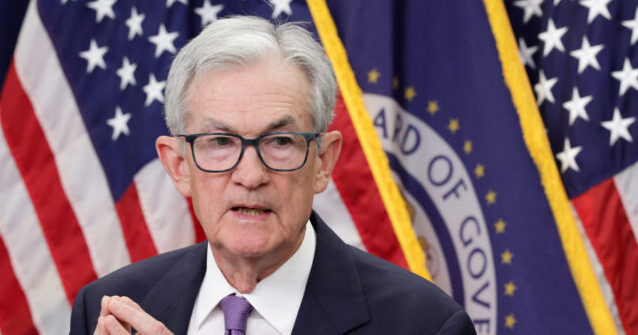
The Federal Reserve approved a quarter-point interest rate cut on Wednesday, the third consecutive interest rate reduction since the Fed resumed easing monetary policy in September, in a decision that exposed the deepest internal split on the rate-setting committee in six years.
The move brings the Fed’s benchmark rate down to a range of 3.50 to 3.75 percent. The Fed also announced a reduction in the interest paid to banks on reserves to 3.65 percent.
“Available indicators suggest that economic activity has been expanding at a moderate pace,” the Fed said in a statement released announcing the cut. “Job gains have slowed this year, and the unemployment rate has edged up through September. More recent indicators are consistent with these developments. Inflation has moved up since earlier in the year and remains somewhat elevated.”
Nine of 12 voting officials on the Federal Open Market Committee, the Fed’s monetary policy body, supported the quarter-point cut. Fed Governor Stephen Miran, who served as a senior White House adviser until his confirmation to the central bank board in September, dissented, favoring a larger half-point cut. This is his third meeting and third dissent favoring a half-point cut when the Fed moved to cut by a quarter point.
Chicago Fed President Austan Goolsbee and Kansas City Fed President Jeffrey Schmid also dissented, preferring to leave the Fed target unchanged. This was the first time three officials have dissented at a single meeting since 2019.
The projections of Fed officials released Wednesday showed the central bankers deeply divided about the path of interest rates in the year ahead. Three officials indicated they expect today’s rate cut to be reversed by the end of next year. Four penciled in no more cuts next year. Four officials indicated they expect one cut next year and another four said they expect two cuts. Two officials expect three cuts, one expects four cuts, and one official—likely Governor Miran—indicated six cuts. That puts the range of rates expected next year to span 2.1 percent to 3.9 percent, an unusually wide dispersion. The median expectation is for the Fed to cut rates one more time next year, which would bring the Fed funds rate to a range of 3.25 to 3.5 percent.
The projections show Fed officials have significantly upgraded their expectations for growth next year. The median forecast is now for the economy to grow 2.3 percent next year, up from 1.8 percent in the projections released in September. The median expectation for inflation came down to 2.4 percent from 2.6 percent. Core inflation, a measure that excludes food and energy costs, is now expected to run at 2.5 percent next year, down from 2.6 percent in September. The expected unemployment rate was unchanged at 4.4 percent.
While only 12 officials—the Fed chairman, the six other Fed governors, the President of the New York Fed, and a rotating group of four other regional Fed presidents—vote on the FOMC, 19 officials submit projections. The larger group includes the non-voting presidents of the regional Fed banks.
The projections released Wednesday also revealed an even deeper division than the formal vote suggests. While only two officials—Goolsbee and Schmid—formally dissented in favor of holding rates steady, the backwards-looking projections for 2025 show six officials indicated they believed the appropriate policy at year-end was 3.875 percent, which represents the midpoint of the 3.75 to 4.0 percent range the Fed held before today’s cut.
Since all 19 officials submit projections but only 12 vote on policy decisions, the additional officials preferring to hold could be non-voting regional Fed presidents. Still, the gap between the three formal dissents and the six dots suggesting a preference to hold reveals significant unease with today’s decision extending beyond those who voted against it.
The Fed directly controls two rates, the overnight intrabank borrowing rate called the Fed funds rate and the rate paid to banks on their reserves. The expected path of these short-term rates influences longer-term interest rates on mortgages, auto loans, corporate borrowing, and bonds issued by the federal government.
The 10-year Treasury yield was down by 0.016 of a percentage point to 4.17 percent on Wednesday after the announcement. That is slightly higher than the rate was at the end of October, when the Fed last met. The two-year Treasury yield fell by 0.033 percentage point to 3.578 percent.
During Fed Chairman Jerome Powell’s press conference, yields fell further. The 10-year yield declined to 4.147, a 0.035 percentage point drop. The two-year yield fell to 3.548 percent, a 0.067 percentage point decline.