Seemingly under intense pressure from China, Iran’s terrorist Islamic Revolutionary Guard Corps (IRGC) modified its threats to close the vital Strait of Hormuz to worldwide oil shipping, claiming that it would only attack American, Israeli, and European ships.
The post Iran Claims Strait of Hormuz Open to Friends After China Pressure, Trump Navy Escort Offer appeared first on Breitbart.
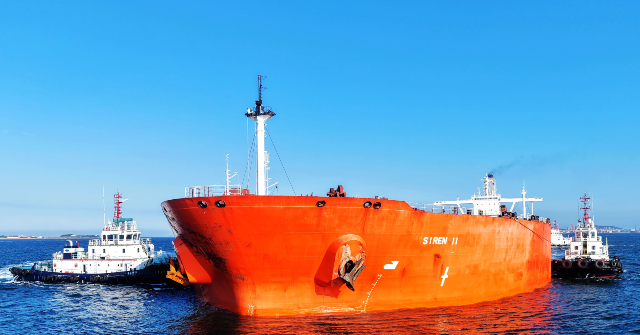
Seemingly under intense pressure from China, Iran’s terrorist Islamic Revolutionary Guard Corps (IRGC) modified its threats to close the vital Strait of Hormuz to worldwide oil shipping, claiming that it would only attack American, Israeli, and European ships.
Beijing nevertheless ordered its largest oil refiners to halt their exports of diesel and gasoline until further notice.
Iran has long threatened to close the Strait of Hormuz in the event of hostilities. The strait is a narrow passage between the Persian Gulf and the Gulf of Oman, through which about a fifth of the world’s oil and liquified natural gas (LNG) flows.
The IRGC announced the strait was “closed” soon after the beginning of Operation Epic Fury and IRGC officials have threatened to “burn” any tanker that attempts to defy their blockade. As of Thursday, no international maritime authority has issued a formal notice of closure for the Strait of Hormuz, but dozens of ships are halted at either end or taking long routes around Africa to avoid the area.
On Thursday, the South Korean government revealed that seven of its tankers, carrying up to two million barrels of crude oil apiece, are “effectively stranded” in the Strait of Hormuz.
President Donald Trump said on Tuesday that the U.S. Development Finance Corporation (DFC) would provide risk insurance for tankers traveling through the Persian Gulf, and the U.S. Navy was prepared to escort them through the Strait of Hormuz if necessary.
“No matter what, the United States will ensure the FREE FLOW of ENERGY to the WORLD,” Trump vowed in a post on Truth Social.
Industry analysts noted that cutting the flow of oil through the strait would hurt Asia far more than the U.S. or Europe, as witnessed by South Korea’s concern for its seven tankers, and it would hurt China most of all. According to some estimates, China gets over 45 percent of its oil from various sources through the Hormuz route.
China publicly pleaded with Iran to keep the Strait of Hormuz open and has been bringing considerable leverage against the regime in Tehran behind the scenes.
“The Strait of Hormuz and its adjacent waters are an important international trade route for goods and energy. To keep the region secure and stable serves the common interests of the international community,” the Chinese Foreign Ministry said on Monday.
On Thursday, the IRGC issued a statement through Iranian state media broadcaster IRIB claiming that ships belonging to the U.S., Israel, European powers, “and their supporters” will “certainly be hit,” but others are free to use the Strait of Hormuz.
“We had previously said that, based on international laws and resolutions, in times of war, the Islamic Republic of Iran will have the right to control the passage through the Strait of Hormuz,” the statement said. Iran has no such right under any interpretation of “international law.”
Iranian officials signaled on Tuesday that they would specifically allow Chinese-flagged ships to pass through the strait as a gesture of gratitude to Beijing for supporting the regime. This does not seem to have persuaded China that the strait was safe to transit.
The new promise by the IRGC to limit its attacks on shipping evidently also failed to reassure Beijing. On Thursday, Bloomberg News reported that the Chinese government has instructed its biggest oil refiners to halt exports of diesel fuel and gasoline.
“Officials from the National Development and Reform Commission, the country’s top economic planner, called for a temporary suspension of refined product shipments that would begin immediately, according to people familiar with the matter. They asked not to be named as the discussions are not public,” Bloomberg reported.
The latest orders from Beijing follow instructions this week for Chinese oil refiners to stop signing new export contracts, and to negotiate cancellations for as many orders as possible. China previously scaled back export quotas when it grew nervous about its domestic fuel supply following Russia’s invasion of Ukraine in 2022, but not by as much as Thursday’s full-stop order.
The Chinese are probably also nervous about losing access to Iran’s discounted, sanctioned oil. China has been buying up to 90 percent of Iran’s crude oil exports for the past few years, much as it has dueled with India to be the top customer for discounted Russian oil — and the Chinese are still reeling from the loss of Venezuelan oil after the fall of narco-terrorist dictator Nicolas Maduro.
China is also heavily dependent on Qatar for its LNG supply, and Iran’s attacks on Qatar have cut off those shipments. Although China took steps last year to shift some of its oil business from Iran to Russia, analysts are divided on whether Russia could significantly reduce the pain from China losing its supply from Iran and the Strait of Hormuz.