Iranian state media on Monday confirmed the selection of Mojtaba Khamenei, the 56-year-old son of slain Ayatollah Ali Khamenei, to become the new Supreme Leader.
The post Meet the Next Khamenei: Iran Appoints U.S.-Sanctioned Son to Replace Dad as Supreme Leader appeared first on Breitbart.
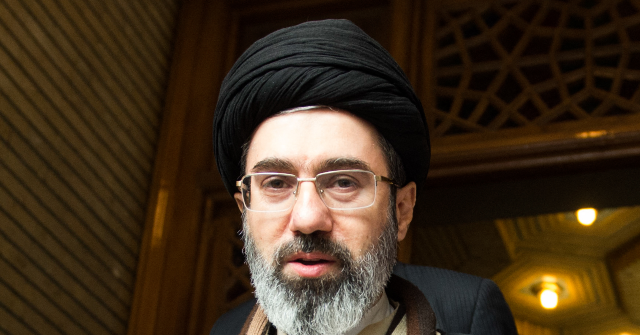
Iranian state media on Monday confirmed the selection of Mojtaba Khamenei, the 56-year-old son of slain Ayatollah Ali Khamenei, to become the new Supreme Leader.
Iran’s terrorist Islamic Revolutionary Guard Corps (IRGC) immediately swore fealty to the new dictator and launched another wave of missiles and drones at Israel and the Gulf Arab states to commemorate his ascension.
The previous “supreme leader” was killed in the opening moments of Operation Epic Fury last week along with dozens of other high-ranking Iranian officials. The 86-year-old Ayatollah Ali Khamenei was only the second Supreme Leader of the Islamic Republic of Iran, following the leader of the 1979 revolution, Ayatollah Ruhollah Khomeini.
Khamenei’s second son Mojtaba has been a reclusive figure until now, often seen orbiting the highest levels of power in the Iranian theocracy but rarely stepping into the spotlight. He has no official resume and no previous positions of responsibility.
As Al-Mayadeen delicately put it on Monday, Mojtaba Khamenei “ascended through informal channels, building an extensive network of relationships across Iran’s security apparatus, religious institutions, and political circles.”
Al-Mayadeen struggled to make Mojtaba look like a refreshing out-of-the-box choice for supreme leader, praising the “scholarly foundation” that supposedly distinguishes him from other “Iranian political figures,” but this is a tormented way of saying that the younger Khamenei has no real experience at governing — and his selection might annoy Iranians who believe in the Islamic Republic’s mythology of revolution against the hereditary monarchy of the Shah of Iran.
Mojtaba Khamenei reportedly has close links to the IRGC, and Al-Mayadeen claimed he spent some of his “formative years” by “serving in military units alongside fighters who would later become prominent commanders in Iran’s security establishment.”
The details of this alleged military service are unclear, although Iranian state media claims Mojtaba joined an influential battalion at the age of 17 during the Iran-Iraq War.
Deutsche Welle (DW) noted Mojtaba’s debut as a power player in Iranian politics came in 2005, when he “engineered” the election that brought hardline President Mahmoud Ahmadinejad to power with a sham vote. One of the other candidates in the election, Mehdi Karroubi, publicly accused Mojtaba Khamenei of manipulating the election to put Ahmadinejad in office.
Mojtaba reportedly interfered again during Ahmadinejad’s re-election campaign in 2009, an even more blatantly rigged election that inspired the “Green Movement” uprising. Protesters in 2009 were known to chant “Death to Mojtaba” due to his roles in both the sham election and the violent crackdown on the Green Movement.
Mahmoud Ahmadinejad went from two terms in the presidency to the Expediency Discernment Council, a top advisory council to the Supreme Leader. He accumulated a sizable following among hardliners and extremists, although he was never able to mount an effective political comeback. He tried to run for president again in 2017, but was disqualified by the clerical Guardian Council, which was widely interpreted as a sign that he was no longer popular within the theocracy.
Iranian state media reported Ahmadinejad was killed last weekend by a U.S.-Israeli airstrike that struck his residence in northeastern Tehran, but other sources claimed he survived the attack.
DW observed that Mojtaba is neck-deep in the sickening levels of corruption that give Iran’s theocratic masters and IRGC officials control over much of the national economy. Khamenei had a network of front companies and “charities” that controlled roughly 60 percent of Iran’s entire economy and that network will presumably pass to his son, which is one reason Mojtaba was seen as the heavy favorite to become the next Supreme Leader.
The regime went out of its way to demonstrate instant and total fealty to Mojtaba Khamenei, arranging a mass pledge of allegiance in Tehran’s Enghelab square on Monday.
The IRGC issued a statement pledging “complete obedience and self-sacrifice” in carrying out the “divine commands” of “the third leader of the sacred system of the Islamic Republic of Iran.”
The head of the inferior secular wing of the Iranian government, President Masoud Pezeshkian, was also quick to bend the knee.
“This valuable choice is a manifestation of the will of the Islamic nation to consolidate national unity; a unity that, like a solid barrier, has made the Iranian nation resistant to the conspiracies of the enemies,” he said.
Influential parliamentary speaker Mohammad Bagher Ghalibaf likewise vowed to “obey the commander-in-chief until the last drop of our blood.”
Mojtaba’s appointment was universally seen as a gesture of defiance against the United States, especially since President Donald Trump had explicitly ruled him an “unacceptable” choice to lead Iran.
Ghalibaf mocked Trump’s warnings on Friday, declaring that “the fate of dear Iran, which is more precious than life, will be determined solely by the proud Iranian nation, not by Epstein’s gang.”
Time magazine suggested Mojtaba’s image as the vengeful son who would fight America and Israel to the last drop of Iranian blood was another factor that clinched his appointment as supreme leader, even though many Iranians are clearly uncomfortable with the choice.
“If before there was even the slightest of chances that Mojtaba Khamenei might take the country down a path of major reforms, such as those initiated by the Saudi crown prince Mohammad Bin Salman, which would include détente with America, it’s now impossible,” an unnamed Tehran-based analyst told Time.
“Mojtaba didn’t lose just a father on that day, he lost a mother, a wife, and a child. He is filled with an undying desire for revenge, and the Guards know this,” he said.
Mojtaba’s wife Zahra Haddad-Adel and one of his two sons were reportedly killed by Operation Epic Fury airstrikes, along with his father the Ayatollah, and possibly his mother. Some Iranian state media reports have claimed he also lost a sister, a nephew, a niece, and a brother-in-law.
On Monday, an Iranian state television broadcast said Mojtaba Khamenei himself was wounded in the “Ramadan War,” the name Iranian media has given to the conflict. The report did not specify when the new supreme leader was wounded, or how severe his injuries are.
Within a few hours of the announcement that Mojtaba Khamenei had been named Supreme Leader, the IRGC launched another wave of missiles and drones at Israel and the Gulf Arab states, including Saudi Arabia, Qatar, Kuwait, Bahrain, the United Arab Emirates (UAE), and Iraq.
The IRGC portrayed the attacks as a powerful blow that was personally ordered by the new Supreme Leader. Officials outside Iran said most of the attacks were intercepted, but there was significant damage in Bahrain, including 32 injuries.