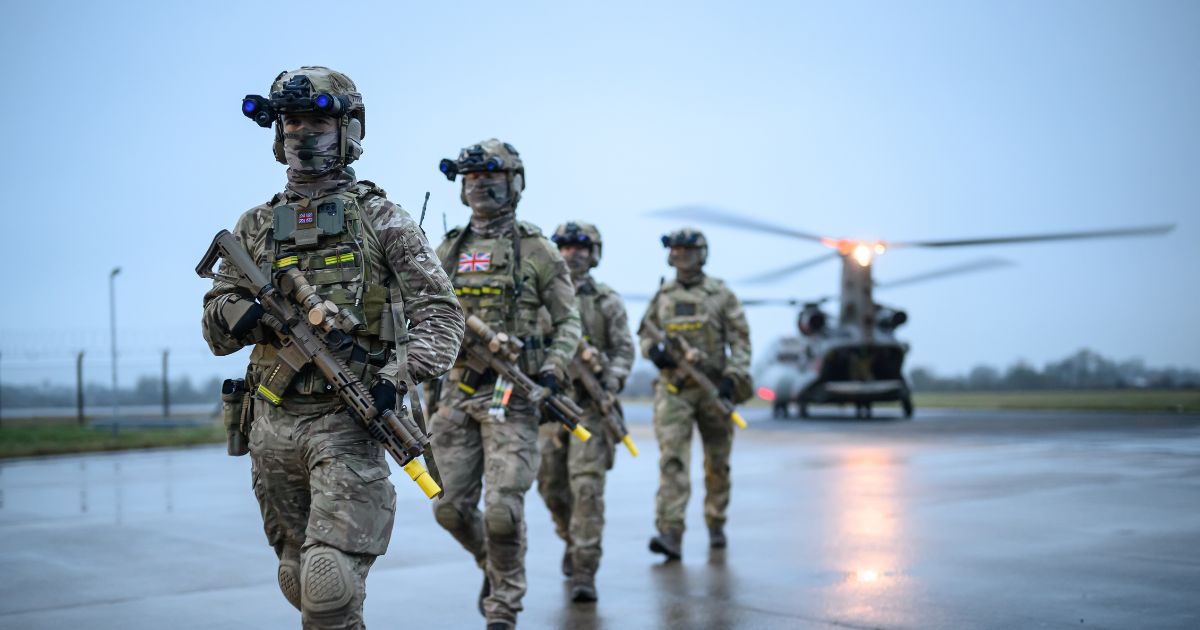
Retired British Army Col. Richard Kemp, who commanded U.K. forces in Afghanistan in the early 2000s, is warning about the current sad state of his country’s military.
In a Wednesday piece for The Telegraph, he wrote that the British military has an alarmingly low level of ammunition on hand.
“Knowledgeable observers have suggested that our munitions stocks — from rifle bullets and artillery shells to long range missiles and drones — would see out only about a week of intensive fighting,” Kemp recounted.
“That’s even taking account of the fact that our Armed Forces are now very small, having been repeatedly hollowed out by successive governments. Even the handful of soldiers and tanks we could put into the field would be out of ammo in a matter of days,” he added.
The combat veteran contrasted that position with the United States, where, “According to a recent contract announcement, the US will raise production of the well-known, very powerful Tomahawk cruise missile to ‘more than 1,000’ per year.
“Output of the Amraam beyond-visual-range weapon, America’s premier air-to-air missile at the moment, will rise to ‘at least 1,900’ annually. Manufacture of the SM-6, one of the few defensive weapons able to shoot down hypersonic threats, will rise to ‘more than 500’ annually. Production of the complex SM-3, able to engage ballistic missiles or even satellites flying outside the atmosphere, will also rise.”
Kemp went on to explain, “When America needs more bombs and bullets it surges production… to create a great leap forward. In Britain, and the rest of Europe, we don’t do that, we just clump along with some minor fiddling at the edges, always evolutionary, never revolutionary.”
The production surges, called “burst mode,” involve the “US government underwriting risk to manufacturers, paying up-front for factory expansion and guaranteeing purchases if the war cools down. Shifts are increased and factories run round the clock. When necessary older, proven designs are implemented with lower specs if that speeds up output,” the military expert pointed out.
Meanwhile, Britain is not willing to risk such “inefficient” spending to crank up munitions production.
This Government is taking its customary plodding approach to our depleted ammunition stockpiles. My article in the Daily Telegraph. (1/2) pic.twitter.com/e6QlUUFwLr
— Rɪᴄʜᴀʀᴅ Kᴇᴍᴘ ⋁ (@COLRICHARDKEMP) February 12, 2026
British military historian Anthony Beevor offered a similar assessment, saying that NATO’s munitions capability is woefully inadequate.
“We’re in the worst position of all. I mean, we have no ammunition,” he told Sky News. “The British Army couldn’t last more than sort of ten days before running out of ammunition in a conflict.”
Without U.S. production, Ukraine would not have the munitions it requires to combat Russia.
‘The British Army couldn’t last more than ten days before running out of ammunition in a conflict.’
Historian Antony Beevor says Europe would face challenges in filling military support for Ukraine if the US withdraws.#TrevorPhillips
⏰ 8:30am
📱 https://t.co/YJ576ZvrZl pic.twitter.com/yVa3p2Tekc— Sky News (@SkyNews) December 7, 2025
Following a Thursday meeting of NATO defense ministers, NATO Secretary General Mark Rutte hailed a “shift in mindset” in Europe with respect to military spending.
“The [5 percent] commitment was made in June,” Rutte said in a news release, “and the evidence of progress in delivering on that commitment is visible. But today we also saw evidence of something else. A real shift in mindset. A unity of vision. A much stronger European defence within NATO. Everyone around the table engaged — with a sense of urgency and ownership — in how we are working together, as Allies, to deliver effective deterrence and defence.”
The Secretary General commended the increased spending levels.
But the release continued, “Making clear that defence production and innovation must also rise, the Secretary General urged Allies to harness new technologies and develop their own industries and production lines on both sides of the Atlantic. He highlighted the value of multinational cooperation in pooling resources and expertise, noting new agreements signed by groups of Allies in the margins of the ministerial meeting.”
So as of now, NATO remains primarily undergirded by the United States, with perhaps some indications that European nations will heed the warnings and increase their capability to arm and protect themselves.

Advertise with The Western Journal and reach millions of highly engaged readers, while supporting our work. Advertise Today.