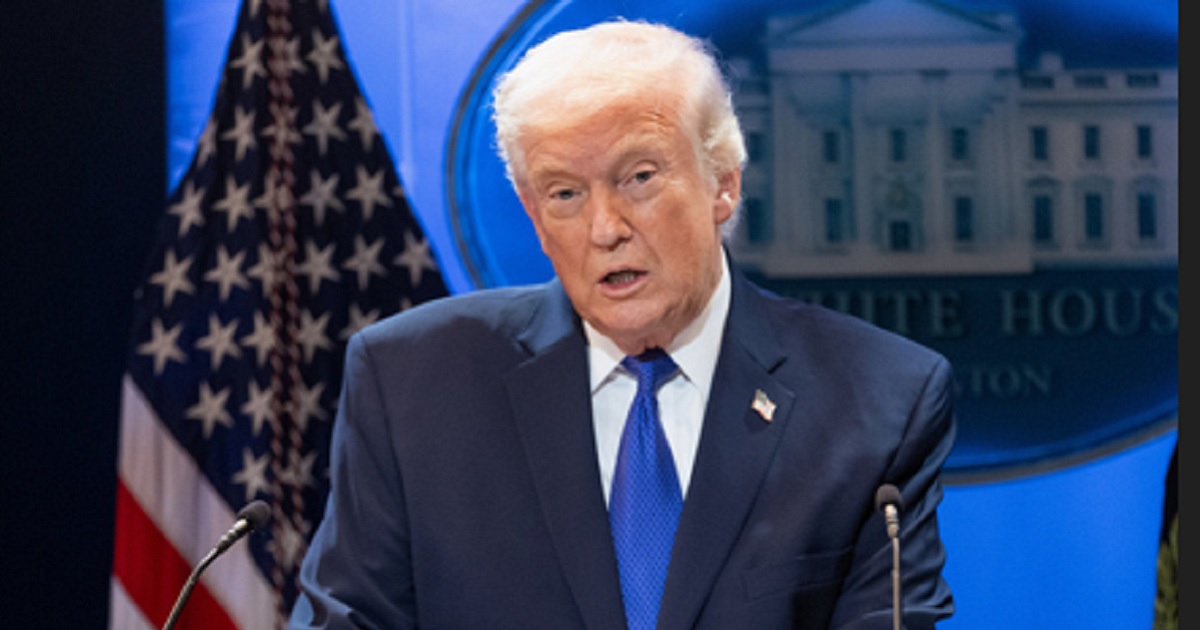
President Donald Trump announced Friday, in response to the Supreme Court striking down his imposition of tariffs using emergency statutory authority, that he will go in a “different direction” — but toward the same goal.
“Probably the direction that I should have gone the first time, but I read the language — and I’m very good at reading language — and it read our way 100 percent. But now I’ll go the way I could have gone originally,” he said.
“Which is even stronger than our original choice.”
In April, Trump imposed tariffs under a 1977 emergency powers law known as the International Emergency Economic Powers Act, citing a record $1.4 trillion trade deficit in 2024.
In Friday’s 6-3 ruling, the high court held that the IEEPA “does not authorize the President to impose tariffs.”
However, legal experts have noted that Trump has other statutory authority to impose tariffs, but they may take a little longer to implement.
Speaking to reporters at the White House on Friday, Trump noted that some of the tariffs that he imposed on China, Mexico, and Canada in relation to fentanyl coming into the U.S. remain in place.
Further, he said, “But other alternatives will now be used to replace the ones that the court incorrectly rejected.”
“We have alternatives, great alternatives. Could be more money,” he said. “We’ll take in more money, and we’ll be a lot stronger for it. We were taking in hundreds of billions of dollars. We’ll continue to do so.”
.@POTUS: “Other alternatives will now be used to replace the ones that the Court incorrectly rejected.” pic.twitter.com/XFxo7vazoO
— Rapid Response 47 (@RapidResponse47) February 20, 2026
For calendar year 2025, the Trump administration collected $287 billion in tariff revenue, a 192 percent increase over the preceding year, according to the Federal Reserve Bank of Richmond. It’s worth noting that Trump did not impose his reciprocal tariffs under IEEPA until April of last year.
“The Supreme Court did not overrule tariffs. They merely overruled a particular use of IEEPA tariffs,” Trump said.
“Effective immediately, all national security tariffs under Section 232 and existing Section 301 tariffs remain in place,” he said, referencing segments of long-established trade laws. “Today, I will sign an order to impose a 10 percent global tariff under Section 122 over and above our normal tariffs already being charged.”
.@POTUS: “Effective immediately, all national security tariffs under Section 232 and existing Section 301 tariffs remain in place… Today, I will sign an order to impose a 10% global tariff under Section 122 over and above our normal tariffs already being charged.” pic.twitter.com/LLMeyj92SE
— Rapid Response 47 (@RapidResponse47) February 20, 2026
The Financial Times reported in December that Trump’s team was preparing to impose tariffs using other statutes should the Supreme Court rule against the administration.
“Nobody thinks the tariffs are going away,” Ted Murphy, a trade lawyer at Sidley Austin in Washington, said in the Financial Times report. “They are just going to be reissued under a different umbrella. They will reissue tariffs the same day.”
The Financial Times explained that the administration could use “an obscure national security law known as Section 232 of the Trade Expansion Act of 1962, which has already been activated to apply levies to cars, steel, aluminium, copper and lumber.”
“Investigations into semiconductors, pharmaceutical goods and medicines, critical minerals and aerospace parts are all under way using Section 232, but their conclusions have remained unpublished,” the outlet further noted.
Trump’s team could also use a measure known as Section 122 of the Trade Act of 1974, allowing for up to 15 percent tariffs to be imposed on trading partners for 150 days as an immediate stopgap measure while other levies are prepared.
Meanwhile, “A separate provision, Section 338 of the Tariff Act of 1930, could also be triggered, although it has been used very rarely in recent history. It allows the government to immediately issue levies of up to 50 per cent on a foreign country that discriminates against US commerce, and can be used to respond to any ‘unreasonable charge, exaction, regulation, or limitation,’” the Financial Times noted.
Throughout the news conference, Trump made clear his essential position on tariffs is unchanged by the court’s ruling.
.@POTUS: “Just so you understand — we have tariffs. We just have them in a different way, and now they’ve been confirmed by the Supreme Court of the United States…. And we’ll be taking in hundreds of billions of dollars.” pic.twitter.com/2eVLBIKmZB
— Rapid Response 47 (@RapidResponse47) February 20, 2026
“We have tariffs. We just have them in a different way,” he said.
“Countries that have treated us badly will have to pay a price for treating us badly.
“And countries that have been good to us will be treated very well.”

Advertise with The Western Journal and reach millions of highly engaged readers, while supporting our work. Advertise Today.