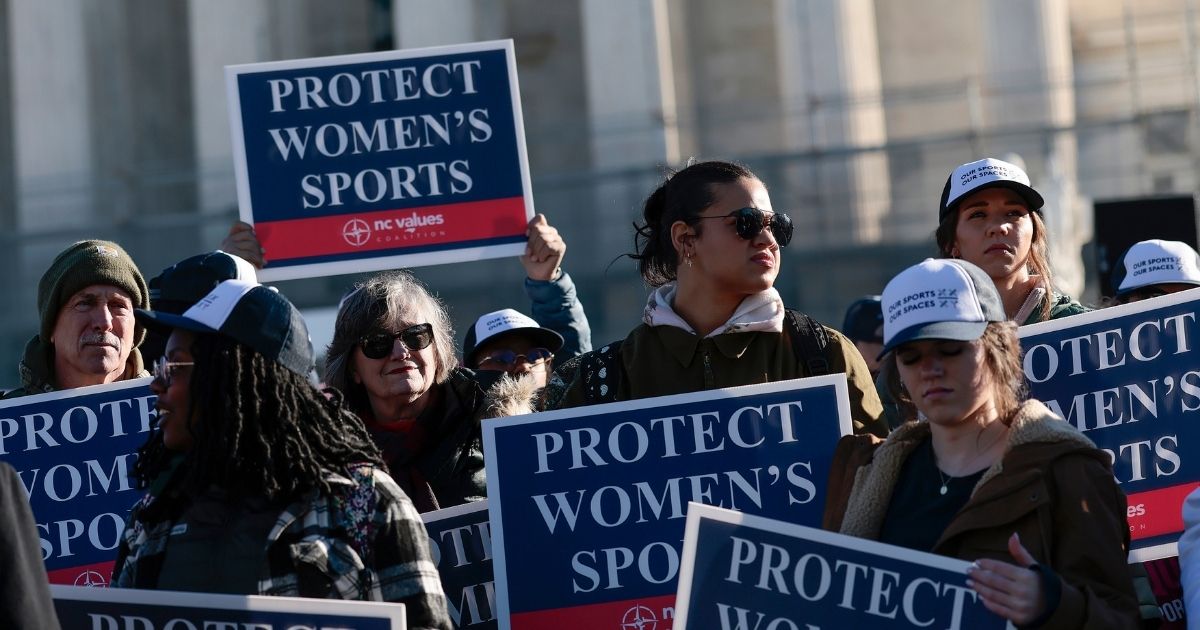
Supreme Court Justice Samuel Alito asked a prescient question as the high court heard oral arguments on Tuesday about banning male transgender athletes from competing in women’s sports.
Both Idaho and West Virginia enacted laws being challenged at the Supreme Court that require athletes to compete based on their birth sex, not how they later choose to identify.
Alito first asked Kathleen R. Hartnett, who is representing a self-described transgender Idaho student seeking to invalidate the ban as unconstitutional, if she would agree that it is permissible for schools to have separate sports teams for boys and girls without violating the Constitution’s equal protection guarantees.
Hartnett immediately responded that having distinct sports teams for boys and girls is permissible under the law.
That being the case, Alito observed that such a standard requires being able to define what a boy and a girl actually are.
Harnett agreed.
Alito then asked the central question of the case: “What is that definition for equal protection purposes?”
Harnett apparently realized that she had rhetorically boxed herself in and responded with a word salad.
Lawyer representing Hecox refuses to define “man” and “woman,” leading Justice Alito to ask how courts are supposed to determine if there’s been sex-based discrimination without knowing “what sex means.” @FDRLST pic.twitter.com/aIHYnfrqfS
— Shawn Fleetwood (@ShawnFleetwood) January 13, 2026
“Sorry, I misunderstood your question,” Harnett answered as she began to backpedal.
“I think the underlying enactment, whatever it was, the policy, the law, we’d have to have an understanding of how the state or the government was understanding that term to figure out whether or not someone was excluded,” she said.
“We do not have a definition for the court… We’re not disputing the definition here,” Harnett asserted.
But there is a gaping hole in her argument. She needed to provide a definition, based on law, that her client, though a male, is a female for purposes of competing in sports.
“What we’re saying is that the way it implies in practice is to exclude birth-sex males categorically from women’s teams, and that there is a subset of those birth-sex males where it doesn’t make sense to do so according to the state’s own interest,” Harnett said.
What would that interest be? It would seem that the state’s true overriding interest is to provide a fair playing field where men compete against other men, and women against other women. It’s not only a fairness issue, but depending on the sport, it can also be a safety issue.
“Men and women are different…you can’t change those differences by suppressing testosterone.”
Madison Kenyon champions the importance of why it’s important to uphold fairness in women’s sports after this morning’s Supreme Court oral arguments. pic.twitter.com/9e7aVsbeEn
— Alliance Defending Freedom (@ADFLegal) January 13, 2026
Alito followed up, reiterating his earlier point about the need for a definition of male and female.
“How can a court determine whether there’s discrimination on the basis of sex without knowing what sex means for equal protection purposes?” the justice asked.
Hartnett conceded that her client, as a “birth-sex male,” is barred from competing on a women’s sports team.
She continued, “So, we’re taking the statute’s definitions as we find them, and we don’t dispute them. We’re just trying to figure out, do they create an equal protection problem?”
Clearly, Hartnett must have thought there was an equal protection problem, or she would not have brought the case all the way to the Supreme Court.
Alito pressed a little further on Hartnett’s failure to provide a definition of male and female grounded in the law.
The justice offered the hypothetical of a male student who does not take puberty blockers, or female hormones, but announces, “I am a woman. That’s who I am.”
“Can the school say, ‘No, you cannot participate?’” Alito queried.
Hartnett answered, “Yes.”
“Is that person not a woman in your understanding?” Aliton wondered.
🚨 HOLY SMOKES. SCOTUS Justice Sam Alito just EVISCERATED the attorney’s argument for a transgender male trying to compete in girl’s sports
Every word. Masterful.
ALITO: Let’s say a school has a boy and girl track team. A male student with no puberty blockers or female… pic.twitter.com/Doejb48Jg4
— Eric Daugherty (@EricLDaugh) January 13, 2026
“I would respect their self-identity in addressing the person, but in terms of the statute, I think the question is, ‘Does that person have a sex-based biological advantage?’”
“What you seem to be saying is yes, it is permissible for the school to discriminate on the basis of transgender status,” Alito replied.
He concluded, “If this person is a ‘trans woman,’ a ‘trans girl,’ and is barred from the girls’ team, then that person is being subjected to differential treatment based on transgender status, right?”
Bingo.
Alito once again highlighted that the state of mind of Hartnett’s client is not a firm foundation upon which to build an entirely new constitutionally protected status.

Advertise with The Western Journal and reach millions of highly engaged readers, while supporting our work. Advertise Today.