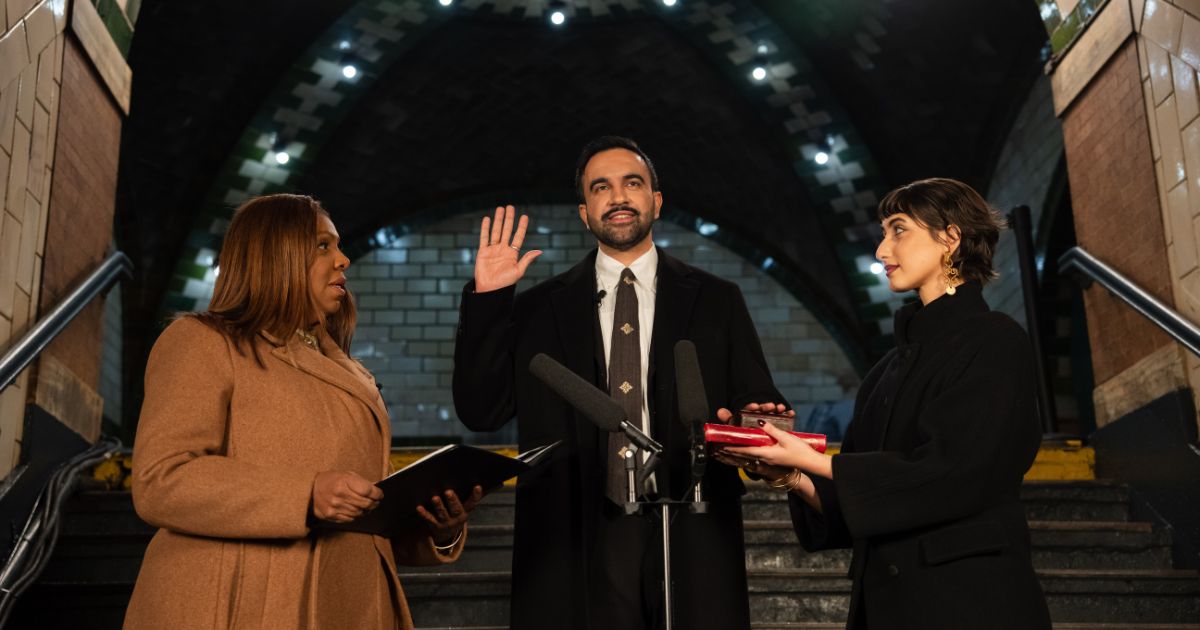
With a single sentence at his New Year’s Day inauguration, New York City Mayor Zohran Mamdani managed to confirm the very fears his defenders spent months dismissing.
Mamdani, sworn in on a trio of Qurans, covered a litany of topics in his inauguration speech, with none of it especially surprising given his past rhetoric.
(Well, perhaps it was a tad surprising that the mask came off so quickly on day one, but I digress.)
Amid all the platitudes, however, one line stood out, and for a very good reason:
MAYOR MAMDANI: “We will replace the frigidity of rugged individualism with the warmth of collectivism.” pic.twitter.com/3LIOVHdKSy
— Fox News (@FoxNews) January 1, 2026
“We will replace the frigidity of rugged individualism with the warmth of collectivism,” Mamdani said.
Promising to replace “the frigidity of rugged individualism with the warmth of collectivism,” Mamdani didn’t just offer a governing philosophy — he took direct aim at one of the most foundational ideas in the American experiment.
Individualism isn’t some cold abstraction to be discarded; it’s the engine that built the country, the city, and the freedoms Mamdani now governs under.
Individual exceptionalism isn’t a fringe philosophy or a dated slogan — it’s woven into the fabric of American identity itself.
From the founding documents to the frontier spirit, the United States was built on the radical idea that individuals possess inherent worth, agency, and the right to chart their own course.
Innovation, prosperity, and upward mobility didn’t emerge from centralized planning or collective mandates, but from millions of individuals taking risks, pursuing ambition, and refusing to be flattened into sameness.
Meanwhile, collectivism — and whatever euphemisms are wrapped around it — has always demanded the same tradeoff: the subordination of the individual to the system.
Whether branded as socialism, communism, or “shared responsibility,” it relies on centralized power deciding outcomes that individuals once shaped for themselves.
History proffers no illusions on this point: collectivist systems do not produce warmth or equity, but stagnation, coercion, and dependency.
When the state becomes the primary engine of purpose and provision, personal initiative withers, and freedom becomes conditional.
More troubling is what Mamdani’s rhetoric signals about where he intends to take the nation’s largest city. Critics warned that his rise would usher socialism into New York’s government, and this line reads less like reassurance than confirmation.
When a mayor openly frames individualism as a flaw to be corrected, it’s no longer paranoid to ask what policies will follow.
It also rings hollow when, as The New York Post pointed out, Mamdani’s wife appeared to be wearing $630 boots:
Socialist Zohran Mamdani’s wife Rama Duwaji appears to wear luxury $630 boots to swearing in ceremony https://t.co/ohy0HVeByC pic.twitter.com/W9GuciHdhS
— New York Post (@nypost) January 1, 2026
Shouldn’t every comrade get $630 boots under Mamdani’s communist worldview? I think we all know the answer to that.
Of course, this wasn’t the only remark that raised a few eyebrows:
Mamdani: For too long, those fluent in the good grammar of civility have deployed decorum to mask agendas of cruelty pic.twitter.com/EAqgWmBPci
— Acyn (@Acyn) January 1, 2026
In a pitch to differentiate himself from his predecessors, Mamdani said, “For too long, those fluent in the good grammar of civility have deployed decorum to mask agendas of cruelty.”
That remark is thick with irony given that Mamdani sold himself in the lead-up to the New York City election with his “good grammar” and “deployed decorum.” After all, it’s not like he had a proven government track record to sell himself on.
In the end, Mamdani’s inauguration ultimately felt like an ominous preview.
When a mayor openly scorns individualism, praises collectivism, and does so beneath luxury trappings that betray the message, voters are right to question what comes next.
New York City didn’t stumble into historic greatness by surrendering itself to the collective. It was built through grit, ambition, and personal agency.
If Mamdani intends to govern by dismantling those principles, he shouldn’t be surprised when he runs headfirst into resistance — because in America’s largest city, and in America itself, individual exceptionalism is not a flaw to be corrected, but a virtue worth defending.

Advertise with The Western Journal and reach millions of highly engaged readers, while supporting our work. Advertise Today.