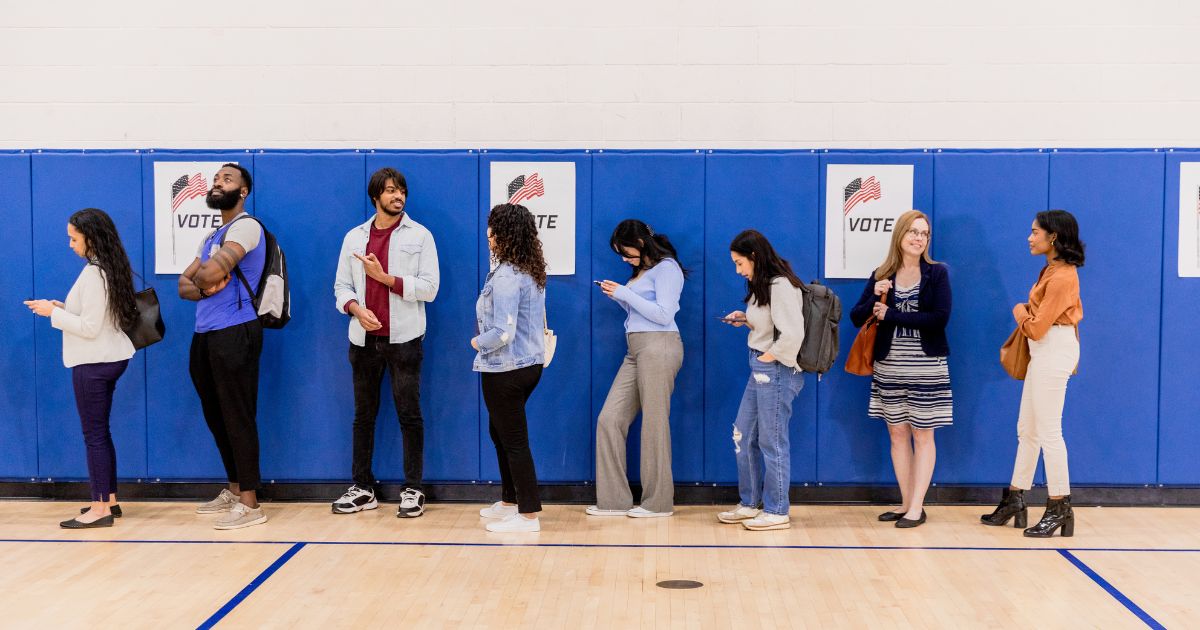
Young Americans are increasingly turning away from the traditional two‑party system in Washington, signaling a broader generational shift in political trust and identity.
A recent poll by the Institute of Politics at Harvard Kennedy School confirmed deepening frustration among those between 18 and 29 across economic, social, and political dimensions.
“Young Americans hold persistently low views of national leadership, reflecting a belief that political leaders are not responsive to the economic and technological pressures they face,” the poll said.
Just 13 percent of respondents said the United States is headed in the right direction; a majority — 57 percent — said they believe things are off on the wrong track.
Financial strain looms large. The poll found 43 percent of young adults describe themselves as “struggling or getting by,” a burden particularly heavy among black and Hispanic respondents and those without a college degree.
The sense of instability extends to economic expectations: only 30 percent believe they will be better off financially than their parents.
This economic unease seems to feed into broader political alienation. Young respondents rated both major parties rather poorly.
According to the poll, when asked to describe each party with one word, 58 percent used negative terms for Democrats (most commonly “weak”), while 56 percent used negative terms for Republicans (most commonly “corrupt”). In contrast, only 16 percent (for Democrats) and 17 percent (for Republicans) offered positive descriptions.
Approval ratings reflect this dissatisfaction. In the most recent survey, approval for congressional Democrats among young adults was just 27 percent, with congressional Republicans right behind at 26 percent.
(Which could lead to some interesting 2026 midterm dynamics.)
The poll’s authors summarized the findings bluntly: young Americans feel that the systems and institutions meant to support them “no longer feel stable, fair, or responsive.”
That sentiment reflects not disengagement, but a generation that feels unheard — pressed by economic stress, shaken by technological change such as artificial intelligence, and skeptical of institutions that once promised stability.
The ambivalence toward both parties suggests that younger voters are not simply shifting from one side to the other. Rather, many appear to be disengaging from the bipartisan model altogether.
Even as the Democrats maintain a nominal lead among registered young voters for control of Congress, the support appears rooted more in relative disaffection than enthusiasm.
For many in Gen Z, the traditional labels of Democrat and Republican are losing meaning — replaced instead by uncertainty, distrust, and a desire for alternatives.
Whether this disillusionment will translate into third‑party growth, independent voting blocs, or generational activism remains unclear.
But the message from young Americans is unmistakable: they are fed up with a duopoly that, in their eyes, has failed to deliver stability, fairness, or a credible path forward.
If political leaders hope to win their trust — and their votes — they’ll need more than rhetoric. They’ll need to show results that actually meet that generation’s uncertain expectations.

Advertise with The Western Journal and reach millions of highly engaged readers, while supporting our work. Advertise Today.