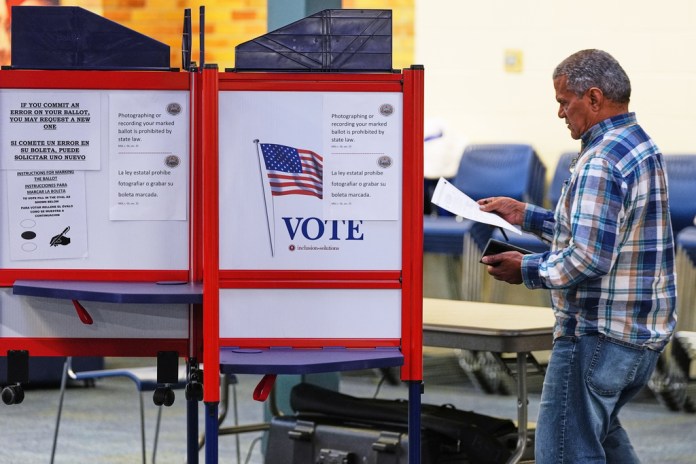
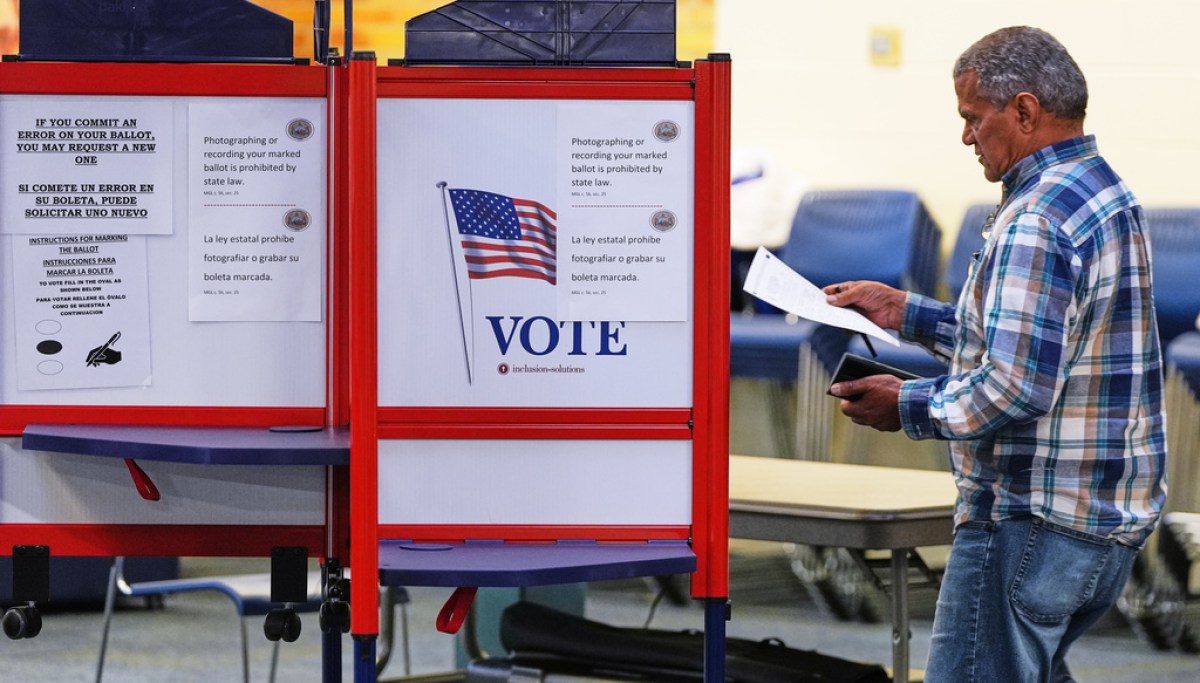
Democratic opponents of the Safeguard American Voter Eligibility Act, also known as the SAVE America Act, have deployed dubious arguments against the latest version of the federal election integrity law.
In its third iteration, the “new and improved” SAVE America Act, which would require both proof of United States citizenship at the time of voter registration and physical identification when casting a ballot, passed the House this week despite scant Democratic support.
Only one House Democrat joined the GOP in advancing the nationwide voter ID bill, designed to prevent foreigners from infiltrating the U.S. election process.
As the SAVE America Act now heads to the Senate, Democrats are deploying some of the same fear-mongering rhetoric about voter suppression that they pushed previously in past fights over Republican-led election reform, though those predictions fell flat once put to the test at the ballot box.
Their most recent claims, also hyperbolic or reliant on far-fetched scenarios, similarly fail to survive basic scrutiny.
No place to photocopy
Some critics of the SAVE America Act, such as Vice President Kamala Harris, have argued that certain voters cannot possibly photocopy their identification documents due to a supposed dearth of photocopy services.
In a 2021 interview that recently went viral on social media, Harris publicly opposed voter ID legislation because she said it would be “almost impossible” for Americans living in remote areas to make photocopies of their ID cards.
“You’re going to have to Xerox or photocopy your ID to send it in to prove you are who you are,” Harris told BET News. “Well, there are a whole lot of people, especially people who live in rural communities, [where] there are no Kinko’s, there’s no Office Max near them.”
Kinko’s no longer exists. It was bought by FedEx in 2006 and operated subsequently as FedEx Office. By 2019, FedEx Office was offering photocopy services at 2,000 locations across the country — and it is far from the only place where customers today can make copies of their documents.
Thousands of places providing photocopy services, whether commercial or self-service, currently exist in the U.S. In fact, on-the-spot photocopying is accessible in every state.
Photocopy machines are widely available at more than 5,300 UPS Store locations, 831 Staples sites, 9,207 public libraries, and over 4,700 CVS stores across the country.
REPUBLICANS LOOK TO USHER THROUGH VOTER ID LEGISLATION FOR THIRD TIME WITH SAVE AMERICA ACT
Furthermore, the vast majority of voters would not even need to provide photocopies under the SAVE America Act, and would only need to do so in instances where they vote by absentee ballot.
In most cases, residents registering to vote can simply show their passport, or other government-issued ID displaying a U.S. birthplace, at their Department of Motor Vehicles office. While voting, U.S. citizens need only present “a tangible (not digital)” document bearing their photograph and citizenship status.
Voters unable to appear in person at the polling place on Election Day must include a copy of their photo ID with requests for and submissions of an absentee ballot. But the measure making its way through Congress takes these rural, shut-in, and disabled voters into account.
A subsection of the SAVE America Act, titled “ACCESSIBILITY,” would require each state to ensure that voters casting a ballot by mail have access to “reasonable accommodations,” such as scanning and printing services, for submitting the mail-in forms.
‘Jim Crow 2.0’ voter suppression
Democratic leadership is also likening the SAVE America Act to racist Jim Crow-era legislation, warning without evidence that the 2026 bill will likewise work to suppress the black vote.
In a social media statement, Senate Minority Leader Chuck Schumer (D-NY) claimed that the bill would disenfranchise millions of black voters.
“The SAVE Act is nothing more than Jim Crow 2.0,” said Schumer, declaring, “Every single Senate Democrat will vote against any bill that contains it,” after Republicans initially sought to include it in a funding package.
However, legislation containing voter ID requirements has actually proven to increase voter turnout, including among black Americans.
REMEMBER DEMOCRATS’ LIES ABOUT GEORGIA VOTER SUPPRESSION?
Following the passage of Georgia’s Election Integrity Act of 2021, or S.B. 202, the state smashed turnout records in the 2022 midterms, breaking the 2 million voter mark during the general election’s early-voting window.
S.B. 202 expanded the number of early voting days in Georgia, and voters accordingly took advantage of the lengthened early-voting period at a record pace, the George State Secretary’s Office reported at the time.
The number of votes cast on Day One of early voting surged to nearly twice the figures recorded in 2018.
That year, Georgia witnessed unprecedented voter turnout across the board. In the 2022 primaries, the state saw a 212% jump in early voting above 2020, the last presidential primary year.
Many of the early voters were black, an outcome which the Black Voters Matter Fund celebrated.
“Voter turnout in Georgia reached historic highs on the first day of early voting in this midterm election, and Black Voters comprised 35% of all those who turned out to vote,” the BLM organization, composed of voting rights activists, touted at the time.
Notably, many black-majority countries, like Haiti and Jamaica, have their own voter ID laws. And the long list of African nations that enforce ID-based voter eligibility regulations include Kenya, Niger, Chad, Burkina Faso, Botswana, Mali, Mauritania, Ghana, South Africa, and Senegal.
Impedes women from registering to vote
Democrats are characterizing Republican attempts to tighten registration requirements as an affront to women’s suffrage, renewing allegations that requiring supporting documentation of U.S. citizenship would somehow infringe on the voting rights of married women all over America who have legally changed their maiden name.
Progressives say that if women’s names upon marriage do not match the surnames on their birth certificates, they will be deprived of the right to vote.
Proof of citizenship, however, is not limited to birth certificates, according to the SAVE America Act. The bill’s proposed language stipulates that a valid driver’s license indicating citizenship; a U.S. passport; military ID; or official photo identification from a federal, state, local, or tribal government showing one’s place of birth was within the U.S. are all acceptable forms of documentary proof at the registration booth.
In the absence of the other options, only then are registrants supposed to produce photo ID paired with a birth certificate to satisfy the SAVE America Act’s requirements.
NO ONE IS BUYING THE DEMOCRATS’ GENDER WAR ATTACKS ON VOTER ID AND THE SAVE ACT
If someone’s supporting documents do not match their birth name because they got married, divorced, were adopted, or changed their name for any number of reasons, the SAVE America Act would compel states to create a fallback process for people in those specific predicaments.
Under guidance from the Federal Election Assistance Commission, each state will have to establish a safety net system in which applicants are allowed to sign a sworn affidavit attesting to their U.S. citizenship and submit “other evidence” to a local election official demonstrating such.
Although the bill does not explicitly spell out what “other evidence” entails, it could include records explaining mismatched or missing paperwork that help bridge gaps in identity confirmation.
The last time the SAVE America Act was up for consideration, House Republicans specified that the bill does not rule out letting married women use a combination of documents to account for any discrepancies due to name changes.
A 2025 study from the University of Maryland found that only 2% of voting-eligible Americans do not possess documentary proof of citizenship and another 7% who do have proof cannot easily access it.
The researchers defined “easy access” as being able to readily retrieve the document within 24 hours, restricted by situations such as if a birth certificate is in another state, lost, held by a family member, or locked away in a filing system.