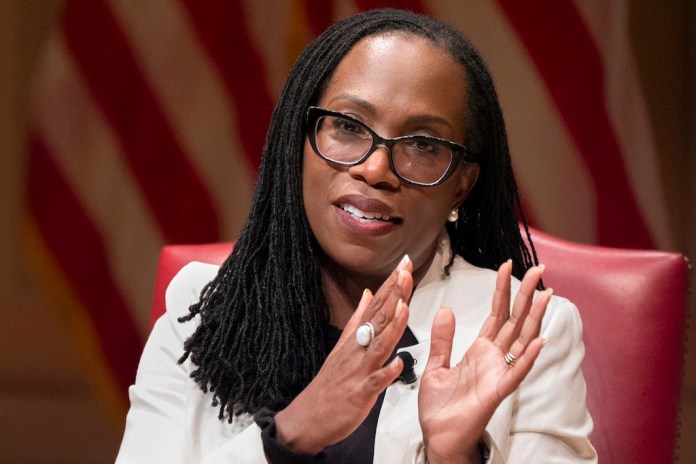
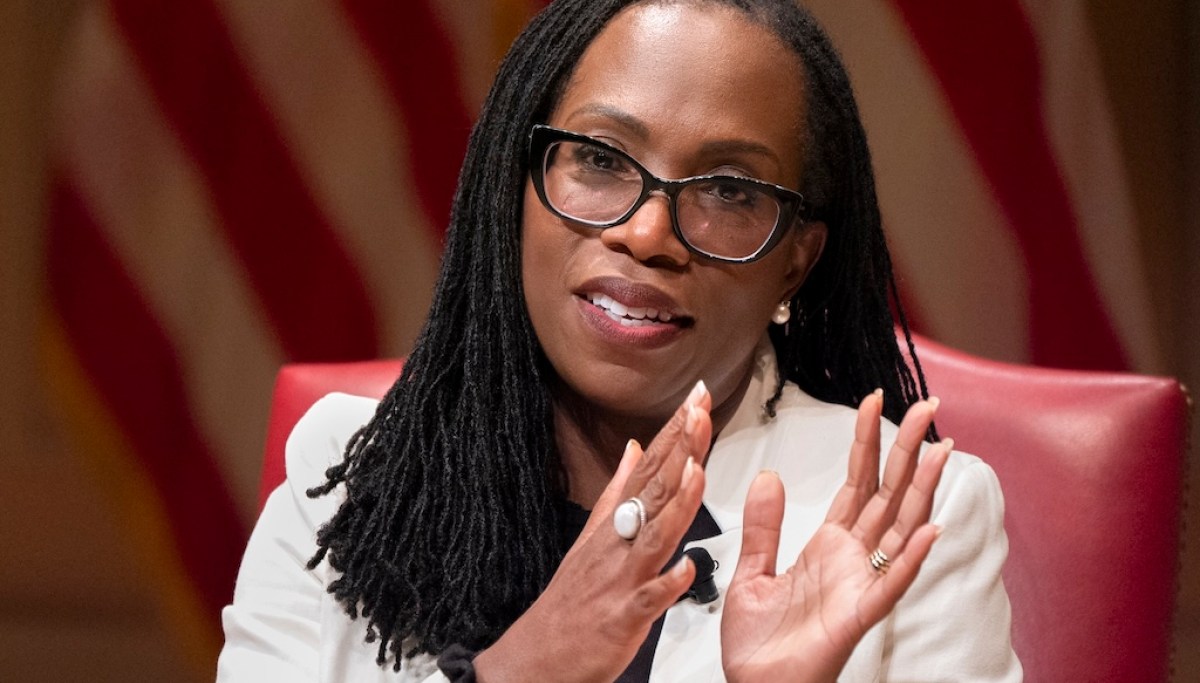
Justice Ketanji Brown Jackson accused the Republican National Committee on Monday of asking the Supreme Court to legislate from the bench by striking down late-arriving mail ballot laws, rather than having Congress or individual states pass laws ending mail ballot collection on Election Day.
The justices heard arguments in Watson v. RNC, where they weighed whether federal law setting Election Day preempts a Mississippi law allowing mail ballots postmarked by Election Day to be counted even if they arrive up to five days late. When RNC lawyer Paul Clement was being questioned by the justices over his argument that federal law indeed forbids the counting of late-arriving ballots, Jackson questioned why lawmakers in Congress were drafting legislation to foreclose those state laws if existing federal law already does so.
“My colleagues have looked at or talked about Congress legislating in this area,” Jackson said. “They are obviously aware that there are states that are doing this. And they have not spoken to it. They have not specifically precluded it. Now, you say that maybe that’s because they assumed that Election Day in the federal statutes that we’re examining from 100 years ago does the work.”
“But Congress is today considering an election-related statute that would specifically prohibit this, which means that Congress probably didn’t understand its existing legislation to do this,” Jackson added, referring to Rep. Bryan Steil’s (R-WI) Make Elections Great Again Act.
Clement claimed the introduction of that bill in Congress was likely because lawmakers are unsure of how the high court will side in this case and want to push a policy that ends late-arriving mail ballots. Jackson responded by claiming the RNC was asking the high court to do Congress’s job of setting election law.
“The worry is that you want this court to decide the case rather than have Congress do it,” Jackson said.
Clement rejected that assertion by Jackson, saying that regardless of how the justices rule in this case, Congress can always pass a new law reversing the finding because the Supreme Court is presently just interpreting whether existing law preempts state late mail ballot laws.
“However this court decides this case, Congress has the power to revisit it,” Clement said. “That’s, I think, common ground among the parties.”
SUPREME COURT WORRIED THAT COUNTING LATE MAIL BALLOTS COULD UNDERMINE CONCEPT OF ‘ELECTION DAY’
During oral arguments, a majority of the justices appeared deeply skeptical of the legality of Mississippi’s law and the implications it could have beyond late-arriving mail ballots. If the high court strikes down the Mississippi law, it could have implications for 13 other states and the District of Columbia, which have similar laws on the books.
The Supreme Court is expected to rule in the pivotal election case by the end of June, months ahead of the midterm elections in November. During the current term, the justices have heard several election-related cases, including on candidates’ ability to sue over election laws, campaign finance laws, and race-based congressional redistricting.