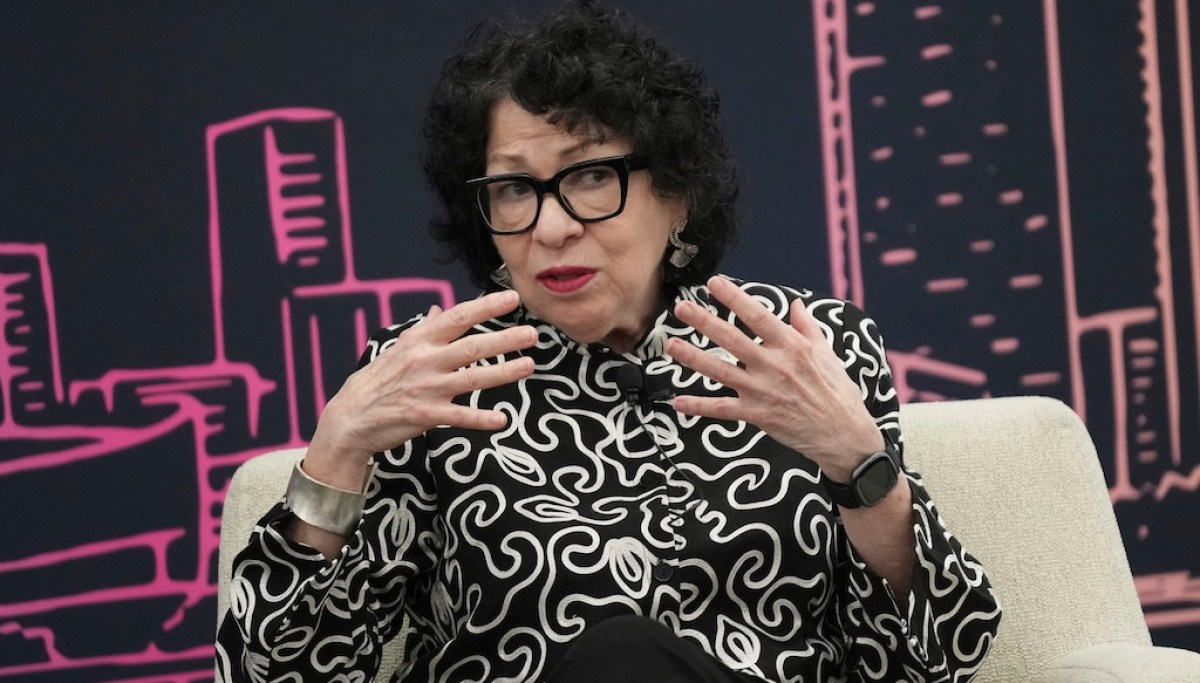
Justice Sonia Sotomayor sharply questioned lawyers on Tuesday over why a Hawaii law that preemptively bars gun owners from carrying their weapon on private property should be struck down, as the Supreme Court heard arguments in the high-profile gun rights case.
During oral arguments in Wolford v. Lopez, Sotomayor pressed lawyer Alan Beck, who argued on behalf of the gun owners suing over the 2023 Hawaii law, over where gun owners’ rights begin and property owners’ rights end. Sotomayor began her questioning by asking why gun owners should have a presumptive right to carry their weapons on private property.
“So you say that there is a right to enter private property with a gun without an owner’s express or implicit consent. The answer has to be simply, no,” Sotomayor said.
The justice then asked Beck whether people have an inherent right to enter private property without permission, or if doing so would be considered trespassing.
“So if we start from there, then I start from the simple proposition. You want to say that there’s a custom that permits you to go on private property without the owner’s express consent, correct?” Sotomayor asked.
Beck responded to Sotomayor’s questioning by arguing that many of the rulings she cited dealt with closed private properties, such as homes, rather than open-facing private property, such as stores.
Sotomayor also questioned Beck on the lack of a historical tradition of carrying firearms in Hawaii, to which he responded that for the constitutionality of gun laws, the national tradition, not local customs, is what courts should examine. Under the standard set by the high court’s landmark 2022 ruling in New York Rifle & Pistol Association v. Bruen, gun laws must conform with the history and tradition of the country’s firearm regulations.
Hawaii’s Act 52, enacted in 2023, bans handgun owners who have a concealed carry permit from bringing their weapon onto private property unless the owner or manager has given the person “express authorization to carry a firearm on the property.”
In their argument that history supports the legality of the state’s ban, Hawaii officials pointed in part to the black codes, a set of racist laws enacted by southern states after the Civil War that were intended to strip rights from black citizens, while acknowledging those laws are “undoubtedly a relic of a shameful portion of American history.”
Justice Ketanji Brown Jackson asked Principal Deputy Solicitor General Sarah Harris, who argued for the Justice Department in support of the coalition of gun owners, why the black codes should not be considered in the history and tradition of the country’s gun laws. Harris responded by arguing that the black codes were unconstitutional from “the moment of their inception,” but Jackson questioned that assertion.
“They were not deemed unconstitutional at the time that they were enacted,” Jackson said to Harris. “They were part of the history and tradition of the country. And when we have a test now that’s asking us to look at what people were doing back then. I don’t understand why they should be excluded.”
Harris pushed back by saying that the Bruen standard calls for outliers in the country’s history to be tossed from consideration, and she argued that the black codes are clearly outliers in the country’s gun laws.
“I can think of no greater outlier than blatantly unconstitutional laws that flipped, what had been the tradition in states like Louisiana and during the period before those states were readmitted to the Union, for the purpose of trying to reduce newly freed slaves back to conditions of servitude, made a new crime, new trespass, in order to go about armed on private property,” Harris said.
“Those are obvious outliers that should not count under the whole point of Bruen,” she added.
The conservative majority on the Supreme Court appeared likely to side with the gun owners challenging the constitutionality of the Hawaii law, with most justices sharply questioning Hawaii’s Act 52.
HAWAII GUN CASE AT SUPREME COURT PITS GUN RIGHTS AGAINST PRIVATE PROPERTY LAWS
The Supreme Court is expected to issue a ruling in the key gun case by the end of June. Next month, the high court will hear another high-profile gun rights case, which could affect the gun rights of marijuana users, with United States v. Hemani.
The high court will have one more oral argument session this month, when it hears arguments in President Donald Trump’s bid to fire Federal Reserve governor Lisa Cook on Wednesday.