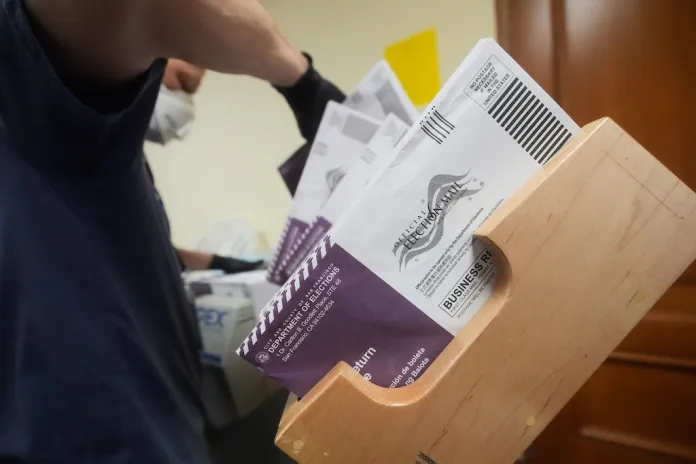
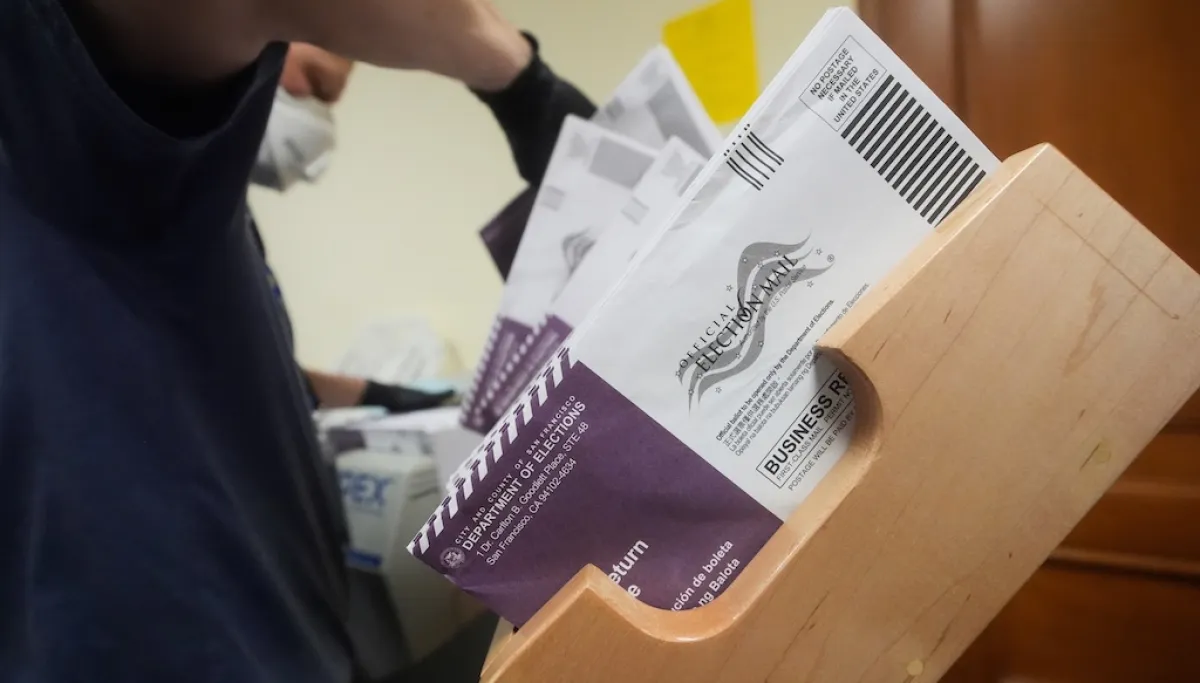
The Republican National Committee asked the Supreme Court to hear a case over Pennsylvania’s law requiring mail ballots to be dated by the voter, warning that an appeals court ruling that struck down the law continues a dangerous precedent of courts intervening in election rulemaking.
The RNC will be before the high court next month, when it argues in Watson v. RNC over the legality of laws that allow states to count mail-in ballots that arrive after Election Day. It also filed a petition to the Supreme Court this week, asking the justices to take up its challenge to an appeals court ruling over another mail ballot law in Pennsylvania, this one requiring voters to write the correct date on their mail-in ballot for the state to count it. The U.S. Court of Appeals for the Third Circuit ruled last year that the law did “not pass constitutional muster,” leading the GOP to appeal to the high court.
“The panel declared unconstitutional perhaps the least burdensome voting rule imaginable: Pennsylvania’s requirement that voters who choose the convenience of mail voting write a date in a specified field on the ballot-return envelope,” the RNC said in its petition.
“This decision continues the alarming trend of courts wielding the so-called Anderson-Burdick framework to anoint themselves, rather than state legislatures, as the ‘bear[ers of] primary responsibility for setting election rules,’” the petition continued.
The RNC argued that the Anderson-Burdick framework, a combination of two prior Supreme Court rulings that outline how courts should look at balancing the interests of the state with the burden an election law imposes on the voter, was misapplied in a vague manner that would leave virtually any voting rule vulnerable to being struck down.
“If that holding is left uncorrected, no voting or ballot-casting rule will be safe from open-ended, standardless federal judicial review—and even invalidation. No burden on voters will be too minimal to escape the federal courts’ notice, and every state interest must be supported by evidence sufficient to satisfy federal judges,” the RNC said in its petition.
“State legislatures will have no latitude to innovate with new voting regimes, including those that make voting easier,” the petition continued.
The RNC also warned that the third circuit ruling “upends the Constitution’s careful balance between States’ authority to regulate elections and the right to vote,” by giving a political victory to people who “lost in the political arena” while also eroding public confidence in elections.
The Supreme Court has already taken up multiple election-related cases this term, including those regarding candidates’ ability to sue over state election laws, campaign finance laws, mail ballot deadlines, and race-based redistricting.
RNC TELLS SUPREME COURT TO STRIKE DOWN LATE-ARRIVING BALLOT LAWS
Of the four election-related cases this term, the high court has already heard three, with the fourth — Watson v. RNC — scheduled for next month. The high court has issued only one ruling in the quartet of cases, ruling in Bost v. Illinois Board of Elections that candidates have an inherent ability to challenge state election laws that police their elections.
The Supreme Court will decide whether to take up the RNC’s latest petition in the coming months, but if it does, the case would likely not be decided until their next term, after the midterm election. In November, voters in Pennsylvania will elect various officers, including the governor and members of Congress.