
–>
February 24, 2023
Here I sit, a middle-aged academic who lived and studies war, suffering daily from wounds received in a battle that has long since been forgotten, struggling to make sense of the West’s strategy in Ukraine. What are we doing? Are we waging a proxy war simply to bleed Russian military resources with the bodies of Ukrainian warriors? Do our leaders really have no understanding of the Ukrainian and Russian people and their long, distinguished history of strategic “stubbornness”? What about the Russian Federation’s brutal effectiveness in Chechnya, Georgia, and Syria? Are our leaders, particularly our military commanders, lacking strategic empathy, the ability to disassociate from oneself and assume the “mind of the other”? The evidence suggests that they are.
‘); googletag.cmd.push(function () { googletag.display(‘div-gpt-ad-1609268089992-0’); }); }
Recently, Chairmen of the Joint Chiefs Gen. Mark Milley declared that Russia has “lost strategically, operationally, and tactically” in Ukraine. This, quite simply, is bombast, borderline propaganda, possibly even rising to the level of disinformation. We are continually led to believe that it is only a matter of months until the whole Russian Army collapses. Almost a year ago, some of our political leaders, military strategists, and media pundits were wildly making claims that Russian President Vladimir Putin’s reign would end due to his “special military operation.” There were even allusions that Putin was near death.
The West’s sanctions, we were told, would cripple the Russian economy, forcing Putin to his knees. The ruble would crash as it did when the Soviet Union disintegrated. The backbone of the Russian economy, its fossil fuel production, would be crushed under the weight of a united West. There was no way that Russia could sustain its invasion given that it was isolated from American and European industry and technology. A year ago, it would have been absurd for someone to advance the idea that Iran, a terrorist regime under strict Western sanctions for almost 50 years, would provide Russia with military technology used to fight in Ukraine.
The American people have heard these fantastical declarations before. Just a few short years ago, American generals annually testified before Congress that it was only a matter of time before Iraq and Afghanistan would be “pacified,” the insurgencies defeated. One more surge, just a few more resources, only a couple more thousand troops, and then, yes, the entire insurgency would effectively cease to exist!
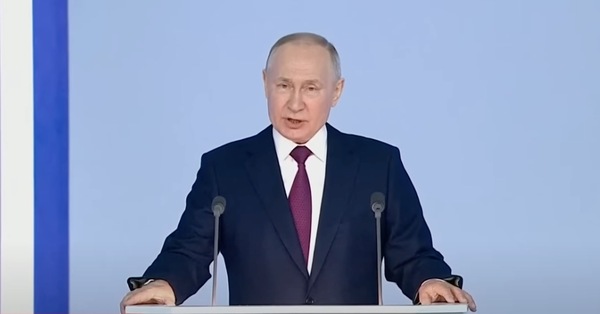
Image: Vladimir Putin. YouTube screen grab.
‘); googletag.cmd.push(function () { googletag.display(‘div-gpt-ad-1609270365559-0’); }); }
It is time to strip away the puffery from the generals and our so-called strategic “experts.” First, we must acknowledge that Russia will continue to wage this war for years. To the Russians, they have already been fighting for close to ten years, since 2014. The invasion last February was merely a new phase in an ongoing war.
Unlike the American military, Russian military doctrine and strategic thinking recognize, account for, and embrace the possibility of decades-long military engagements that transition between periods of high-intensity combat operations and low-intensity, population-centric police actions. Chechnya, South Ossetia, Transnistria, and Syria are all examples of such practices.
Second, Russia’s strategic objectives are fluid and will change according to the conditions on the ground. Western intelligence agencies are still trying to understand why Putin decided to move on Kyiv in 2022, especially because it appeared he was winning on all fronts beforehand. Whatever the reason, Putin’s generals were able to recognize their failed strategy, disengage tens of thousands of troops, and redeploy them to prosecute campaigns in the south and east.
Similarly, Ukraine’s eastern-marching offensive several months ago showed that Russian forces were willing to accept tactical and operational defeat to maintain a strategic foothold in Donetsk and Luhansk. Unofficial reports on the ground indicate that Russian soldiers initially withdrew immediately, without much of a fight. This, however, changed when the Ukrainians ran into successive Russian defensive lines that were prepared well in advance.
Furthermore, the West is completely unsure as to what Putin’s grand vision is for Ukraine. Is the goal to take the entire country? Is it to consolidate the annexed territory in the east? Is it to crush Ukraine’s military capacity to render it harmless to Russian interests? Is it to depose the Zelensky government and install one friendly to Russia? Is it to keep NATO from accepting Ukraine as a treaty partner? Is it all of them? Is it a combination of them?
Most likely, Putin’s own inner circle is asking the same questions. The answer lies somewhere in the broad category of “yes, no, perhaps, maybe so.” Traditionally, Russians are pragmatists, willing to trade short-term losses in the hope that the weight of their efforts will ultimately prevail. Ardant du Picq, the famed French tactician who died in 1870 during the Franco-Prussian War, described this phenomenon as “that inertia of the Russians which is called tenacity.” The Russian military’s embrace of long-duration conflict indicates the continued presence of such thinking.
‘); googletag.cmd.push(function () { googletag.display(‘div-gpt-ad-1609268078422-0’); }); } if (publir_show_ads) { document.write(“
Third, there is a constant, unrelenting echo that Russia’s military is incompetent. There is little doubt that its tactical performance has been lackluster at best. Russia’s initial invasion plan was based on faulty intelligence and the overconfidence of braggadocios generals. This is quite typical of the Russian military. It is why improving military success in the “initial period of war” was a continuing theme throughout their military journals from 2010 onwards. They are learning, adapting, and prosecuting their war, according to their timeline, not ours.
The constant relief of Russian generals for failing is an organizational strength, not a weakness. The battlefield deaths of senior officers indicate a willingness to share in the danger of combat with their soldiers, something the troops admire. In the end, however, the Russian military’s strategic acumen and stubborn resolve are the most deadly.
I have seen the destruction of war, the mangled bodies of the dead and the dying, and the shattered souls of those touched by its cold embrace. I continue to bury my brothers who succumbed to the wounds they received almost 20 years ago. We, the warfighters, believed that our commanders’ strategies in Iraq and Afghanistan were rooted in a deep understanding of our enemy. Victory was always only one more battle away. As the recent past demonstrates, those strategies were built on flawed assumptions that, ultimately, led to perpetual, never-ending conflict.
The West’s unwillingness to acknowledge these “Russian” realities will only lead to failures like Iraq and Afghanistan. Here, once again, we are supporting a brave people, fighting for their homeland while lying to ourselves about the adversary. Real people—men, women, and children—are dying by the thousands. The Ukrainian fighting soldiers, those who are being maimed and killed, deserve an honest, clearheaded assessment of the situation. It is, without a doubt, a moral imperative that we craft a coherent strategy focused on ending this war on terms that both sides can live with. Unfortunately, as of this writing, our only strategy is to bleed the Russians through an unending blood sacrifice of Ukrainians.
Dr. Earl J. Catagnus Jr. is currently an instructor of security and risk analysis at Penn State Brandywine, and was previously a visiting professor in the Department of Military Strategy, Planning, and Operations at the U.S. Army War College. He is also a combat wounded former U.S. Marine scout/sniper section leader who fought in the Second Battle of Fallujah.
<!– if(page_width_onload <= 479) { document.write("
“); googletag.cmd.push(function() { googletag.display(‘div-gpt-ad-1345489840937-4’); }); } –> If you experience technical problems, please write to [email protected]
FOLLOW US ON
<!–
–>
<!– _qoptions={ qacct:”p-9bKF-NgTuSFM6″ };  –> <!—-> <!– var addthis_share = { email_template: “new_template” } –>