(function(d, s, id) { var js, fjs = d.getElementsByTagName(s)[0]; if (d.getElementById(id)) return; js = d.createElement(s); js.id = id; js.src = “https://connect.facebook.net/en_US/sdk.js#xfbml=1&version=v3.0”; fjs.parentNode.insertBefore(js, fjs); }(document, ‘script’, ‘facebook-jssdk’)); –>
–>
January 14, 2024
In the wake of the Hamas-Israel conflict and its aftermath, major university presidents have demonstrated a willingness — or notable reticence — to speak out amid the anger expressed by faculty, students, alumni, and donors. The perfect storm of campus unrest has brought forth a new national debate — namely, how can universities support free speech principles during the current turbulent times and beyond?
‘); googletag.cmd.push(function () { googletag.display(‘div-gpt-ad-1609268089992-0’); }); document.write(”); googletag.cmd.push(function() { googletag.pubads().addEventListener(‘slotRenderEnded’, function(event) { if (event.slot.getSlotElementId() == “div-hre-Americanthinker—New-3028”) { googletag.display(“div-hre-Americanthinker—New-3028”); } }); }); }
Renewed interest is being focused on the 1967 Kalven Report at the University of Chicago, which was updated in a 2014 report there by a Committee on Freedom of Expression chaired by Geoffrey R. Stone, the Edward H. Levi Distinguished Service Professor of Law.
Professor Stone is one the nation’s pre-eminent First Amendment scholars, and also a former university provost. He has a unique vantage point for both the theory and practice of setting workable free speech boundaries on college campuses. In 2021, we discussed critical ideas that now are receiving increased attention. Our conversation is especially useful to consider amid today’s headlines. It can help illuminate a pathway toward restoring free inquiry and free speech throughout higher education — articulating principles that are being tested almost daily as new expressive landmines appear.
Brotman: Let’s talk about free speech in schools, including universities. I know you have been central in shaping thinking in this area obviously, chairing the committee at the University of Chicago, building upon the work of one of your influencers, Harry Kalven, who had authored a major report in this area a few decades earlier. What is your thinking about how the First Amendment does or doesn’t apply in the university context?
‘); googletag.cmd.push(function () { googletag.display(‘div-gpt-ad-1609270365559-0’); }); document.write(”); googletag.cmd.push(function() { googletag.pubads().addEventListener(‘slotRenderEnded’, function(event) { if (event.slot.getSlotElementId() == “div-hre-Americanthinker—New-3035”) { googletag.display(“div-hre-Americanthinker—New-3035”); } }); }); }
Stone: First of all, it’s important to understand that the First Amendment applies only to public institutions. The First Amendment applies to the University of California or the University of Illinois, which are public institutions, but it does not apply to the University of Chicago or Harvard or Stanford, which are private institutions.
The First Amendment has no impact on the decision making or autonomy of a private institution. So it’s important to draw that distinction at the outset. On the other hand, even private universities should aspire to promoting free and open discourse and the questioning and challenging of ideas. This is accepted wisdom for the intellectual life of universities, in much the same way as the values embodied in the First Amendment have come to be understood over time.
That’s not true, by the way, for all entities. Private corporations, for example, don’t have the same values and aspirations as a university.
But at the core of a university is the search for truth. At the core of the university is the mission of seeking knowledge, seeking wisdom, seeking insights that give us a better understanding of our society, of science, and of culture.
In the same way that Justices Holmes and Brandeis argued that virtually unfettered speech helps to achieve truth in the political arena, the best way to achieve truth in the academic arena is not to have censorship but to have a broad and robust freedom of debate and discussion and dis- agreement. So even in private universities, there should be a commitment to free expression that is very similar to what the First Amendment itself imposes on government entities.
What that means is that the institution should not suppress the opportunity for students and faculty and other members of the university community to explore ideas in ways that enable them to advocate for what they see as wisdom, and to challenge what others may believe to be wisdom and truth and facts in order to seek greater knowledge. That’s the absolute core of the mission of a university, and it’s very much at the core of the mission of the University of Chicago in particular, which from its very founding has been a leader in the pursuit of those values.
‘); googletag.cmd.push(function () { googletag.display(‘div-gpt-ad-1609268078422-0’); }); document.write(”); googletag.cmd.push(function() { googletag.pubads().addEventListener(‘slotRenderEnded’, function(event) { if (event.slot.getSlotElementId() == “div-hre-Americanthinker—New-3027”) { googletag.display(“div-hre-Americanthinker—New-3027”); } }); }); } if (publir_show_ads) { document.write(“
Brotman: Let’s begin with the Kalven Report.
Stone: In 1967, the president of the University of Chicago, Edward Levi, appointed Harry Kalven to chair a committee to look at the extent to which a university should itself adopt positions on matters of public pol- icy. This was during the height of the Vietnam War, and a large part of the issue was whether universities should weigh in on whether the Vietnam War being a good or bad thing. I must say, at roughly that time, I was arguing as a student in college, and later as a student at the University of Chicago law school, that colleges and universities should take positions opposing the Vietnam War. I was wrong about that but I believed that was true. I was within my rights to advocate for it but it was the wrong position.
Brotman: And now?
Stone: I came to understand the Kalven Report, which was written at that time, took the position that the University of Chicago should not weigh in on matters of public policy, unless those issues directly affect the university itself. But on matters of general public policy, if the university takes positions, it would have a serious chilling effect on the willingness of faculty and students to take positions that are in opposition to what the university has declared to be “the right position.” Therefore, the university should be extremely cautious about taking formal positions on matters of public policy.
I chaired the University of Chicago committee on free speech fifty years later. It had to do with the fact that at that time, at colleges and universities across the nation, it was increasingly the case that students and faculty members were demanding that universities disinvite speakers, or that speakers who had been invited should be silenced because the views that they would express would be opposed by the students or faculty as wrongheaded, inappropriate, and offensive. The challenge for universities was (and still is) to figure out whether certain speakers should or should not be invited, or invited and then silenced because members of the community oppose their views.
Brotman: What were the Stone Report’s conclusions?
Stone: The University of Chicago adopted a statement that is three pages long. The first half of it discussed the history of the University of Chicago and gave examples of its own commitment to a robust protection of free speech.
Then the second part of it articulated an approach to free speech that basically says that free and open discourse is essential to the values and aspirations of a university and that a university therefore should not prohibit members of the community from inviting speakers who express views that others may find offensive.
Indeed, the report explained, it is the responsibility of the university affirmatively to protect the rights of students and faculty and other com- munity members to speak themselves, or to invite speakers who would express views that others might find offensive. It should encourage students to listen to those views and to respond to the merits, to debate and to challenge those views if they disagree with them, but not to try to silence them, not to try to disrupt them or to prevent them from having their say.
Brotman: How has this been received?
Stone: Interestingly, we wrote that report specifically for the University of Chicago. But several universities, beginning with Princeton, recognized that they could lop off the first half of the report, which talked about the history of the University of Chicago, and then adopt the second half of the report, which discussed about the central principles. There now are some eighty colleges and universities across the country that have adopted what has come to be called the Chicago Principles. This is the standard that many institutions of higher education now embrace.
Brotman: And public universities?
Stone: Public universities have a different situation, because they are governed by the First Amendment. They do not have the freedom that a private university has, in theory, to reject those principles. So public universities have to conform strictly to what the First Amendment demands of them.
For the most part, that’s what the Chicago Principles articulate: a public university, under the First Amendment, is responsible for allowing the expression by students, by faculty, and by visitors who are invited of views that may be disturbing or offensive to other members of the community, because they are subject to the basic principles of the First Amendment.
Brotman: How might this be limited in practice?
Stone: The commitment to free expression doesn’t mean that in the classroom in, say, a mathematics course, a student can start giving a speech about politics. There are constraints on the time, place, and manner of speech, which are permissible even, as illustrated by my example, on the content of speech in narrow circumstances, like the classroom.
Similarly, a commitment to free expression doesn’t mean that professors cannot grade student papers or exams, based upon what the professor views as the wisdom or the excellence of the ideas that are being expressed.
The academic mission has within it a responsibility to teach and to evaluate scholarship. In so doing, one tries not to be ideological or political, but obviously the university and its faculty have to make judgments about who to hire, who to promote, which students get A’s and which students get B’s, and so on.
But in the realm of public discourse in the university, the notion that the university, or its students or faculty, should have the authority to silence
others because they don’t like the views being expressed is incompatible with the First Amendment in a public university and incompatible with the core values and aspirations of a private university as well.
Brotman: California treats public and private universities the same, right?
Stone: The state of California has apparently said there’s no real distinction between a public university and a private university in this respect. Private universities have to act in accordance with the same standards that would apply in a public university.
Now this raises an interesting problem, because the private university has First Amendment rights to decide for itself what speech it wants or doesn’t want to allow. A private university that seeks to achieve the goals and aspirations that I believe are essential to a true, well-functioning academic institution would itself choose to aspire to the same values that the First Amendment would apply to it.
But they don’t have to do that. They have a First Amendment right to decide for themselves who they are. So I think government laws that try to impose on private institutions obligations to comport with what the First Amendment would impose upon public institutions are making very difficult and delicate judgments about the academic freedom of a private institution.
Brotman: You seem firmly committed to the principle that universities should be silent when necessary.
Stone: Yes, I think the Kalven Report notion that universities themselves should not take official positions on political or other debates on public issues that do not directly affect the university is the proper stance. Because once a university goes down that road, it’s very hard to say when to stop. Universities that declare certain ideas to be right or wrong will deter students and faculty members from challenging those ideas in a way that they should be free to do. It is simply not the business of a university to declare that abortion is wrong or that Trump was a bad president or that the war in Vietnam was a mistake. It is simply not the role of the university to take such positions except when such issues are directly related to the core functioning of the university itself.
It’s not that I don’t think there are right or wrong positions. But I don’t think universities should take them, because they produce a chilling effect on the willingness of their students and their faculty to take counter positions. That’s a dangerous thing in terms of the larger aspirations of a university community.
Stuart N. Brotman is the Alvin and Sally Professor of Media Law, Enterprise, and Leadership at the University of Tennessee, Knoxville. The conversation excerpt with Professor Geoffrey R. Stone is from Stuart N. Brotman, The First Amendment Lives On (University of Missouri Press, 2022).

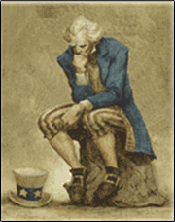
Image: Pezibear via Pixabay, Pixabay License.
<!–
–>
<!– if(page_width_onload <= 479) { document.write("
“); googletag.cmd.push(function() { googletag.display(‘div-gpt-ad-1345489840937-4’); }); } –> If you experience technical problems, please write to [email protected]
FOLLOW US ON
<!–
–>
<!– _qoptions={ qacct:”p-9bKF-NgTuSFM6″ };  –> <!—-> <!– var addthis_share = { email_template: “new_template” } –>