(function(d, s, id) { var js, fjs = d.getElementsByTagName(s)[0]; if (d.getElementById(id)) return; js = d.createElement(s); js.id = id; js.src = “https://connect.facebook.net/en_US/sdk.js#xfbml=1&version=v3.0”; fjs.parentNode.insertBefore(js, fjs); }(document, ‘script’, ‘facebook-jssdk’)); –>
–>
September 30, 2023
The New York Times and the Washington Post have long been considered America’s journalistic icons, ably representing the professionalism and integrity of their calling, and deserving their places on the Olympic media peak. I often praised and quoted them in my writings, and not because they published good stories with nice photos about me, members of my family, and our business, but because they deserved it.
‘); googletag.cmd.push(function () { googletag.display(‘div-gpt-ad-1609268089992-0’); }); document.write(”); googletag.cmd.push(function() { googletag.pubads().addEventListener(‘slotRenderEnded’, function(event) { if (event.slot.getSlotElementId() == “div-hre-Americanthinker—New-3028”) { googletag.display(“div-hre-Americanthinker—New-3028”); } }); }); }
But The Post and The Times have changed, and one can only argue about when the process of their degradation began. Historically, both papers have represented the Democrats and the left, causing much Republican criticism. As examples, Republicans during Reagan’s day called them “Pravda on the Hudson” and “Pravda on the Potomac,” respectively, but this name-calling was mostly a humorous jab.
Things changed dramatically after Donald Trump announced his first White House bid in the 2016 election. Journalistic integrity and responsible reporting were thrown into the toilet and replaced by overwhelmingly fake news and stories. Trump must be defeated, and all means were justified in achieving that goal, including Hillary Clinton’s grotesque “Russiagate” campaign to depict Trump as Vladimir Putin’s stooge.
When Trump won despite this onslaught, the whole of the Democrat machinery, including the NYT and the WaPo, was mobilized to destroy his presidency, together with his intention to turn U.S.-Russia relations from confrontation to cooperation.
‘); googletag.cmd.push(function () { googletag.display(‘div-gpt-ad-1609270365559-0’); }); document.write(”); googletag.cmd.push(function() { googletag.pubads().addEventListener(‘slotRenderEnded’, function(event) { if (event.slot.getSlotElementId() == “div-hre-Americanthinker—New-3035”) { googletag.display(“div-hre-Americanthinker—New-3035”); } }); }); }
The American and Russian presidents’ joint statement:
The “Spirit of the Elbe” is an example of how our countries can put aside differences, build trust, and cooperate in pursuit of a greater cause. As we work today to confront the most important challenges of the 21st century, we pay tribute to the valor and courage of all those who fought together to defeat fascism. Their heroic feat will never be forgotten.
Had Trump succeeded, there would be no war in Ukraine and no threat of nuclear WW3, but both papers even supported Antony Blinken’s operation to blame the Hunter Biden “laptop from hell” story on Russia, helping Biden to win the 2020 election and taking us one step closer to war with Biden’s rejection of Russia’s December 2021 proposals for mutual security guarantees. The key point in these proposals was a neutral status for Ukraine, with no membership in any military blocs, including NATO. Biden had until February 23, 2022 to agree on this deal, but he rejected Russia’s proposals. Here again, both the NYT and the WaPo applauded this approach.
Below are relevant quotes from their top columnists, Thomas Friedman and David Ignatius, whom I often quoted and applauded in my Washington Times and other columns back in the late ’90s, when many of us still hoped for new, brighter, and mutually beneficial relations between the United States and post-communist Russia.
When the first round of NATO expansion began in 1998, Friedman interviewed one of the most distinguished American diplomats, George Kennan, who called NATO expansion a fatal foreign policy mistake:
‘It shows so little understanding of Russian history and Soviet history. Of course, there is going to be a bad reaction from Russia, and then [the NATO expanders] will say that we always told you that is how the Russians are — but this is just wrong.’
‘); googletag.cmd.push(function () { googletag.display(‘div-gpt-ad-1609268078422-0’); }); document.write(”); googletag.cmd.push(function() { googletag.pubads().addEventListener(‘slotRenderEnded’, function(event) { if (event.slot.getSlotElementId() == “div-hre-Americanthinker—New-3027”) { googletag.display(“div-hre-Americanthinker—New-3027”); } }); }); } if (publir_show_ads) { document.write(“
And this is what Friedman is saying now:
Back in the early 1990s, I opposed NATO expansion after the fall of the Berlin Wall because I thought our priority should be trying to nurture a democratic Russia. … Now, 30 years later, though, when the prospects for a democratic Russia feel utterly remote, I would gladly use NATO and the E.U. to nurture and secure a democratic Ukraine.”
As for the WaPo’s David Ignatius, here is what he said in his article “Who Robbed Russia?” back in 1999, where he highlighted some of the most damning revelations of the multi-billion-dollar robbery of Russia with the help of the Federal Reserve Bank of New York and with the acquiescence of the Clinton administration:
By allowing the oligarchs — in the name of the free market — to grab Russia’s resources and siphon anything of value into their own offshore bank accounts, the United States poisoned Russia’s transition from communism. … What makes the Russian case so sad is that the Clinton administration may have squandered one of the most precious assets imaginable — which is the idealism and goodwill of the Russian people as they emerged from 70 years of Communist rule. The Russia debacle may haunt us for generations.
These 18 months of war have been a strategic windfall, at relatively low cost (other than for the Ukrainians). The West’s most reckless antagonist has been rocked. NATO has grown much stronger with the additions of Sweden and Finland. Germany has weaned itself from dependence on Russian energy and, in many ways, rediscovered its sense of values. NATO squabbles make headlines, but overall, this has been a triumphal summer for the alliance.
Of course, both the NYT and the WaPo just follow the voices of Lindsey Graham, Mitch McConnell, Mitt Romney, Polish president Andrzej Duda, and many others, including president Zelensky of Ukraine, who openly declare their desire to use Ukrainians as cheap cannon fodder for their geostrategic goals of defeating Russia, a country whose people and leaders from Gorbachev to Putin offered friendship, cooperation, and even alliance to America, only to be rebuffed in the name of a unipolar world order under U.S. hegemony.
I think it would be appropriate to conclude with a quote from Luke 23:34-35: “And Jesus said, ‘Father, forgive them; for they know not what they do.'”
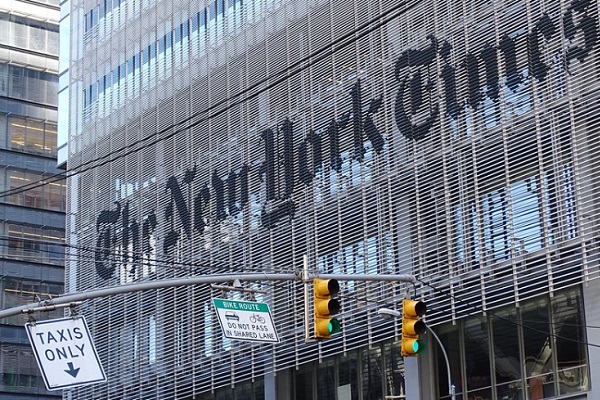
Image: Adam Jones via Flickr, CC BY 2.0 (cropped).
<!–
–>
<!– if(page_width_onload <= 479) { document.write("
“); googletag.cmd.push(function() { googletag.display(‘div-gpt-ad-1345489840937-4’); }); } –> If you experience technical problems, please write to [email protected]
FOLLOW US ON
<!–
–>
<!– _qoptions={ qacct:”p-9bKF-NgTuSFM6″ };  –> <!—-> <!– var addthis_share = { email_template: “new_template” } –>