Federal law states that it is “unlawful for a Federal contractor” to “make, either directly or indirectly, any contribution or expenditure of money or other thing of value … to any political party, committee, or candidate for Federal office or to any person for any political purpose or use.”
Despite this prohibition, a Washington Examiner analysis of campaign finance and procurement records identified several federal contractors, many of them major corporations, that may have run afoul of this law in 2025. The prohibition on federal contributions from firms contracting with the federal government exists to combat impropriety in the procurement process or any appearance thereof.
Among the firms identified by the Washington Examiner that made contributions to national political committees while holding active federal contracts, either directly or through one of their corporate arms, were United Healthcare Services, Chevron, Coinbase, Atmos Energy Corporation, General Motors, Google, L3Harris Technologies, and Tenet Healthcare Corporation. These contractors cut checks to the Congressional Leadership Fund, Make America Great Again Inc., the Center Forward Committee, House Majority PAC, the Rolling Sea Action Fund, the federal account of the Democratic Lieutenant Governors Association, the National Republican Senatorial Committee, Atmos Energy Corporation PAC, and the Lincoln Project.
“At the federal level, it is not all that uncommon for government contractors to make illegal campaign contributions to political committees, especially to super PACs,” Craig Holman, a veteran campaign finance lobbyist working for Public Citizen, told the Washington Examiner. “Many contractors view the lack of enforcement and very narrow interpretations of the law by the Federal Election Commission as an open invitation to violate the spirit if not the letter of the law.”
Holman is right that much of the money donated by contractors this year went to super PACs and that the FEC has historically been reluctant to enforce the law.
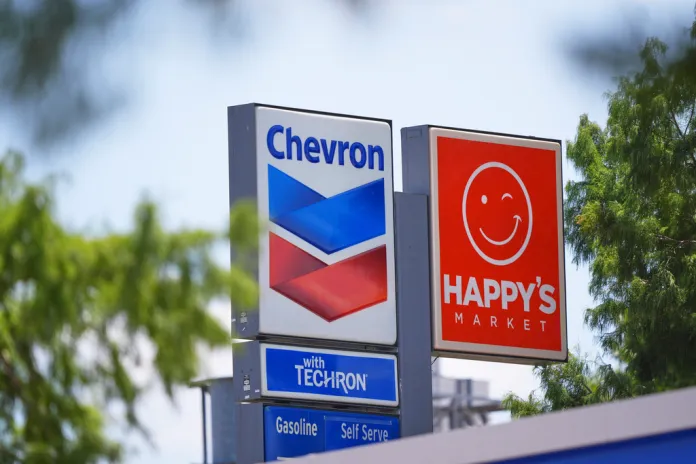
Coinbase, which procurement records show is under contract to provide cryptocurrency services to the U.S. Marshals Service, contributed just over $1 million spread across the GOP’s Congressional Leadership Fund, the Democratic House Majority PAC, and the Rolling Sea Action Fund while that contract was active. Chevron, meanwhile, donated $100,000 to the Center Forward Committee, a centrist super PAC, while having millions of dollars in contracts to provide the Department of War with aviation fuel.
“I have filed formal complaints with the FEC against some contractors for violating the law, the most recent being against Chevron,” Holman told the Washington Examiner. “Chevron produced a very weak defense that was widely repudiated by state enforcement authorities that enforce state pay-to-play laws, but warmly accepted by the FEC: that one division of Chevron owned the government contracts, while another division of Chevron made the campaign contributions. The FEC bought this line of reasoning hook, line, and sinker despite being repudiated by such enforcement agencies as the Connecticut Elections Enforcement Commission and the mayor of Philadelphia.”
Past high-profile apparent defections from the law, as Holman suggests, could be explained by the fact that the FEC has historically been reluctant to enforce the prohibition on donations from federal contractors and that, when the law is carried out, the penalty is typically a relatively small fine.
“This distinction without a real difference essentially guts the law,” Robert Weissman, co-president of Public Citizen, said of the FEC’s 2014 Chevron decision. “Any business can establish legally distinct entities, and then have the parent corporation dole out campaign cash with the hope of winning government contracts, while its subsidiary takes in those contracts. Public officials with influence over government contracts are unlikely to miss the relationship between the source of the contributions and the company seeking the contract.”
United Healthcare Services, in an instance similar to the Chevron case, donated $5 million to MAGA Inc., President Donald Trump’s main super PAC, on Jan. 9, while procurement documents show it had an active federal contract worth nearly $10 million to provide “vision insurance administrative services.” A source close to United Healthcare explained that both the campaign finance and procurement records name “United Healthcare Services” because it is the payment processor for the corporation, and that the donation was made by a different arm of the company than the one holding the contract.
Press reports indicate that the FEC first enforced the ban against super PAC contributions in 2017 when the Suffolk Construction Company gave $200,000 to the liberal super PAC Priorities USA Action while bidding on and carrying out federal contracts for the U.S. Army Corps of Engineers. The FEC ultimately fined the firm $34,000 for the infraction. Enforcement increased considerably during the Biden administration.
Since then, transparency advocates such as the Campaign Legal Center, Public Citizen, and Citizens for Responsibility and Ethics in Washington have pointed to reams of federal contractor donations and called for government action. Enforcement is currently stalled because the FEC lacks a quorum.
Federal law does not prohibit employees of federal contractors from making contributions to national political committees, only the firms themselves. Corporations that don’t have federal contracts and aren’t otherwise prohibited from spending on U.S. campaigns are free to pour unlimited funds into super PACs.
Additionally, the Democratic Lieutenant Governors Association reported that a number of federal contractors had cut it five-figure checks this year. Among these were Archer Daniels Midland, HNTB Corporation, Pfizer, and r4 Technologies. While the federal law in question states that it “does not apply to contributions or expenditures in connection with State or local elections,” the DLGA has a history of making transfers to national political committees in addition to its spending on state races, according to campaign finance records.
A spokesperson for r4 Technologies told the Washington Examiner that the DLGA erroneously placed its contribution into an account that could be used for federal expenditures.
“r4 Technologies has received and acknowledged correspondence from the Democratic Lieutenant Governors Association (DLGA) recognizing that their contribution was made specifically for local/state outreach,” the spokesperson said. “r4 never anticipated or was aware that it could be used for federal outreach. The DLGA has moved the contribution to an administrative 527 account that does not spend on elections. This will be reflected in their year-end report on 1/31/26.”
The DLGA did not respond to a request for comment. It is unclear if the PAC made the same mistake with its other corporate contributions.
McKinsey & Company also made a contribution to the DLGA, but, similar to the Chevron case mentioned by Holman, made the contribution with one corporate arm while fulfilling federal contracts with another. A source close to McKinsey told the Washington Examiner that the $25,000 it provided constituted an event sponsorship.
A third instance, AMD’s $1 million donation to MAGA Inc., which was followed by a $1 billion supercomputer and AI partnership with the Department of Energy, illustrates how gaps in public knowledge can make enforcement difficult. It is unclear if AMD was negotiating this partnership with the federal government at the time of its donation to the pro-Trump super PAC.
Opponents of the ban on federal contractor donations have argued in the past that it violates the First Amendment by restricting the political activities of businesses. A court disagreed with this argument in 2015, upholding the restrictions on the grounds that the FEC’s desire to achieve “protection against quid pro quo corruption and its appearance” was sufficient justification to limit the rights of corporations.
The Washington Examiner reached out to the firms mentioned in this piece for comment.