Authored by Lance Roberts via RealInvestmentAdvice.com,
Overly optimistic investor expectations of market returns may be a problem. To wit:
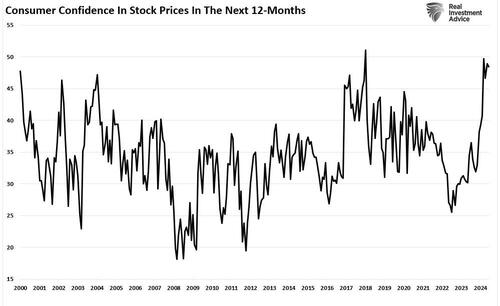
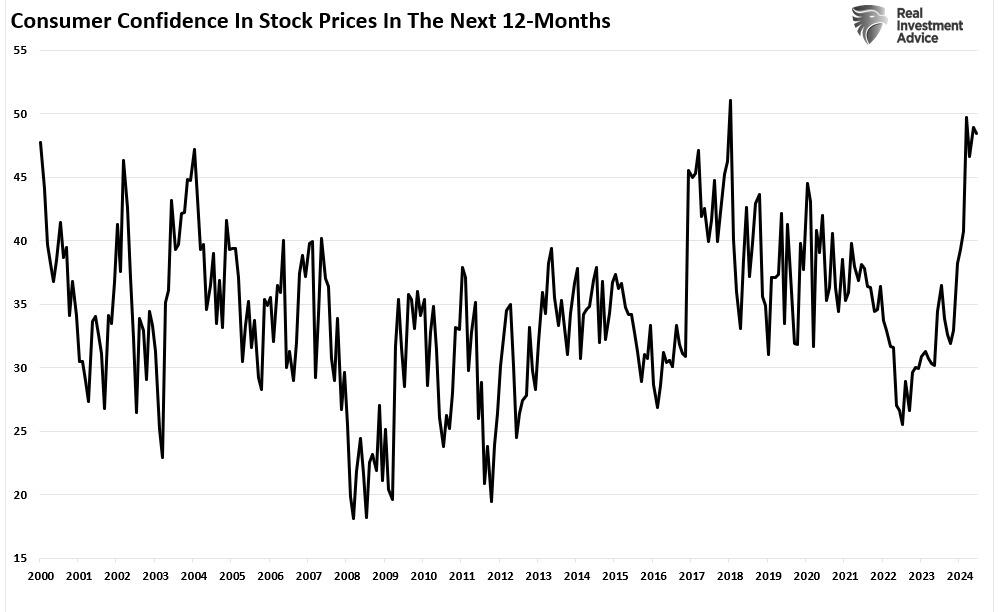
“While consumers are not very confident about the economy, they are highly optimistic about the stock market. In that same consumer confidence report from the Conference Board, the expectations for rising stock prices over the next 12 months are near the highest on record.“
Of course, after a decade of 12% returns, why should they not be optimistic that the future will be much the same as the past? A good example came from a recent discussion with an individual wanting me to review the “financial plan” for their retirement goals. The plan was generated by one of the many “off the shelf” software packages that take all the inputs of income, assets, pensions, social security, etc., and then spits out assumptions of future asset values and drawdowns in retirement.
The problem is that the return assumptions were grossly flawed.
In the vast majority of these plans, the optimistic assumption is that individuals will have a rate of return of somewhere between 6-10% annually heading into retirement and 4-8% thereafter. The first major flaw in the plan is the “compounding” of annual returns over time, which does NOT happen.
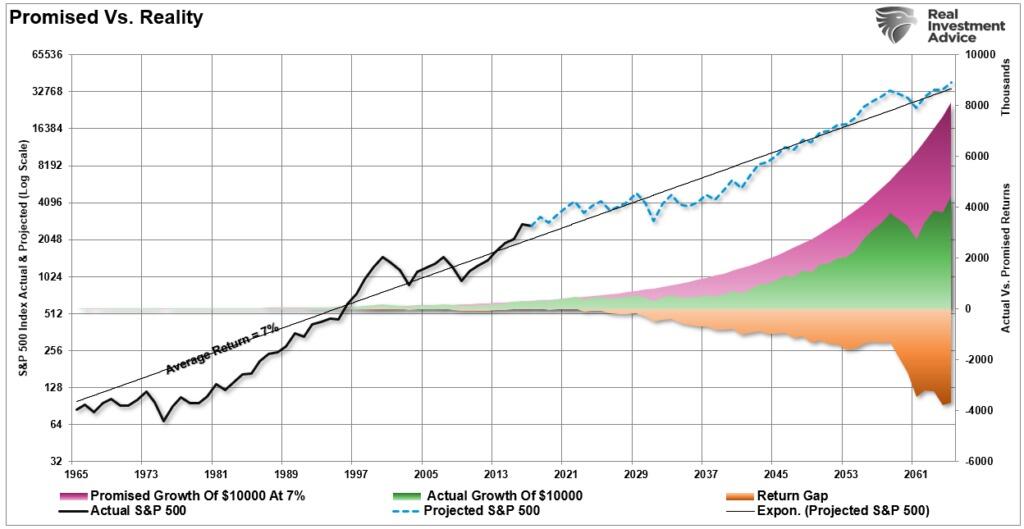
“There is a massive difference between AVERAGE and ACTUAL returns on invested capital. Thus, in any given year, the impact of losses destroys the annualized “compounding” effect of money.
The chart below shows the difference between “actual” investment returns and “average” returns over time. See the problem? The purple-shaded area and the market price graph show “average” returns of 7% annually. However, the return gap in “actual returns,” due to periods of capital destruction, is quite significant.”
The second and most important is the future expectation of individual returns over the next 10-20 years.
This second point is what I want to address today.
There are two main reasons why returns over the next decade or two are currently overestimated. The first is a “you problem,” and the second is “math.”
It’s A You Problem
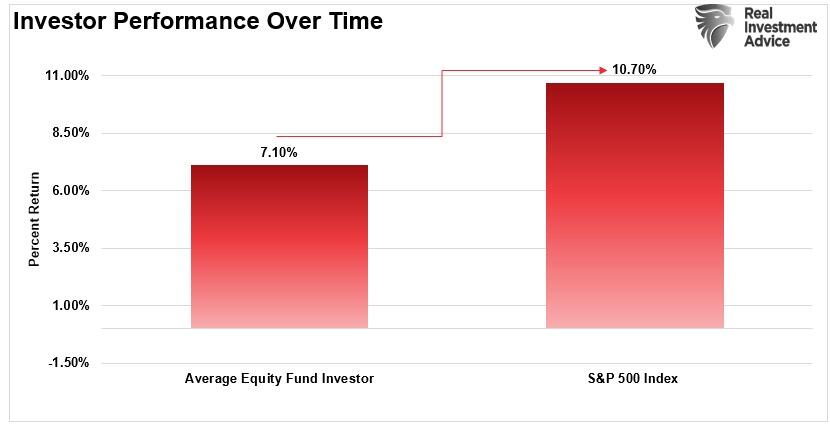
Back in 2016, I wrote an article discussing a Dalbar investor study explaining why investors consistently “suck” at investing. As I detailed in that article, one of the biggest impediments to achieving long-term investment returns is the impact of emotionally driven investment mistakes.
Investor psychology helps us to understand the thoughts and actions that lead to poor decision-making. That psychology drives the “buy high/sell low” syndrome and the traps, triggers, and misconceptions that lead to irrational mistakes that reduce returns over time.
As the Dalbar study showed, nine distinct behaviors impede optimistic investors based on their personal experiences and unique personalities.
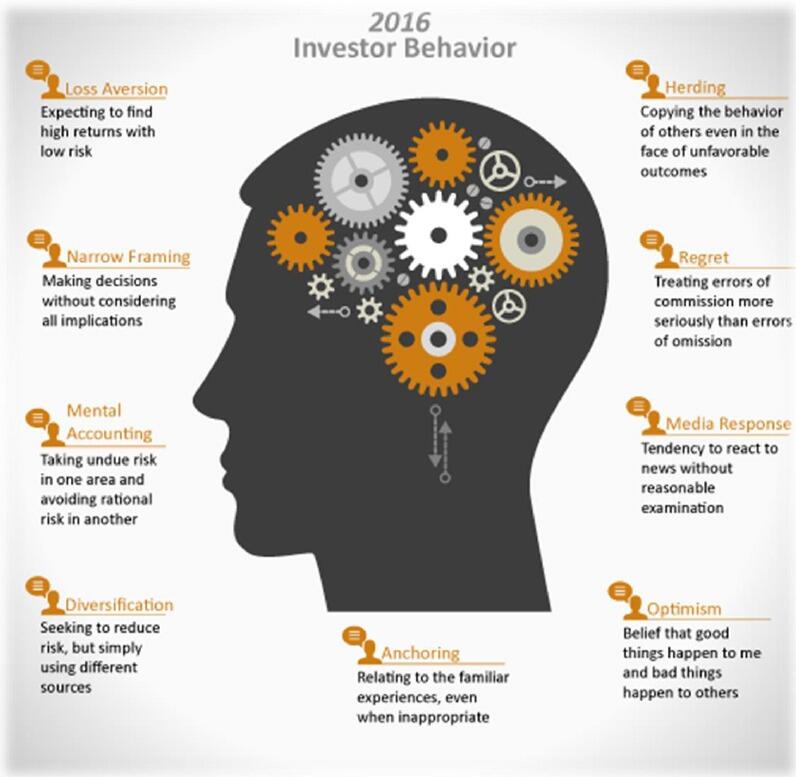
The most significant problems for individuals are the “herding effect” and “loss aversion.”
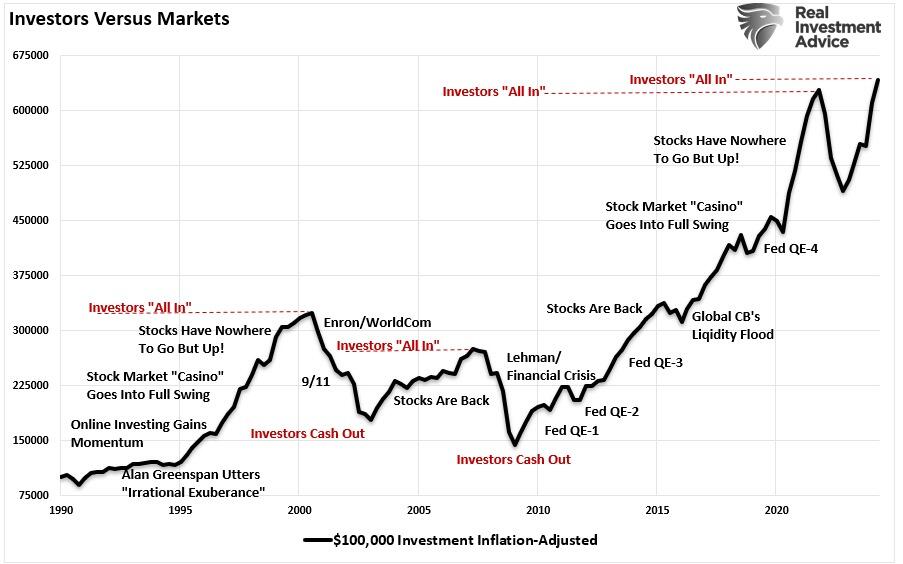
These two behaviors tend to function together compounding the issues of investor mistakes over time. As markets are rising, individuals are optimistic the current price trend will continue to last for an indefinite period. The longer the rising trend last, the more ingrained that optimistic belief becomes until the last of “holdouts” finally “buys in” as the financial markets evolve into a “euphoric state.”
As the markets decline, there is a slow realization that “this decline” is something more than a “buy the dip”opportunity. As losses mount, the anxiety of loss begins to mount until individuals seek to “avert further loss” by selling.
As shown in the chart below, this behavioral trend runs counter-intuitive to the “buy low/sell high” investment rule.”
“In the end, we are just human. Despite the best of our intentions, it is nearly impossible for an individual to be devoid of the emotional biases that inevitably lead to poor investment decision-making over time. This is why all great investors have strict investment disciplines that they follow to reduce the impact of human emotions.
More importantly, despite studies that show that “buy and hold,” and “passive indexing” strategies, do indeed work over very long periods of time; the reality is that few will ever survive the downturns in order to see the benefits.”
The impact of these emotionally driven mistakes leads to long-term underperformance below those “goal-based” financial projections.
It’s Just Math
“But Lance, the markets has returned 10% on average over the last century, so I will probably be okay.”
True. If you can contract “vampirism,” avoid sunlight, garlic, and crosses, you can live long enough to achieve the “average annual rate of return” over the last 124 years.
For the rest of us mere mortals, and why “duration matching” is crucial, we only have between today and retirement to reach our goals. For the majority of us – that is about 15 years.
And therein lies the problem.
Despite much of the commentary that continues to suggest we are in a long-term secular bull market, the math suggests something substantially different. However, it is essential to understand that when low future rates of return are discussed, it does not mean that each year will be low, but the return for the entire period will be low.
The charts below show the 10- and 20-year rolling REAL, inflation-adjusted returns for the markets compared to trailing valuations.
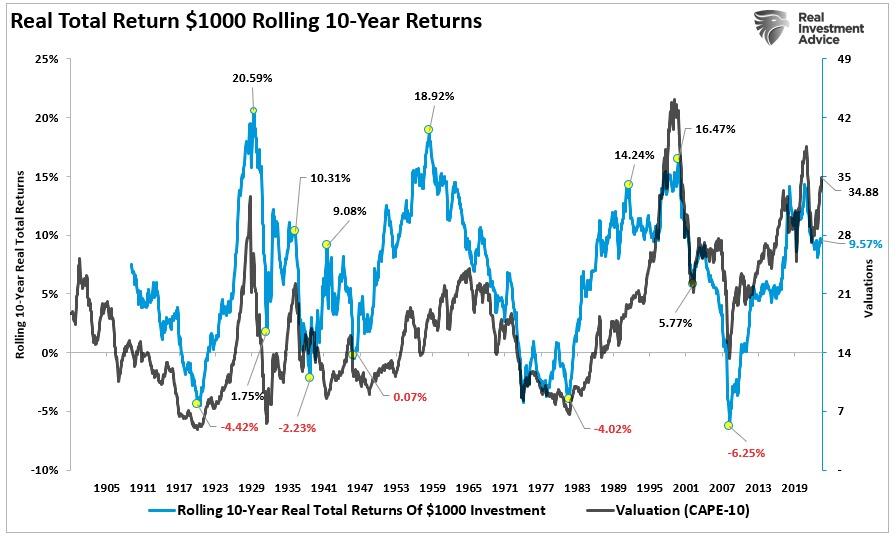
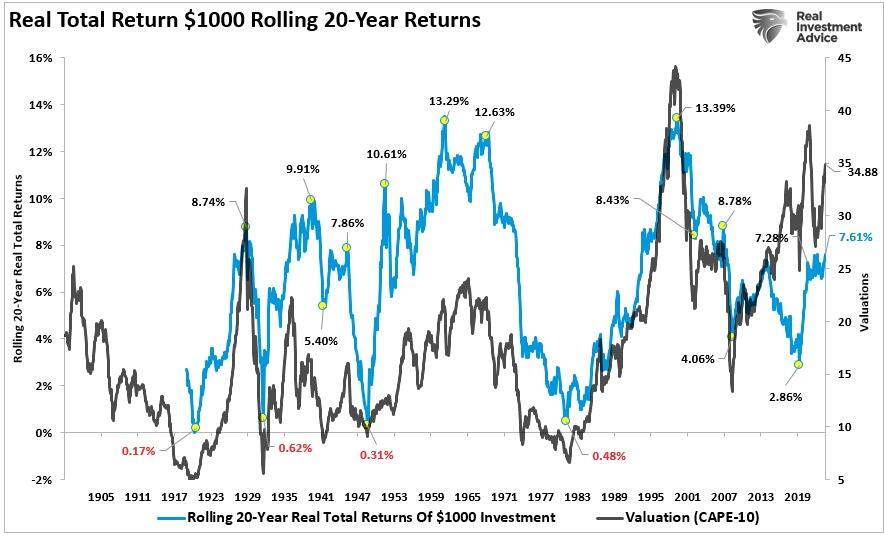
(Important note: Many advisors/analysts often pen that the market has never had a 10 or 20-year negative return. That is only nominal and should be disregarded as inflation must be included in the debate.)
There are two crucial points to take away from the data. First, there are several periods throughout history where market returns were near zero and negative. Secondly, the periods of low returns follow periods of excessive market valuations. Such suggests that betting “This time is not different” may not work well.
As David Leonhardt noted previously:
“The classic 1934 textbook ‘Security Analysis’ – by Benjamin Graham, a mentor to Warren Buffett, and David Dodd – urged investors to compare stock prices to earnings over ‘not less than five years, preferably seven or ten years.’ Ten years is enough time for the economy to go in and out of recession. It’s enough time for faddish theories about new paradigms to come and go.”
History shows that valuations above 23x earnings have tended to denote secular bull market peaks. Conversely, valuations at 7x earnings or less have tended to denote secular bull market starting points.
This point is proven simply by looking at the distribution of returns as compared to valuations over time.
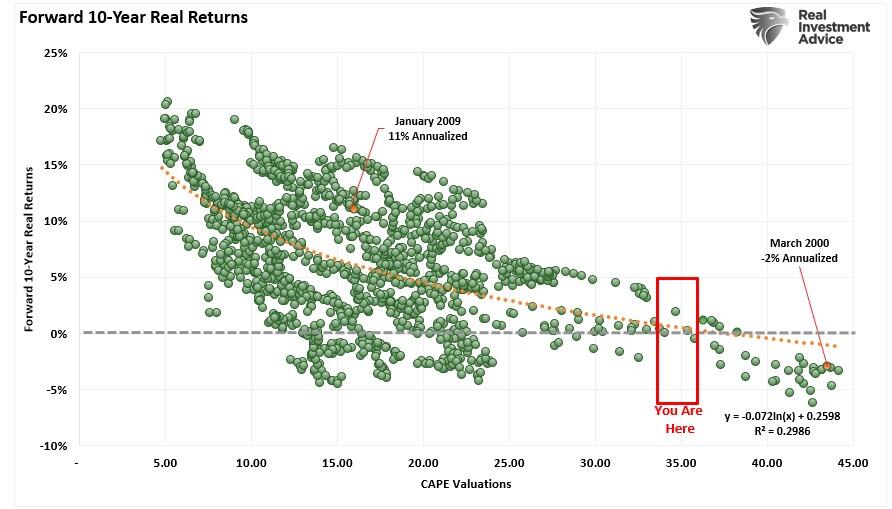
From current levels, history suggests that returns to investors over the next 10 and 20 years will likely be lower than higher. However, as I said, we can also prove this mathematically. As I discussed in “Rising Bullishness:”
“Capital gains from markets are primarily a function of market capitalization, nominal economic growth, plus dividend yield. Using John Hussman’s formula, we can mathematically calculate returns over the next 10-year period as follows:
(1+nominal GDP growth)*(normal market cap to GDP ratio / actual market cap to GDP ratio)^(1/10)-1
Therefore, IF we assume that GDP could maintain 2% annualized growth in the future, with no recessions ever, AND IF current market cap/GDP stays flat at 2.0, AND IF the dividend yield remains at roughly 2%, we get forward returns of:
(1.02)*(1.2/1.5)^(1/10)-1+.02 = -(1.08%)
But there are a “whole lotta ifs” in that assumption. Most importantly, we must also assume the Fed can get inflation to its 2% target, reduce current interest rates, and, as stated, avoid a recession over the next decade.”
In either case, these numbers are well below most financial plan projections, leaving retirees well short of their expected retirement goals.
Conclusion
While most analysis assumes that individuals should “buy and hold” indexed-based portfolios, the reality is quite different.
Retirement plans have a finite period for asset accumulation and distribution. The time lost “getting back to even” following a significant market correction should be a primary consideration.
Unfortunately, most investors remain woefully behind their promised financial plans. Given current valuations and the ongoing impact of “emotional decision-making,” the outcome will not likely improve over the next decade or two.
Markets are not cheap by any measure. If earnings growth slows, interest rates remain elevated, and demographic trends impact the economy, the bull market thesis will disappoint as “expectations” collide with “reality.”
Such is not a dire doom and gloom prediction or a “bearish” forecast. It is just a function of how the “math works over time.”
For optimistic investors, understanding potential returns from any given valuation point is crucial when considering putting their “savings” at risk. Risk is an important concept as it is a function of “Loss.“
The more risk taken within a portfolio, the greater the destruction of capital will be when reversions occur.
This time is “not different.” The only difference will be what triggers the next valuation reversion when it occurs. If the last two bear markets haven’t taught you this by now, I am unsure what will.
Maybe the third time will be the “charm.”
Authored by Lance Roberts via RealInvestmentAdvice.com,
Overly optimistic investor expectations of market returns may be a problem. To wit:
“While consumers are not very confident about the economy, they are highly optimistic about the stock market. In that same consumer confidence report from the Conference Board, the expectations for rising stock prices over the next 12 months are near the highest on record.“

Of course, after a decade of 12% returns, why should they not be optimistic that the future will be much the same as the past? A good example came from a recent discussion with an individual wanting me to review the “financial plan” for their retirement goals. The plan was generated by one of the many “off the shelf” software packages that take all the inputs of income, assets, pensions, social security, etc., and then spits out assumptions of future asset values and drawdowns in retirement.
The problem is that the return assumptions were grossly flawed.
In the vast majority of these plans, the optimistic assumption is that individuals will have a rate of return of somewhere between 6-10% annually heading into retirement and 4-8% thereafter. The first major flaw in the plan is the “compounding” of annual returns over time, which does NOT happen.
“There is a massive difference between AVERAGE and ACTUAL returns on invested capital. Thus, in any given year, the impact of losses destroys the annualized “compounding” effect of money.
The chart below shows the difference between “actual” investment returns and “average” returns over time. See the problem? The purple-shaded area and the market price graph show “average” returns of 7% annually. However, the return gap in “actual returns,” due to periods of capital destruction, is quite significant.”

The second and most important is the future expectation of individual returns over the next 10-20 years.
This second point is what I want to address today.
There are two main reasons why returns over the next decade or two are currently overestimated. The first is a “you problem,” and the second is “math.”
It’s A You Problem
Back in 2016, I wrote an article discussing a Dalbar investor study explaining why investors consistently “suck” at investing. As I detailed in that article, one of the biggest impediments to achieving long-term investment returns is the impact of emotionally driven investment mistakes.
Investor psychology helps us to understand the thoughts and actions that lead to poor decision-making. That psychology drives the “buy high/sell low” syndrome and the traps, triggers, and misconceptions that lead to irrational mistakes that reduce returns over time.
As the Dalbar study showed, nine distinct behaviors impede optimistic investors based on their personal experiences and unique personalities.

The most significant problems for individuals are the “herding effect” and “loss aversion.”
These two behaviors tend to function together compounding the issues of investor mistakes over time. As markets are rising, individuals are optimistic the current price trend will continue to last for an indefinite period. The longer the rising trend last, the more ingrained that optimistic belief becomes until the last of “holdouts” finally “buys in” as the financial markets evolve into a “euphoric state.”
As the markets decline, there is a slow realization that “this decline” is something more than a “buy the dip”opportunity. As losses mount, the anxiety of loss begins to mount until individuals seek to “avert further loss” by selling.
As shown in the chart below, this behavioral trend runs counter-intuitive to the “buy low/sell high” investment rule.”

“In the end, we are just human. Despite the best of our intentions, it is nearly impossible for an individual to be devoid of the emotional biases that inevitably lead to poor investment decision-making over time. This is why all great investors have strict investment disciplines that they follow to reduce the impact of human emotions.
More importantly, despite studies that show that “buy and hold,” and “passive indexing” strategies, do indeed work over very long periods of time; the reality is that few will ever survive the downturns in order to see the benefits.”
The impact of these emotionally driven mistakes leads to long-term underperformance below those “goal-based” financial projections.

It’s Just Math
“But Lance, the markets has returned 10% on average over the last century, so I will probably be okay.”
True. If you can contract “vampirism,” avoid sunlight, garlic, and crosses, you can live long enough to achieve the “average annual rate of return” over the last 124 years.
For the rest of us mere mortals, and why “duration matching” is crucial, we only have between today and retirement to reach our goals. For the majority of us – that is about 15 years.
And therein lies the problem.
Despite much of the commentary that continues to suggest we are in a long-term secular bull market, the math suggests something substantially different. However, it is essential to understand that when low future rates of return are discussed, it does not mean that each year will be low, but the return for the entire period will be low.
The charts below show the 10- and 20-year rolling REAL, inflation-adjusted returns for the markets compared to trailing valuations.


(Important note: Many advisors/analysts often pen that the market has never had a 10 or 20-year negative return. That is only nominal and should be disregarded as inflation must be included in the debate.)
There are two crucial points to take away from the data. First, there are several periods throughout history where market returns were near zero and negative. Secondly, the periods of low returns follow periods of excessive market valuations. Such suggests that betting “This time is not different” may not work well.
As David Leonhardt noted previously:
“The classic 1934 textbook ‘Security Analysis’ – by Benjamin Graham, a mentor to Warren Buffett, and David Dodd – urged investors to compare stock prices to earnings over ‘not less than five years, preferably seven or ten years.’ Ten years is enough time for the economy to go in and out of recession. It’s enough time for faddish theories about new paradigms to come and go.”
History shows that valuations above 23x earnings have tended to denote secular bull market peaks. Conversely, valuations at 7x earnings or less have tended to denote secular bull market starting points.
This point is proven simply by looking at the distribution of returns as compared to valuations over time.

From current levels, history suggests that returns to investors over the next 10 and 20 years will likely be lower than higher. However, as I said, we can also prove this mathematically. As I discussed in “Rising Bullishness:”
“Capital gains from markets are primarily a function of market capitalization, nominal economic growth, plus dividend yield. Using John Hussman’s formula, we can mathematically calculate returns over the next 10-year period as follows:
(1+nominal GDP growth)*(normal market cap to GDP ratio / actual market cap to GDP ratio)^(1/10)-1
Therefore, IF we assume that GDP could maintain 2% annualized growth in the future, with no recessions ever, AND IF current market cap/GDP stays flat at 2.0, AND IF the dividend yield remains at roughly 2%, we get forward returns of:
(1.02)*(1.2/1.5)^(1/10)-1+.02 = -(1.08%)
But there are a “whole lotta ifs” in that assumption. Most importantly, we must also assume the Fed can get inflation to its 2% target, reduce current interest rates, and, as stated, avoid a recession over the next decade.”
In either case, these numbers are well below most financial plan projections, leaving retirees well short of their expected retirement goals.
Conclusion
While most analysis assumes that individuals should “buy and hold” indexed-based portfolios, the reality is quite different.
Retirement plans have a finite period for asset accumulation and distribution. The time lost “getting back to even” following a significant market correction should be a primary consideration.
Unfortunately, most investors remain woefully behind their promised financial plans. Given current valuations and the ongoing impact of “emotional decision-making,” the outcome will not likely improve over the next decade or two.
Markets are not cheap by any measure. If earnings growth slows, interest rates remain elevated, and demographic trends impact the economy, the bull market thesis will disappoint as “expectations” collide with “reality.”
Such is not a dire doom and gloom prediction or a “bearish” forecast. It is just a function of how the “math works over time.”
For optimistic investors, understanding potential returns from any given valuation point is crucial when considering putting their “savings” at risk. Risk is an important concept as it is a function of “Loss.“
The more risk taken within a portfolio, the greater the destruction of capital will be when reversions occur.
This time is “not different.” The only difference will be what triggers the next valuation reversion when it occurs. If the last two bear markets haven’t taught you this by now, I am unsure what will.
Maybe the third time will be the “charm.”
Loading…