(function(d, s, id) { var js, fjs = d.getElementsByTagName(s)[0]; if (d.getElementById(id)) return; js = d.createElement(s); js.id = id; js.src = “https://connect.facebook.net/en_US/sdk.js#xfbml=1&version=v3.0”; fjs.parentNode.insertBefore(js, fjs); }(document, ‘script’, ‘facebook-jssdk’)); –>
–>
November 30, 2023
The 17th century English philosopher Thomas Hobbes memorably, and quite dramatically, broke from the political-moral tradition of his ancient Greco-Roman and medieval Christian predecessors when he insisted that there was no ultimate good, like the “happiness” or “flourishing” of citizens, that the political institutions of societies exist to serve. Rather, there is a greatest evil: a violent death.
‘); googletag.cmd.push(function () { googletag.display(‘div-gpt-ad-1609268089992-0’); }); document.write(”); googletag.cmd.push(function() { googletag.pubads().addEventListener(‘slotRenderEnded’, function(event) { if (event.slot.getSlotElementId() == “div-hre-Americanthinker—New-3028”) { googletag.display(“div-hre-Americanthinker—New-3028”); } }); }); }
And politics are meant to mitigate the fear and likelihood of that.
Anyone can kill anyone, Hobbes insisted, for the physical and mental differences between human beings are not sufficiently substantial to immunize the strongest and smartest against the predatory designs of the weakest and stupidest.
Regarding physical prowess, “the weakest has strength enough to kill the strongest, either by secret machination, or by confederacy with others, that are in the same danger with himself.” As for mental powers, there is even greater parity among people, “for prudence, is but experience; which equal time, equally bestows on all men, in those things they equally apply themselves unto.”
‘); googletag.cmd.push(function () { googletag.display(‘div-gpt-ad-1609270365559-0’); }); document.write(”); googletag.cmd.push(function() { googletag.pubads().addEventListener(‘slotRenderEnded’, function(event) { if (event.slot.getSlotElementId() == “div-hre-Americanthinker—New-3035”) { googletag.display(“div-hre-Americanthinker—New-3035”); } }); }); }
One needn’t be a full-throated Hobbesian (I’m not) in order to appreciate the profundity of Hobbes’ insight.
On November 7, Stairway Press released, The Warrior-Scholar Ideal Revisited: New Essays on an Old Vision.
I am one of its two co-authors, the other being retired USMC Lieutenant-Colonel Al Ridenhour, the founder of Warrior Flow Combatives, a system of self-defense, close quarters combat, in which I am one of his Senior-Instructors.
The essays in WSIR are intended to supply readers with a vision, an ethical vision that, as such, is designed to promote self-empowerment through self-transformation. For this reason, we deliberately avoided expressing partisan positions on topical political issues, for it is not, in the last analysis, a political book at all. This, though, doesn’t mean that from these essays there aren’t long-term implications, however oblique, for our politics. After all, politics are always the politics of a people. Thus, if people transform by way of adopting a new vision, so too will their politics eventually transform.
We contend that despite the conventional fare of moralistic rhetoric to which Americans have grown accustomed, fear is a dominant force driving our politics.
It’s not just that the fortunes of politicians and their counterparts in corporate media are predicated upon tireless fear-mongering. From “mostly peaceful protests” of one sort or another to promises of riots to “Cancel Culture,” the threat of violence, whether it’s overt or covert, is always present.
‘); googletag.cmd.push(function () { googletag.display(‘div-gpt-ad-1609268078422-0’); }); document.write(”); googletag.cmd.push(function() { googletag.pubads().addEventListener(‘slotRenderEnded’, function(event) { if (event.slot.getSlotElementId() == “div-hre-Americanthinker—New-3027”) { googletag.display(“div-hre-Americanthinker—New-3027”); } }); }); } if (publir_show_ads) { document.write(“
In order to change their politics, citizens must change themselves. In order to change themselves, they must, then, manage their fears, particularly their fear of violence.
And in order to do this, they must make themselves into…warriors.
More precisely, they need to transform themselves into warrior-scholars.
Thucydides was perhaps the Western world’s first historian. His History of the Peloponnesian War is remarkable for reading like a modern work. Equally impressive is that its author was a general who fought in this very war. Thucydides is credited with having said: “A society that separates its scholars from its warriors is one that will have its thinking done by cowards and its fighting done by fools.” (That it’s unlikely that Thucydides actually said this is neither here nor there, for it is certainly a sentiment that he would’ve wholeheartedly endorsed.)
Miyamoto Musashi, a 17th century undefeated Japanese Samurai swordsman, expressed essentially the same idea:
It is said that the warrior’s is the twofold Way of pen and sword, and he should have a taste for both Ways.
Musashi adds:
Even if a man has no natural ability, he can be a warrior by sticking assiduously to both divisions of the Way.
Human beings are not souls inhabiting bodies. We are spiritual unities, psychosomatic synergies, bodies and minds. Our physicality, psychology, and emotionality are mutually reinforcing. How we move our bodies affects how we think and feel, and how we think and feel affect how we move our bodies.
To repeat, all that we do we must do in and with the bodies that we have. We are embodied beings.
This being the case, the Warrior-Scholar ideal beckons us to train so as to maximize the efficiency, the ease and comfort, with which we move our bodies. To do this, though, we must have a specific goal in mind toward which to train our bodies. Movement for movement’s sake is abstract, aimless. The goal posited by the ideal for whose restoration we contend is that of nothing less than victory in mortal combat.
In other words, in training to successfully defend ourselves and our loved ones against those who imminently threaten our well-being, we train to move our bodies as subtly, as fluidly, as possible. Subtle movement is refined movement. It reveals mastery, and it is difficult for assailants to track.
Yet mastery of body movement is also, and can only be, mastery of the mind. Martial means “of or pertaining to war.” Historically, it was understood that the martial arts are warrior arts, arts of war. Training in a warrior art demands a focus of the will. As the body becomes harder and more refined, so too does the mind, and as goes the mind, so goes the body, and on and on. A refined mind is an educated mind, for it is a mind, discriminate and discerning, appreciative of nuances and, as such, skeptical toward sweeping ideological dogmas that become the conventional wisdom.
Plato remarked that philosophy springs from wonder. Doubtless, there’s something to be said for this view. Yet if it is to avoid collapsing into proverbial naval-gazing, philosophy, critical thinking, must begin from where we’re at, in the nit and grit, the joys and tribulations, of this embodied existence. Training in an art of war, entailing, as it does, the subjection of one’s body to a measure of trauma designed to simulate (within limits, of course) the trauma one could expect in a real life-or-death situation, has a way of forcing us to come to terms with reality. It grounds us. Mike Tyson, in his own way, made the point when he said, “Everyone has a plan until they get punched in the face.”
Training to win, not a sports match, a “street fight,” or a barroom brawl is not the same thing as training to prevail in potentially mortal combat against homicidal aggressors. It is not the same thing as training to win the battle of and for your life—a battle, hopefully, that you’ll never have to wage.
But because one trains to master the use of violence against the violent, one is that much more disposed to avoid trouble, and to avoid it by seeing nonsense for what it is.
Additionally, training in an art of war will help people to acknowledge their fears for what they are, and to differentiate those that are rational from those that are not.
Politics will change when people begin to see themselves and their world through a new vision, the vision delineated in The Warrior-Scholar Ideal Revisited.
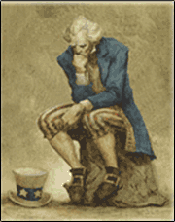
Image: Pixabay / Pixabay License
<!–
–>
<!– if(page_width_onload <= 479) { document.write("
“); googletag.cmd.push(function() { googletag.display(‘div-gpt-ad-1345489840937-4’); }); } –> If you experience technical problems, please write to [email protected]
FOLLOW US ON
<!–
–>
<!– _qoptions={ qacct:”p-9bKF-NgTuSFM6″ };  –> <!—-> <!– var addthis_share = { email_template: “new_template” } –>