
(function(d, s, id) { var js, fjs = d.getElementsByTagName(s)[0]; if (d.getElementById(id)) return; js = d.createElement(s); js.id = id; js.src = “https://connect.facebook.net/en_US/sdk.js#xfbml=1&version=v3.0”; fjs.parentNode.insertBefore(js, fjs); }(document, ‘script’, ‘facebook-jssdk’)); –>
–>
November 11, 2023
When he embarked on his journey to discover a path to India, Christopher Columbus’ lead ship was the Santa Maria. Built in 1460, it measured 62 ft with a crew of just 40, but the Santa Maria would take Columbus to the New World and would change the course of human history.
‘); googletag.cmd.push(function () { googletag.display(‘div-gpt-ad-1609268089992-0’); }); document.write(”); googletag.cmd.push(function() { googletag.pubads().addEventListener(‘slotRenderEnded’, function(event) { if (event.slot.getSlotElementId() == “div-hre-Americanthinker—New-3028”) { googletag.display(“div-hre-Americanthinker—New-3028”); } }); }); }
Half a century earlier, there was another man who sailed ships but who didn’t change the course of human history. His name was Zheng He, and he commanded the Chinese navy during the early 15th century. His Treasure Ships were not only larger than the Santa Maria, but they were more than six times the size, measuring 440 feet long with crews of 600. Zheng had an armada of them at his disposal during his seven Treasure Journeys between 1405 and 1433 that took him as far away as the Red Sea and the east coast of Africa.
Zheng’s navy was by far the most powerful the world had ever seen, and he used it to explore and initiate trade and tribute routes. And what did the Chinese do with this extraordinary power? Nothing. After Zheng’s death, the Treasure Journeys stopped. The Chinese had traditionally been an inward-looking society, and after Zheng’s 30-year exploration aberration, the old tradition returned.
Why are we not speaking Chinese today? Why didn’t the Chinese conquer the world (or at least try) when they had a navy exponentially superior to anything else in the world? Why did the kingdom that gave us paper and gunpowder not go on to dominate the world of commerce or ideas? The answer is largely because the Chinese had very little competition in the area of said ideas. Ruled by an emperor who was all-powerful, competition in the realm of ideas was rarely tolerated in China for most of its history, never mind flourishing. What the emperor said was gospel. And the emperor said we stay home.
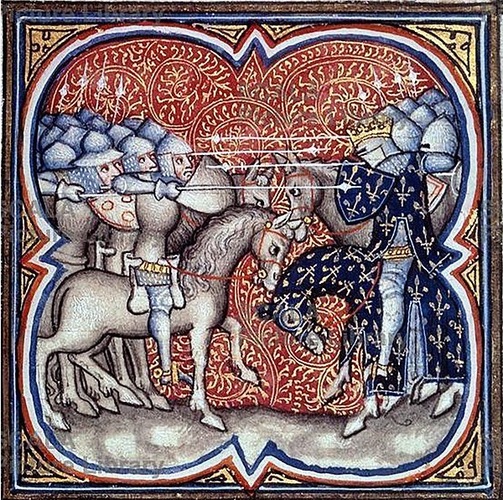
Image: The Battle of Tours. Public domain.
‘); googletag.cmd.push(function () { googletag.display(‘div-gpt-ad-1609270365559-0’); }); document.write(”); googletag.cmd.push(function() { googletag.pubads().addEventListener(‘slotRenderEnded’, function(event) { if (event.slot.getSlotElementId() == “div-hre-Americanthinker—New-3035”) { googletag.display(“div-hre-Americanthinker—New-3035”); } }); }); }
Similar kingdoms held dominion over wide swaths of land yet had a very limited impact on the world beyond. The Mongol Empire comes to mind, for it was the largest contiguous empire in human history, or the countless Muslim empires, up to and including the Ottoman Empire. Robust competition of ideas did not exist in those empires any more than it did in China, and, indeed, most of us do not speak Mongol, Arabic, or Turkish.
Now compare that to the West. At one point, the British Empire covered a quarter of the world’s landmass and a quarter of her people. Today, more people speak English than any other language on the planet. There may be a billion people speaking Chinese, but 95% of them live in China, while 95% of the English speakers don’t live in England. Similarly, half a billion people speak Spanish, and less than 10% of them live in Spain.
Beyond that, almost every aspect of life for most people today is the result of Western ideas. Cars, phones, planes, elevators, televisions, cameras, advanced agriculture, computers, MRI machines, DNA testing, heart transplants, nuclear power, space travel, fracking, movies, advanced agriculture, and much, much more. For all intents and purposes, the West developed the modern world. And for all its current deprivation, it is extraordinary.
So, what accounts for the difference in the impact between what the Chinese accomplished over the last thousand years and what Europe did? Simple: Competition. And, in particular, the competition of ideas.
Competition, more than any single thing, is responsible for the West’s advances. Between countries, there’s been competition. Within countries, there’s been competition. Within religions, there’s been competition, which sometimes split sides across countries and between them. And the competition was relentless, frequently resulting in bloodshed and oftentimes in war, sometimes lots of both. In addition, alliances shifted regularly between countries and within them. There was rivalry, there was espionage and, of course, there was betrayal and treachery.
The real competition that helped to create the world we live in evolved in the centuries following the collapse of the Roman Empire. What we know of today as France, Germany, Spain, Italy, and Britain didn’t exist then. They formed over hundreds of years of competing tribes, towns, and estates that evolved into domains and then into kingdoms.
‘); googletag.cmd.push(function () { googletag.display(‘div-gpt-ad-1609268078422-0’); }); document.write(”); googletag.cmd.push(function() { googletag.pubads().addEventListener(‘slotRenderEnded’, function(event) { if (event.slot.getSlotElementId() == “div-hre-Americanthinker—New-3027”) { googletag.display(“div-hre-Americanthinker—New-3027”); } }); }); } if (publir_show_ads) { document.write(“
Initially, chieftains would compete with one another for local peasants’ loyalty to increase their power and holdings using such incentives as more food in exchange for their labor or fealty. Those chieftains would eventually evolve into local nobility and continue to expand their lands. Later, particularly in times of more instability, dukes or kings would compete for the allegiance of local nobility by offering lower taxes or more freedom than their opponents.
The reality of this can be seen in the evolution of European nations, particularly France, Italy, and Germany. The ebb and flow of borders over the 1500 years since the fall of Rome has been nothing less than stunning. And each of those nations, plus Britain and Spain, were the core drivers of the evolution of civilization over the last 500 years.
All that evolution came about because of competition, whether driven by ideas, religion, or simple power. At different times over that span, the French were fighting against the British, the Spanish, the Papal States, Austria, the Prussians, the Russians, and more. At other times, they were fighting alongside those same nations. Britain, Italy, Germany, and the rest of Europe have similarly chaotic histories.
And it wasn’t just external fighting. France, like most Western countries, saw vast amounts of internal strife as the landed gentry and various regions fought one another for dominance or liberation. The same holds true for religion. While Christianity dominated Europe, the reality is that it battled with Islam for dominance for centuries. In the 8th century, Christendom barely stopped Islam at Poitiers (the Battle of Tours) in France, and, 900 years later, the same happened at the gates of Vienna. Simultaneously, Christianity battled itself bloody for the 500 years following the Reformation.
As if all that chaos wasn’t enough, sometimes power and religion made for strange bedfellows. That occurred when Francis I of France partnered with the Muslim Ottoman sultan Suleiman the Great in the 16th century to fight the Christian Hapsburgs, who controlled much of Europe beyond France.
The most obvious outcome of all this fighting and shifting was a competition of ideas for everything from developing improved weapons of war to advances in art and architecture to science and math. Whether it resulted in competition to build the largest cathedral or the most luxurious palace, the most accurate painting style, or the most efficient gun barrel, such advances were the fertilizer that fed modern civilization. It’s no wonder that the West is where the Renaissance, the Age of Enlightenment, the Industrial Revolution, and advances such as flight, DNA, computers, cellphones, and the Internet originated. So, too, freedom of the press, speech, religion, and free markets, resulting in widespread prosperity and freedoms never before seen in human history.
All that hangs in the balance as Western nations face the catastrophic amalgamation of the woefully uninformed left, rapidly increasing anti-freedom Muslim populations, and increasingly despotic governments willing to abandon fundamental Western principles in their pursuit of power. The $64,000 question is, how do we maintain those principles while increasingly those among us detest them and technology makes it easier than ever to target and marginalize those willing to stand up for them?
Follow Vince on Twitter at ImperfectUSA or you can visit his new website Gratitude for America.
<!–
–>
<!– if(page_width_onload <= 479) { document.write("
“); googletag.cmd.push(function() { googletag.display(‘div-gpt-ad-1345489840937-4’); }); } –> If you experience technical problems, please write to [email protected]
FOLLOW US ON
<!–
–>
<!– _qoptions={ qacct:”p-9bKF-NgTuSFM6″ };  –> <!—-> <!– var addthis_share = { email_template: “new_template” } –>