(function(d, s, id) { var js, fjs = d.getElementsByTagName(s)[0]; if (d.getElementById(id)) return; js = d.createElement(s); js.id = id; js.src = “https://connect.facebook.net/en_US/sdk.js#xfbml=1&version=v3.0”; fjs.parentNode.insertBefore(js, fjs); }(document, ‘script’, ‘facebook-jssdk’)); –>
–>
October 3, 2023
Everyone who watches crime dramas such as CSI, NCIS, Castle, or Bones, knows that every episode focuses on the issue of Motive. The reason is obvious. Correctly assessing Motive an important consideration in figuring out who has committed what crime.
‘); googletag.cmd.push(function () { googletag.display(‘div-gpt-ad-1609268089992-0’); }); document.write(”); googletag.cmd.push(function() { googletag.pubads().addEventListener(‘slotRenderEnded’, function(event) { if (event.slot.getSlotElementId() == “div-hre-Americanthinker—New-3028”) { googletag.display(“div-hre-Americanthinker—New-3028”); } }); }); }
Why then has the issue of Motive on January 6 been swept off the stage of public discourse?
To many, asking such a question may appear provocative, even uninformed. After all, Democrats have repeatedly told us the Motive for January 6: Trump, according to them, wanted to foment an “insurrection.” Yet if that Motive were really so obvious, why has it been necessary for the anti-Trumpers to repeat it so relentlessly, literally many times every day?
If we examine the true Motive for ourselves, we soon discover that the repeated cries of “insurrection” have tried to stifle analysis of the actual January 6 Motive in favor of accepted “fact.” Despite that relentless attempt, or rather because of it, we should ask ourselves: just who actually had the Motive to disrupt the congressional deliberations taking place in the Capitol Building?
‘); googletag.cmd.push(function () { googletag.display(‘div-gpt-ad-1609270365559-0’); }); document.write(”); googletag.cmd.push(function() { googletag.pubads().addEventListener(‘slotRenderEnded’, function(event) { if (event.slot.getSlotElementId() == “div-hre-Americanthinker—New-3035”) { googletag.display(“div-hre-Americanthinker—New-3035”); } }); }); }
The Electoral Count Act, in place since 1887, sets forth procedures by which in a joint session of Congress, presided over by the Vice President, can raise concerns about election irregularities. Using that legally established framework, senators such as Cruz, Hawley, and Johnson, together with House members, proposed to follow the statutorily provided process to review voting irregularities in certain swing states.
Trump wanted these procedures to go forward unimpeded. They were, however, anathema to anti-Trumpers, who wanted the procedures to stop, or better yet, never to get started.
On January 4th, Vice President Mike Pence, knowing that he was to preside over the proceedings, explained why he thought it would be good for the American People to let the legal process play out, declarIng:
“I know we’ve all got doubts about the election. I share the concerns of millions of Americans about voting irregularities. I promise you this Wednesday [January 6] we’ll have our day in Congress. We’ll hear the objections. We’ll hear the evidence.”
There was nothing secretive about Pence’s declaration. With full transparency, he announced that he wanted the process to go forward, and why.
In the years since January 6, Pence has consistently reiterated his belief that the process would have been beneficial. Despite years of facing demands that he recant, Pence has not deviated from that conviction.
‘); googletag.cmd.push(function () { googletag.display(‘div-gpt-ad-1609268078422-0’); }); document.write(”); googletag.cmd.push(function() { googletag.pubads().addEventListener(‘slotRenderEnded’, function(event) { if (event.slot.getSlotElementId() == “div-hre-Americanthinker—New-3027”) { googletag.display(“div-hre-Americanthinker—New-3027”); } }); }); } if (publir_show_ads) { document.write(“
For example, in an interview on ABC News on November 22, 2022, Pence said:
“I was fully prepared to make sure that we had all the arguments, concerns that members of Congress had brought. But… the riot… that ensued eclipsed all that…”
In an interview by Judy Woodruff of PBS News on December 1, 2022, she repeatedly tried to get Pence to change his mind by advancing false premises. Nevertheless, Pence stuck to his conclusion:
“…I did support the objections that were filed in the Congress, because the Electoral; Count Act allows for, that objections that were filed by member[s]… are to be considered under the Electoral Count Act… The fact is that there were irregularities that took place in the election… And the possibility that there would emerge evidence of fraud was always there… I thought… quite honestly, that channeling the great concern of millions of Americans about the 2020 election into the legal process… in the Congress of the United States, would be very useful, to hear of the irregularities…”
In a subsequent interview on ABC News on March 19, 2023, Pence reiterated:
“I think it was worthwhile that the Congress debate the objections and consider the facts and then move forward with the peaceful transition.”
As it turns out, there was nothing peaceful when the proceedings that Trump and his supporters wanted to go forward unimpeded were instead disrupted by the January 6 riot.
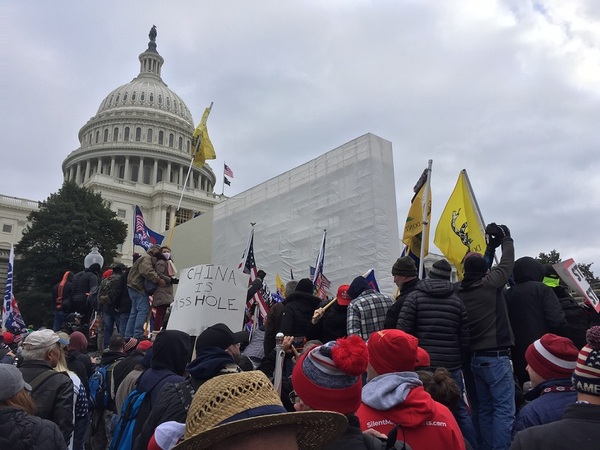 Trump and Pence did disagree on the potential next step after the joint session. They did not disagree at all, however, on the desirability of using the statutory procedures to bring information about the election to the wider court of public opinion. Both Trump and Pence were in favor of transparency and Free Speech on that topic of intense public interest.
By contrast, it was the Democrats who did not want that information made public. They wanted to make sure that the People, using Pence’s words, would not get to “hear the evidence.” They, not Trump, had the Motive to disrupt the process taking place in the Capitol.
In sum, no one could reach any other conclusion about the contrasting Motives on January 6, if each would just ask, and honestly answer, two basic questions:
1) Did Trump want the process interrupted?
2) Did the anti-Trumpers want it stopped?
The answers to these two questions are so clear, despite the blitz of “Insurrection!”, that it would be possible to wrap up the discussion of Motive at this point. Yet because the Left has been so relentless to deflect consideration of actual Motive, it is useful to point out that there is an abundance of corroborating evidence. Here is a partial list:
1) Before January 6, it was the Democrat mayor of D.C. and the Democrat speaker who turned down Trump’s offer of troops to protect the proceedings in the Capitol, thereby making the path for disruption more open.
2) After January 6, both the mayor and speaker turned D.C. into an armed military zone, with thousands of troops, heavy military equipment, barricades, and barbed wire. The disruption had already succeeded, and now it was useful to make vivid the false “insurrection” narrative. (It never came, and finally the pretense and waste of taxpayer dollars became too embarrassing to continue).
3) It was Democrats in the joint session who tried to truncate the proceedings.
4) When Trump talked to his supporters before they went over to the Capitol, he told them to do so “peacefully and patriotically” — not the advice one would give if one wanted the proceedings disrupted.
5) Only about one percent of the protesters in D.C. actually entered the Capitol. If Trump’s Motive was to disrupt the process, then he must be accounted one of the most ineffective “insurrectionists” of all time. In fact, it was the 99 percent who stayed out of the Capitol that followed his request.
6) Even among that one percent, video the Democrats tried to hide shows that many who entered the Capitol did so at the invitation of the Speaker’s Capitol Police, who opened the doors for them and waved them in.
7) The Left not only tried to hide the fact Trump told his supporters beforehand to be peaceful, but also tried to suggest that Trump did nothing to discourage the disruption. A quick review of the timeline demonstrates the opposite. The first protester entered the Capitol at 2:12 P.M. Then:
a) Just 26 minutes later, Trump tweeted: “Please support our Capitol Police and Law Enforcement. They are truly on the side of our Country. Stay Peaceful.”
b) At 3:13 Trump tweeted again “to remain peaceful.”
c) At 4:17 Trump released a video in which he said: ” …you have to go home now. We have to have peace.”
d) At 6:01 Trump tweeted: “Go home with love & in peace.”
These tweets were removed by the social media censors. Why did they do so, if not to delete evidence that it was Trump who did not want the proceedings disrupted?
8) On the next day, shortly after Twitter temporarily unlocked his account, Trump released a video condemning the Capitol building disruption. He said he was “outraged,” hardly the sentiments of a man who wanted the proceedings interrupted.
9) After the Capitol was cleared and the joint session reconvened, the statutory proceedings were truncated. The Democrats had achieved their disruption Motive.
10) It was the Democrats who later led the rewrite of the Electoral Count Act to remove the procedures that were interrupted on January 6.
11) Both before and after January 6, the Democrats have attempted in multiple channels to quash any claims of 2020 election irregularities, i.e. have pursued the same Motive as disrupting the January 6 joint session.
12) Disruption of government business they do not like is a consistent Democrat strategy, which they not only pursue but praise. Examples include the coordinated “absenteeism” of Democrat State legislators in Texas, disruption of legislative work in the Tennessee State House, disrupting meetings of the Federal Energy Regulatory Commission, praising Antifa and BLM attacks on Federal buildings, and pulling a fire alarm to prevent an unwanted vote in Congress.
In summary, corroborating evidence confirms just who had, and who had not, the Motive to disrupt the January 6 proceedings. The American People should not be deflected from exercising their own independent judgment on this question. They should realize that Trump was concerned about the 2020 election irregularities and wanted them aired on January 6, and still wants that evidence to be heard. It is the Democrats who resisted then, and still do.
Image: TapTheForwardAssist
<!–
–>
<!– if(page_width_onload <= 479) { document.write("
“); googletag.cmd.push(function() { googletag.display(‘div-gpt-ad-1345489840937-4’); }); } –> If you experience technical problems, please write to [email protected]
FOLLOW US ON
<!–
–>
<!– _qoptions={ qacct:”p-9bKF-NgTuSFM6″ };  –> <!—-> <!– var addthis_share = { email_template: “new_template” } –>