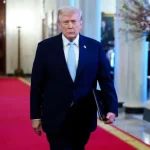
President Donald Trump has largely stayed out of the picture as lawmakers on Capitol Hill scramble to find a healthcare proposal that Republicans can get behind.
It’s a notable contrast from past direction-setting stances from the White House — one that Sen. Rick Scott, R-Fla., jokingly noted seems out of character for a president known for weighing in on just about any picture.
“I mean, he’s a pretty quiet guy. He just doesn’t get engaged in things much, does he?” Scott quipped.
Trump’s silence on legislative affairs doesn’t just extend to healthcare. Lawmakers have received little word from the White House in recent months on issues like codifying cuts to government spending, the potential for a second reconciliation package and legislation on affordability.
To Rep. Aaron Bean, R-Fla., the chair of the once hyperactive House DOGE Caucus, that doesn’t mean Trump is absent.
“That’s not my perception,” Bean said when asked if Trump had pulled off a disappearing act. “He’s been there. His people are here; they’re in the room — they were here tonight.”
Although Trump’s direction may ultimately prove necessary to bring the party together on any of those topics, Republicans across both chambers of Congress believe the president is giving legislators latitude to work on key issues while staying plugged in behind the scenes.
Trump’s hands-off approach comes as lawmakers wrestle with whether to extend COVID-19-era federal subsidies used by the vast majority of Obamacare policyholders, let them expire at the end of the year and let health insurance costs jump overnight, or attempt broader reforms to bring the costs of the program down.
HOUSE GOP TENSIONS ERUPT AS REPUBLICANS TURN ON EACH OTHER HEADING INTO YEAR’S END
Republicans have just two weeks to come up with a solution before the subsidies expire.
“My sense is I think he’s trying to give some room for negotiators to come to something that could get consensus and seize that as a way to be helpful,” Sen. John Hoeven, R-N.D., said.
Rep. Andy Harris, R-Md., chairman of the House Freedom Caucus, a group that’s known for its breaks with party leadership, said he expected Trump to get involved eventually to help build consensus when it’s needed.
“I think that if we get to comprehensive reform in the beginning of the year, then I suspect the White House will get granular,” Harris said.
That’s also the view of Matthew Dickinson, a professor of political science at Middlebury College. Dickinson studies the American presidency and its relationship with Congress. He observed that while it’s unusual for Trump to remain quiet, it’s not outside the norm for other presidents facing legislative forks in the road.
“Typically, presidents like to do so when it is clear their involvement may prove decisive. It may be a bit too early in the process for that to be the case. At this point, Republicans can’t even agree on the outlines of a healthcare proposal,” Dickinson said.
Others view Trump’s relative silence as a more cautious stance brought about by past blunders — especially when it comes to healthcare.
Jon Rogowski, a professor of political science at the University of Chicago, said that’s a legislative area that’s left Trump wounded before.
“Trump was not particularly successful in uniting the Republican conference behind major legislative initiatives when his party controlled Congress in his first term. Taking an aggressive posture on a particular bill risks splintering the Republican conference and will make it difficult for Democrats to support the bill,” Rogowski said.
That’s also the view of Rep. Thomas Massie, R-Ky.
“You know, in his first term, that’s the first thing he took up — healthcare,” Massie said. “And that bill was junk. Maybe he learned something from that, you know, to not get on board too quickly.”
HOUSE GOP UNVEILS HEALTHCARE PLAN AHEAD OF VOTE NEXT WEEK AS COST HIKE LOOMS FOR MILLIONS
Massie posited the White House may also just not have direction to give for now. When it comes to something as politically charged as extending the enhanced premium tax credits being utilized by 90% of Obamacare’s 24 million enrollees, does the president know what he wants?
“Probably not. I don’t know,” Massie said.
The White House did not respond to a request for comment.