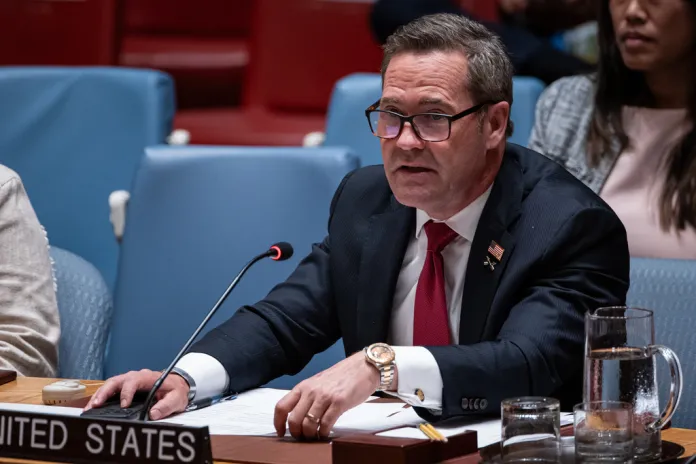
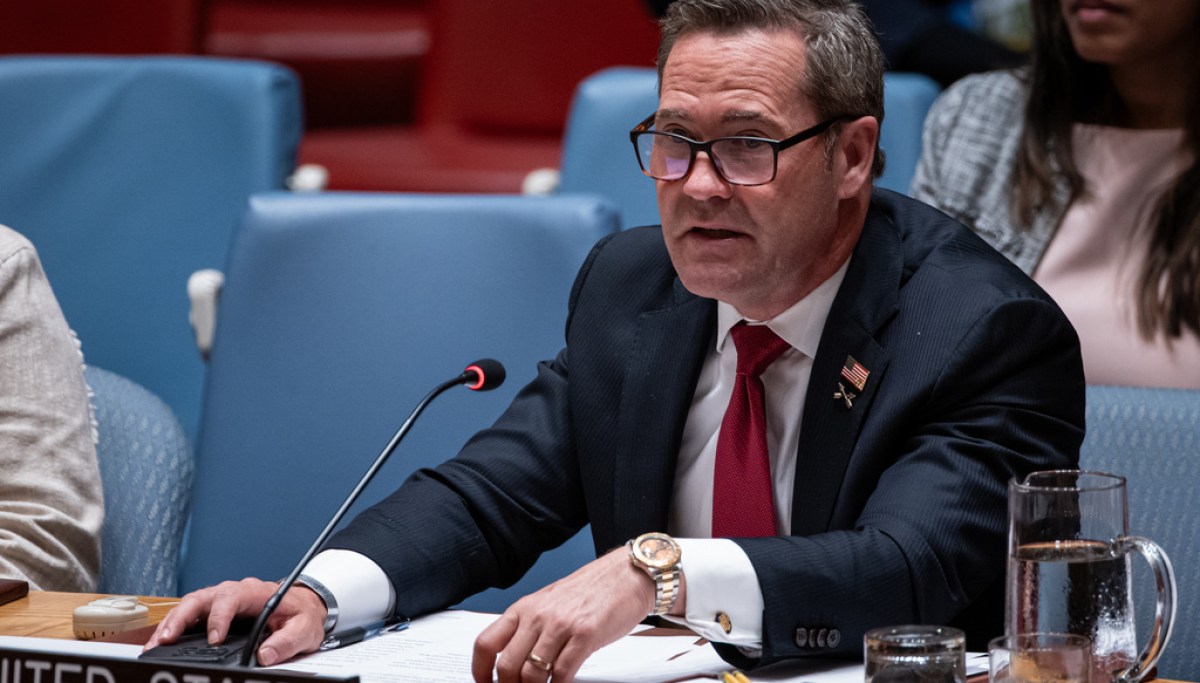
U.S. Ambassador to the United Nations Mike Waltz faced questioning from House Democrats on Friday about the flow of humanitarian aid into Gaza, after the Trump administration backed major changes to how vital supplies are distributed.
Rep. Lois Frankel (D-FL), the leading Democrat on the House Appropriations Subcommittee on National Security, Department of State, and Related Programs, pressed Waltz on President Donald Trump’s move to revoke funding and involvement in the U.N. Relief and Works Agency for Palestine Refugees following revelations that nine UNRWA employees participated in Hamas’s Oct. 7 terrorist attack on Israel, and 10 more individuals were accused of playing a role. The Gaza Humanitarian Foundation, a private organization backed by the United States and Israel, has taken over aid operations, fueling backlash from Hamas, as well as the U.N., and some Democratic lawmakers in the U.S, who have argued UNRWA remains a vital part of aid infrastructure.
Waltz defended moves against UNRWA during testimony this week before the House committee and said that the number of aid trucks and food reaching Gazans in the new aid structure has “exceeded” prior amounts. Frankel pushed back. She conceded UNRWA employees should be “better” vetted, but argued pulling support from the U.N. agency has helped lead to a hunger crisis “beyond proportions” in Gaza.
“UNRWA was set up to be a temporary mechanism to deliver not only food but health and education, and the elimination of our participation in that effort has destroyed a delivery system that is providing food. And if you don’t believe that there is a humanitarian hunger crisis in Gaza today, I don’t know what planet you are on, and it is not just a hyperbole or propaganda from Hamas,” she told Waltz.
“It is a crisis beyond proportions. Yes, the people who were there, there were 19, I believe, out of 11,000 employees, they were gone. We should vet them better, et cetera. But the delivery system has been cut off,” she claimed.
Waltz said there is still “a long way to go” to make sure Gazans are well supplied. But he added: “I will point out, and I say this as a matter of pride, I visited Gaza, I visited our civil military coordination center, and we have exceeded the number of trucks and the amount of aid.”
During the hearing, Waltz outlined a series of reforms he has sought to make at the U.N., describing them as a way to save taxpayer dollars. He said the U.S. funds roughly one-fifth of the body’s budget and “the entire Western world is in a much more fiscally restrained position.” Among the measures the U.S. has taken are reforming peacekeeping missions and pulling out of agreements or organizations viewed as unnecessarily redundant, he said. The U.S. led the U.N. in adopting a 15% cut to its budget in December, eliminating nearly 3,000 headquarters positions and producing $126 million in savings to Washington, according to Waltz.
“America is a humanitarian nation, but we will do everything we can to make sure those dollars are being used efficiently and effectively. And when I talk to outside organizations, and they complain to me that by their estimate, only 30, 40% of their money is actually reaching people in need as it filters through these layers of bureaucracy, that’s what we’re seeking to clean out,” he told lawmakers.
ELISE STEFANIK, ISRAEL, AND THE ‘ANTISEMITIC ROT’ AT THE UN
“The U.N.’s budget in the last 25 years has quadrupled. We have not seen, arguably, a quadrupling of peace and security around the world commensurate with those hard-earned dollars,” he added.
Walz faced concerns from Democrats on the panel about the U.S. cutting ties with scores of international agreements and organizations over the course of Trump’s second term. But he said the “trade over aid” approach, moving away from the “old model” of NGO humanitarian networks with a new focus on private sector incentives, would promote better conditions in struggling countries, fueling more economic opportunity for individuals.
“What we’re trying to do, and in a healthy way, is to pull in the private sector of companies and industries in developing nations. We’re reorienting, for example, to lower barriers to foreign direct investment so that we can create jobs locally, and move these aid grants and organizations out of business over the long term,” he said.
“We’re building on this momentum heading into the next year,” he said. “The U.N. has tremendous potential. My charge from him [Trump] is to help it realize that potential. We are dedicated to making the U.N. live up to that promise, to Making The U.N. Great Again.”