The top House Republican on housing said that provisions in the Senate’s bipartisan reform legislation wouldn’t have passed the House because they involved spending but emphasized that there is much overlap between that bill and the House’s new bipartisan measure.
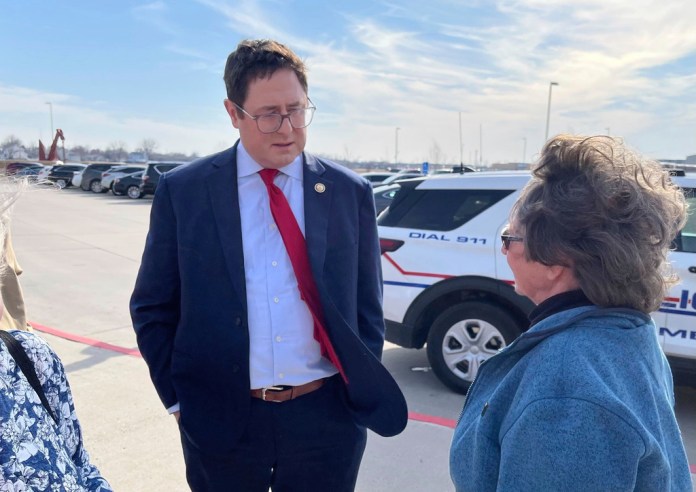
The House Financial Services Committee advanced the bill, the Housing for the 21st Century Act, in December. The Washington Examiner sat down with Rep. Mike Flood (R-NE), the chairman of the housing subcommittee, to discuss the legislation, the process of crafting it, and what’s next.
TOP DEMOCRAT CHALLENGES TRUMP ON BAN OF BIG INVESTORS FROM SINGLE-FAMILY HOUSES
Currently, the legislation, which Flood characterized as a “true compromise” between the two parties, is awaiting a full vote in the House. There is also separate bipartisan housing legislation in the Senate, the Road to Housing Act.
Flood said some of the provisions in the Senate version wouldn’t be able to receive support in the House because of spending. He said that the House version is narrower, while the Senate version is broader, creating seven new programs and some pilot programs.
“Anything that spends money is going to run afoul of what our majority leader and what our committee chairman has charged us with doing,” Flood said during an interview in his office on Capitol Hill. “And so, not to say they’re bad ideas, it’s just a budget issue.”
The Senate version includes a pilot program to incentivize housing development using Community Development Block Grant funding. Also left out of the House version is a new grant program for localities that increase housing supply, and another that would steer more funding to cities that make it easier to build near transit.
Still, Flood said that both bills have been positively received by the White House. He said the Trump administration is broadly supportive of recent bipartisan housing legislation and expressed optimism about efforts to boost housing supply and ease the affordability crisis.
“They’ve read it provision by provision, I think they largely think a lot of what the House did and the product’s really good, it’s been vetted,” Flood said.
The committee voted 50-1 to move forward with the Housing for the 21st Century Act, legislation that was first introduced by Rep. French Hill (R-AR), the committee’s chairman, last month.
Flood emphasized that many of the same themes were reflected in the House bill as were in the Senate bill.
“I think that what I’ve heard from the administration is they see value in both the Senate and the House proposals,” he said. “They love the fact that both are coming to the table. They want to put their own fingerprint on it.”
“I think of all the problems we have this year with all the different issues, this is the one issue that is the most bipartisan,” Flood added.
Flood said that a lot of effort was put into the legislation, and that he and Rep. Emanuel Cleaver (D-MO), the ranking member of the Financial Services Subcommittee on Housing and Insurance, spent a lot of time working together to find common ground.
Cleaver told the Washington Examiner this week that the effort came from both sides of the aisle.
“I’ve been here 21 years, I think this is what I would really like to claim to be bipartisanship,” Cleaver said.
“It turns out that both of us wanted the same thing in terms of creating opportunities for greater homebuying by our constituents, and maybe also creating an atmosphere where the federal government is actually, with intentionality, increasing the available housing,” the congressman said.
At a high level, the Housing for the 21st Century Act is designed to help modernize local development and rural housing programs, further expand opportunities for manufactured and affordable housing finance, and protect borrowers and assisted families. It also enhances oversight of housing providers.
There is a lot of overlap with the Senate bill, House Financial Services Chairman French Hill told the Washington Examiner.
“As much of the overlap of ROAD to Housing priorities of both Democrats and Republicans that we can get to good on in the language would be in there,” Hill said. “Meaning they have some provisions inside ROAD as attached to the NDAA that if we change some of the wording, but not gut the initiative, we could get to good on — even if we don’t think it’s the best idea on the planet.”
One significantly different measure in the House bill is a provision that would overhaul the HOME Investment Partnerships Program, a major housing program administered by the Department of Housing and Urban Development.
Flood and Cleaver say it would modernize and strengthen the program, which provides about $1.25 billion a year in block grants to states and cities to provide affordable housing.
The legislation would provide greater flexibility for governments in allocating funding under the program, which was created in 1990 as part of a broader shift in housing policy toward giving more responsibility to states and cities. It would also provide relief from federal environmental rules that slow down projects.
GOP CHAIRMAN ISSUES DEFENSE OF POWELL IN BREAK WITH TRUMP
The Housing for the 21st Century Act would also direct HUD to promote “point-access block” buildings, meaning buildings accessible by just one stairwell — a reform sought by many urbanists.
Such buildings are popular in many parts of the world, and some U.S. neighborhoods, but are effectively prohibited throughout much of the country because of model building codes that most cities use. Generally, apartment buildings in the U.S. are required to have two stairwells for egress in case of fire, which some designers have blamed for forcing awkward construction choices and making it harder to build small-scale multifamily properties.