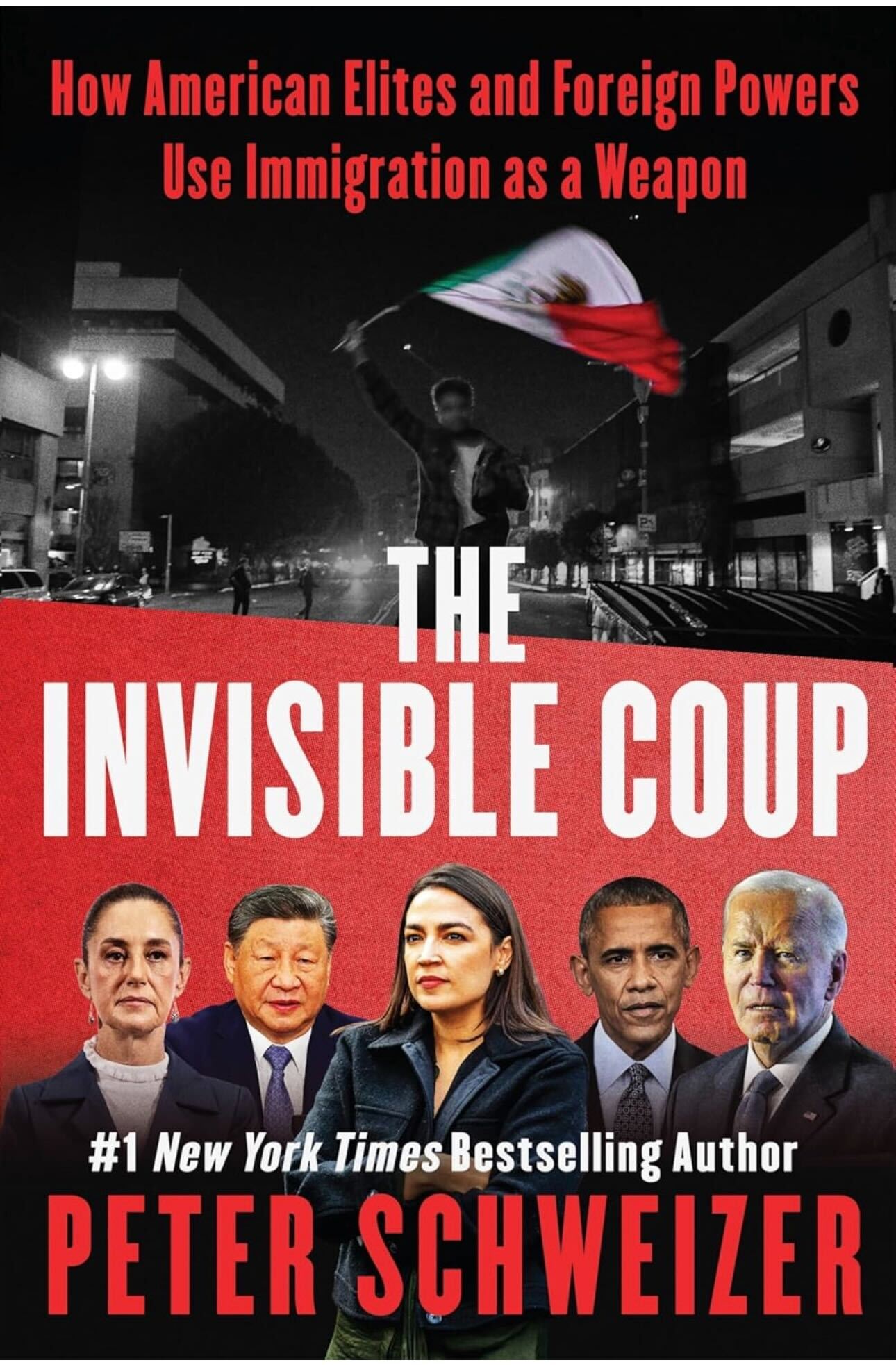
Mexico is flooding the United States with Marxist anti-American textbooks to ideologically weaken its northern neighbor and indoctrinate immigrants away from properly assimilating, Peter Schweizer details in his new book "The Invisible Coup: How American Elites and Foreign Powers Use Immigration as a Weapon."
The post TEXTBOOK HATE: How Mexico Floods the U.S. with Anti-American Textbooks to Indoctrinate Kids from L.A. to Orlando appeared first on Breitbart.
Mexico is flooding the United States with Marxist anti-American textbooks to ideologically weaken its northern neighbor and indoctrinate immigrants away from properly assimilating, President of the Government Accountability Institute Peter Schweizer details in his latest book The Invisible Coup: How American Elites and Foreign Powers Use Immigration as a Weapon.
Schweizer, who has written several New York Times bestsellers exposing political corruption and dirty dealings, lays out how Mexico sends anti-capitalist textbooks through more than 50 consulates in the United States, which far exceeds the number of other countries. The effort, he writes, can be traced to the political ruling class’s belief in “Reconquista,” or “the reconquering of the American Southwest…territories lost to the United States in the nineteenth century.”
“With this massive network in place, the Mexican government began ‘creating consulate programs to bolster migrants’ political, cultural, and economic loyalty’ to Mexico…,” he writes in “Chapter 2: Mexico’s Reconquista of the U.S. is Real,” citing a study that is reportedly “sympathetic” to Mexico’s mission.
“Indoctrination begins with children,” he continues. “Mexico does not want young migrants in the United States to be loyal to the United States; it wants them instead to cling to Mexico’s resentments about its northern neighbor. It accomplishes this by invading our classrooms. Local US school administrators, either out of ignorance or sympathy for the cause, are happy to oblige.”
Schweizer writes that the Mexican government sends approximately one million textbooks into the United States each year to “teach its version of American history and other subjects.” He notes that these textbooks are the same controversial textbooks that students in Mexico use, which offer a “decolonial” perspective on all topics. The books are inspired by Brazilian Marxist Paulo Freire, who authored Pedagogy of the Oppressed.
Schweizer cites a 2023 Associated Press report on these textbooks, with the article describing how the materials “wax nostalgic of the old Soviet Union” and how one of the two officials in charge of compiling the textbooks proudly has the first name “Marx” and the other worked for Venezuelan dictator Nicolás Maduro.
An introduction to a seventh-grade language arts book detailed in the report states: “The Rabfak, the schools for workers in the former Soviet Union, were considered spaces of knowledge. The dream is that Mexican middle schools and their textbooks can achieve that quality.” The AP additionally reported finding “plenty of references to capitalism being bad in the textbooks, as early as fourth grade.”
[embedded content]
Another secondary-level book teaches students that “a fundamental cause of the origin of inequality [is] neoliberal socio-economic models [capitalism]” and that “in modern capitalist societies, a small group ‘exploits’ the majority.”
“Clearly, distributing such books to American schools to teach Mexican migrants in the United States is meant to foster Mexican, not American, patriotism,” Schweizer writes, pointing out another Mexican history book that “celebrates the troops who fought the Americans during the Mexican-American War,” and paints the U.S. as the “enemy” who won the war and performed a “flag wave at the National Palace.”
“The Mexican government especially likes to keep its version of the Mexican- American War alive in the minds of young migrants,” he explains. “…“Other advocates cheer the textbook program as promoting “‘Greater Mexico’— one textbook at a time.’” For their part, Mexican diplomats speak poetically of ‘strengthen[ing] the identity of Mexican children and youth living in the United States.’”
Schweizer quotes Raquel Romero, director of Mesoamerica Foundation — a nonprofit that helps distribute the Mexican government schoolbooks in the U.S. — who states that the effort is about transforming America.
“This is more than an outreach program,” she said.
“This is part of a concerted program to educate Hispanic children in the United States, and to help the United States make the transition into a bicultural society this century,” she continued. “It is a way of understanding that Mexican culture is expanding across the border, that it is in ascendance, and that Hispanic and Latino children in the United States will never be blond, blue- eyed Anglos.”
But Schweizer notes that Mexico has another reason to hinder Mexicans in the United States from assimilating: money.
“Mexicans living in the United States send more than $60 billion annually to their home country in the form of remittances. Much of that, of course, goes to their families. But they also send money home to their local regions where the funds are supposed to be used for development,” he writes. “Mexicans living in the United States who adopt an affinity for America would be much less likely to send money back to their home country.”
Schweizer’s The Invisible Coup: How American Elites and Foreign Powers Use Immigration as a Weapon is published by HarperCollins and is available to purchase now.