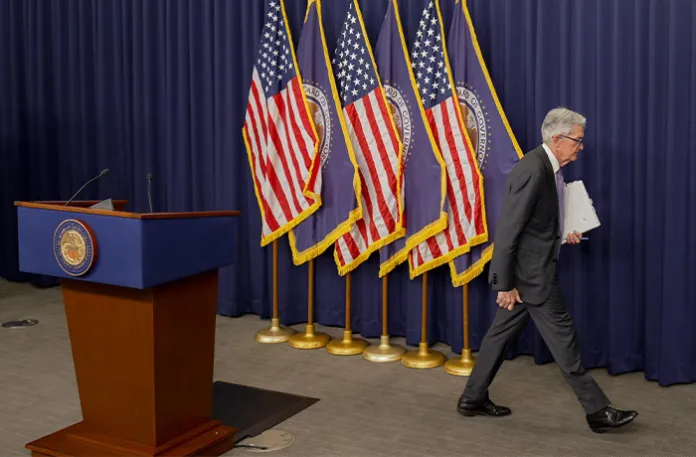
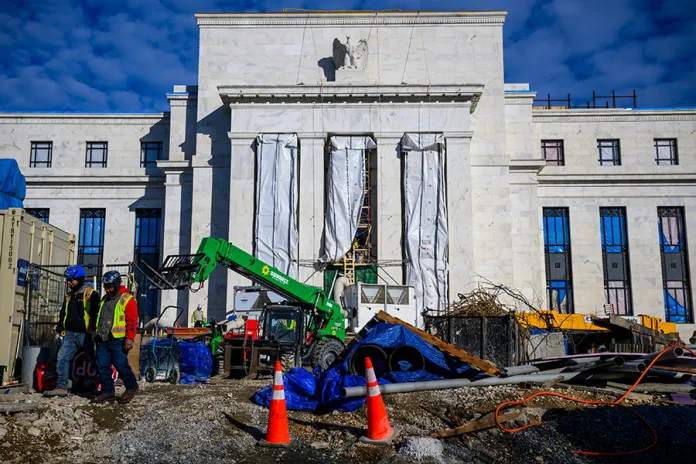
President Donald Trump has spent months criticizing Federal Reserve Chairman Jerome Powell over interest rates, repeatedly arguing they should be lower. Now the Justice Department has opened a criminal investigation tied to Powell’s testimony on a costly Fed renovation project, prompting swift criticism from economists and former Fed chairs.
On Capitol Hill, a small but vocal group of Republicans has warned that the investigation risks politicizing the central bank at a sensitive moment for monetary policy. The sharpest response has come from Sen. Thom Tillis (R-NC), who is not running for reelection. Tillis recently said he would oppose any Fed nominee put forward by the White House until the matter involving Powell is resolved.
Sen. Lisa Murkowski (R-AK) has explicitly aligned herself with Tillis. In an X post, Murkowski said the investigation was “nothing more than an attempt at coercion,” warning that “if the Federal Reserve loses its independence, the stability of our markets and the broader economy will suffer.” She added that Tillis “is right in blocking any Federal Reserve nominees until this is resolved.”
Senate Majority Leader John Thune (R-SD) was a little more cautious, saying he wanted the matter resolved quickly while reaffirming his support for the Fed’s independence. Sen. John Kennedy (R-LA), meanwhile, dismissed the investigation bluntly, saying, “We don’t need this,” reflecting unease among some Republicans about the possible political consequences against the backdrop of the 2026 midterm elections.
Democrats, naturally, have been more uniformly critical. Sen. Elizabeth Warren (D-MA) said the investigation amounted to political interference in monetary policy, warning that “using law enforcement to pressure the Fed threatens economic stability.” Sen. Chris Van Hollen (D-MD) echoed those concerns, calling the investigation “deeply troubling” and arguing that it risks undermining investor confidence in the central bank. Other Democrats have framed the investigation as part of a broader effort to exert political pressure on the Fed as it weighs interest-rate decisions.
For markets, the concern is less about the investigation’s legal merits than about the signal it sends. The Fed’s credibility and perceived independence are embedded in everything from Treasury yields to mortgage rates, and even the suggestion of political or prosecutorial pressure can introduce uncertainty into rate expectations. Several economists have warned that actions seen as intimidating the Fed could ultimately push borrowing costs higher, not lower, as investors demand a premium to account for institutional risk.
Powell acknowledged the investigation while pushing back on the suggestion that it has affected the Federal Reserve’s work. In a brief statement, he said the central bank would continue to carry out its mandate independent of political considerations, emphasizing that monetary policy decisions would remain guided by economic data rather than outside pressure. He also reiterated that the renovation project at the center of the inquiry had been disclosed to Congress and overseen through established internal processes.
A letter signed by several former Fed chairs and senior economic officials, including Ben Bernanke, who was appointed by President George W. Bush, heightened concerns about the broader implications of the investigation. The letter warned that perceived pressure on the central bank would “threaten the independence of the Federal Reserve and could undermine confidence in U.S. monetary policy,” emphasizing that even if the investigation proves inconclusive, it risks damaging the Fed’s credibility with investors and markets.
Economists reacting to the investigation echoed those concerns. Ryan Monarch, an associate professor of economics at Syracuse University, described the inquiry as “the most serious attempt to curtail the Fed’s independence in modern history,” warning that markets are highly sensitive to signals suggesting monetary policy could be influenced by legal or political pressure. Others noted that uncertainty surrounding the Fed’s autonomy could ultimately push borrowing costs higher, offsetting any near-term benefits from lower interest rates.
Trump’s demands for lower interest rates
The dispute reflects fundamentally different views of the current risks in the economy. Trump has repeatedly argued that lower interest rates are necessary to spur growth, support equity markets, and ease borrowing costs for consumers and businesses. Trump hasn’t said where he wants target rates to be, but his concern is not the macroeconomic picture. For him, lower rates are good because they represent a political win for which he can take credit.
By contrast, Federal Reserve officials have emphasized the need to balance growth against inflation risks, particularly as price pressures, while easing, remain above the central bank’s long-term target. Economists note that while rate cuts can provide short-term stimulus, cutting too aggressively, particularly under political pressure, risks unsettling bond markets and forcing rates higher over time.
The political stakes extend beyond the investigation itself and into the administration’s ability to reshape the Federal Reserve. The investigation was launched under the U.S. attorney for the District of Columbia, Jeanine Pirro, a close Trump ally, a fact that has drawn some scrutiny even from within the president’s orbit. Appearing on Fox News’s Hannity, Pirro was defiant, defending the investigation and rejecting claims that it amounted to political intimidation.
“No one is above the law, nor should anyone think that they have the right to be above the laws,” she said, arguing that scrutiny of the Federal Reserve chair should not be treated differently from that of other public officials.
Former Trump economic adviser Larry Kudlow disagreed and publicly urged the investigation be dropped.
“I don’t think he’s a criminal,” Kudlow said, warning that the case risked distracting from economic priorities and complicating the White House’s broader economic agenda. His comments reveal genuine concern among some Trump allies that the investigation creates unnecessary political headwinds as the administration looks ahead to future Federal Reserve nominations.
Those headwinds are already visible in the Senate when it comes to confirming Powell’s successor. Amid the investigation into Powell, Democrats are likely to oppose any Trump nominee. As such, the administration would need near-unanimous Republican support to secure confirmation.
If only Tillis and Murkowski maintain their opposition, a nominee could still advance on a 51-49 vote. However, should Sen. Susan Collins (R-ME) join them, the split would be 50-50, requiring Vice President JD Vance to cast a tiebreaking vote. Any additional defections would effectively block confirmation, increasing pressure on the White House to resolve the dispute before moving forward.
The confirmation math could ultimately shape the White House’s next move. Trump has shown in past standoffs a willingness to back off when he sees a possible win escaping his grasp, and that dynamic may apply here as well. Securing a hand-picked successor to Powell would carry far greater long-term political victories than pursuing an investigation that risks stalling or derailing a nomination. If Trump sees there is any risk to the nomination, he would undoubtedly direct Attorney General Pam Bondi to order Pirro to drop the investigation.
WHAT TO KNOW ABOUT THE DOJ INVESTIGATION INTO FED CHAIRMAN JEROME POWELL
Powell is set to step down as Fed chairman in May, a timeline that significantly raises the stakes. As that date approaches, the politics surrounding the central bank are likely to intensify, with Trump expected to move quickly to name a successor aligned with his preference for lower interest rates, most likely before Powell departs.
Ultimately, the episode may test whether the institutional guardrails around monetary policy hold as the White House presses for lower rates and greater control over the central bank.
Jay Caruso (@JayCaruso) is a writer living in West Virginia.