European leaders are beginning to believe their continent is the last advocate for a world that isn’t governed with a sense of might-makes-right.
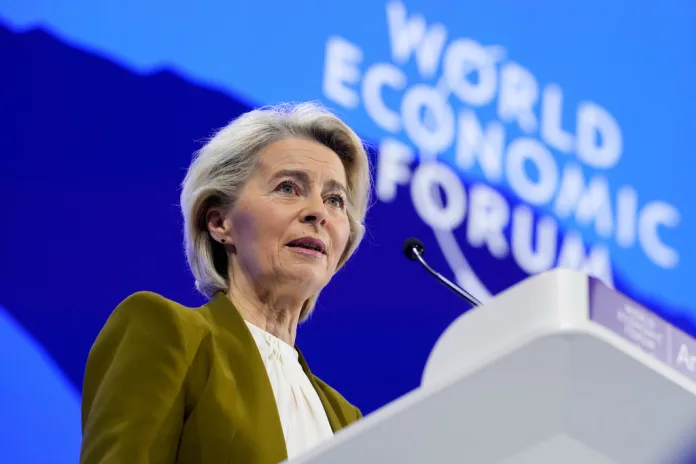
Between the Russian invasion of Ukraine, U.S. demands for sovereignty over Greenland, and other geopolitical upheavals to global norms, European Commission President Ursula von der Leyen is lamenting it all as a “shift in the international order” that is both “seismic” and “permanent.”
“In essence, the post-war international order … was based on the major powers’ respect, at least formally, for the rules of international law,” Nicolas Tenzer, a professor at the Paris School of International Affairs and senior fellow at the Center for European Policy Analysis, told the Washington Examiner. “Even if it covered up some rotten fruit, the idea that democracy had to be defended and spread throughout the world was a project shared by the allies on both sides of the Atlantic.”
Now, the Old Continent seems to be in agreement that its diplomatic posture will need to change drastically — learning to assert itself with confidence and solidarity in the face of a “world defined by raw power.”
“Adapting to the shifting world order should in no way mean forgoing our principles,” one European official told the Washington Examiner. “It means defending our sovereignty, our independence, and our values with greater assertiveness, strength, and determination than ever.”
This new attitude was on full display at the World Economic Forum in Davos, Switzerland, this week — a summit that, for many attending leaders, felt more like a funeral for how geopolitics used to be.
Heading into the conference, President Donald Trump had intensified his demands that Denmark give up its sovereignty over Greenland — ostensibly for the purpose of upgrading security infrastructure on the island.
For many, this demand, following a year that brought weaponized tariffs, mercurial attitudes toward defending Ukraine, and the abduction of a sitting world leader, proved to be the breaking point.
“Until now, we tried to appease the new president in the White House,” Belgian Prime Minister Bart De Wever told the crowd in Davos. “We were very lenient, also with the tariffs, we were lenient, hoping to get his support for the Ukraine war. “We were in a very bad position at the moment; we were dependent on the United States, so we chose to be lenient, but now so many red lines are being crossed that you have the choice between your self-respect.”
The Belgian leader characterized Europe as a continent forced to reject transitioning from the status of “happy vassal” to “miserable slave.”
“Every day we’re reminded that we live in an era of great-power rivalry,” Prime Minister Mark Carney of Canada told the audience. “That the rules-based order is fading. That the strong can do what they can, and the weak must suffer what they must.”
Canada, the northern neighbor of the U.S., has suffered perhaps the most explicit threats of annexation from the White House. Trump has repeatedly alluded to making the country America’s “51st state,” spurring Canada to consciously align itself with its European allies.
German Chancellor Friedrich Merz warned that the “new world of great powers” is “not a cozy place,” but that Europeans “do not have to accept this new reality as fate.”
“We are not at the mercy of this new world order,” Merz said. “We do have a choice. We can shape the future. To succeed, we must face harsh realities and chart our course with clear-eyed realism.”
Ukrainian President Volodymyr Zelensky, the leader of a war-torn nation desperately seeking refuge within the ranks of the European Union, offered a rebuke of the continent’s ineffectual posture.
“Instead of becoming a truly global power, Europe remains a beautiful but fragmented kaleidoscope of small and middle powers,” Zelensky, who is generally prone to flattery and thankfulness, said Thursday. “Instead of taking the lead in defending freedom worldwide — especially when America’s focus shifts elsewhere — Europe looks lost, trying to convince the U.S. president to change. But he will not change.”
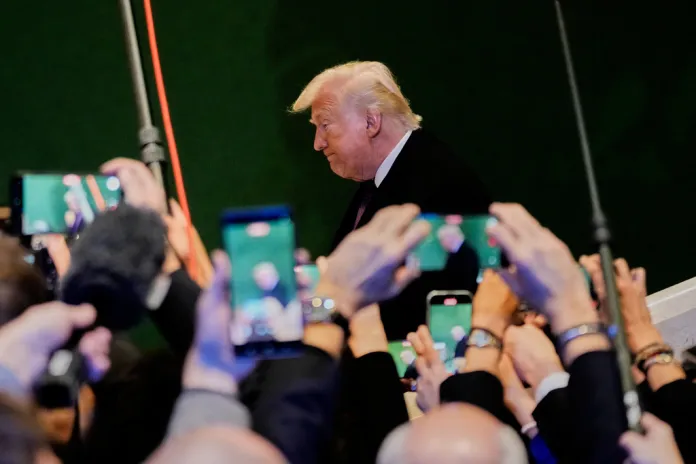
Meanwhile, Trump has continued to expand his transnational ambitions unhindered, hosting a slew of world leaders for a signing ceremony that cemented his “Board of Peace,” which will oversee the reconstruction of the Gaza Strip. Trump will hold autocratic executive authority on the board, which has been embraced by a slew of Eastern European and Middle Eastern states but largely ignored by Western Europeans.
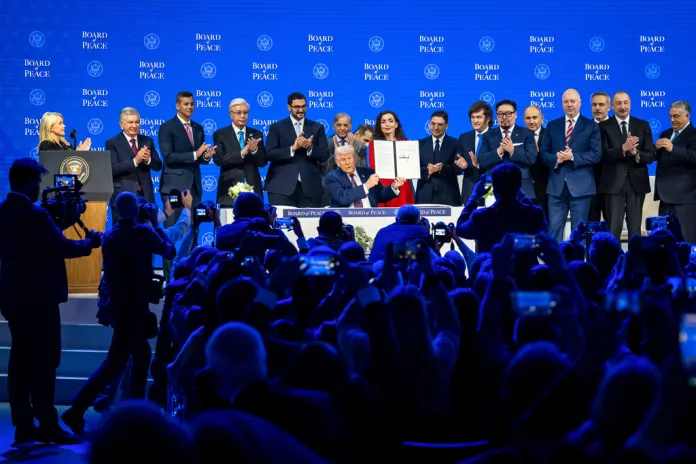
In these unilateral actions by the U.S., Europe sees concerning parallels to the actions of its preeminent rivals.
“Who are the powers targeted by Ursula von der Leyen and other European leaders? Let’s be clear: it is primarily Russia and China, not the United States,” Tenzer told the Washington Examiner. “The fear is therefore less that the United States will attack us — that would be stupid — than the fact that there is an ideological alignment between these three powers and an indifference, perhaps hostility, on the part of the United States towards the European model of democracy.”
But for all the talk of shattered friendships and inescapable upheavals, Europe seems at least to be leaving the door open for the U.S. to correct course.
Not long after Trump spoke at the Davos summit — a bellicose speech that included explicit jabs at many of the world leaders in attendance, including Carney and French President Emmanuel Macron — an unexpected breakthrough was announced.
American, Danish, Greenlandic, and NATO officials agreed to begin negotiations on the future of Greenland that would be mutually satisfactory for all parties. Trump is seeking assurances that U.S. military actions on the island are legally unrestricted and will never expire. Europe just wants to keep Greenland under Danish control.
Virtually zero concrete details about these negotiations have been announced, but all sides are celebrating their mere existence as a victory.
“We will have everything we want. We’re getting everything we want at no cost,” Trump told Fox Business on Thursday. “I’m not going to have to pay anything. We’re going to have total access to Greenland. We’ll have all the military access that we want.”
Meanwhile, Macron touched down in Brussels and told the press that the negotiations show that “Europe can make itself be respected.”
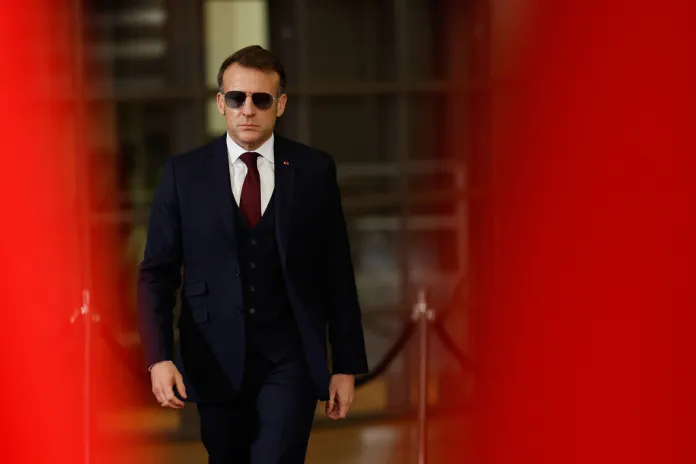
“When we use the tools that we have at our disposal, we get respect, and that’s what happened this week,” the French president said.
Macron was arriving in Belgium for an emergency summit planned before the Davos breakthrough, a meeting intended to discuss coercive mechanisms that would punish the U.S. for its Greenland ambitions.
ZELENSKY URGES EUROPE TO DOUBLE ARMY BY 2030 TO COMBAT RUSSIA’S POSSIBLE 2.5 MILLION TROOPS
With negotiations underway, focus shifted to normalizing trans-Atlantic trade, a priority disrupted by the dispute.
Regardless of the outcome in Greenland negotiations and the finalization of the trade deal, European leaders have made clear that they remain skeptical of Trump’s insistence that “the United States cares greatly about the people of Europe — we really do.”