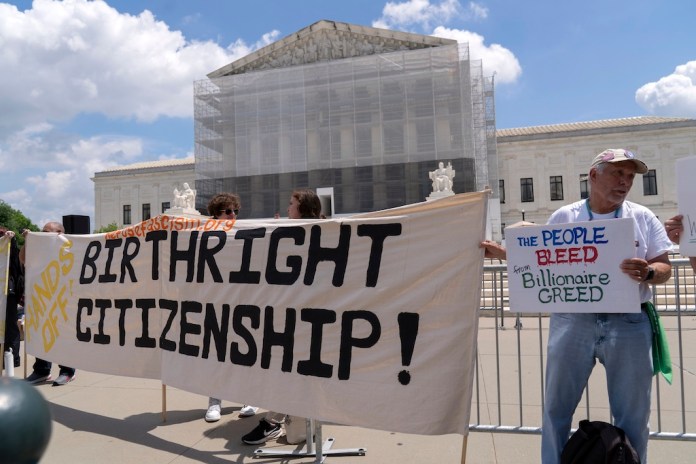
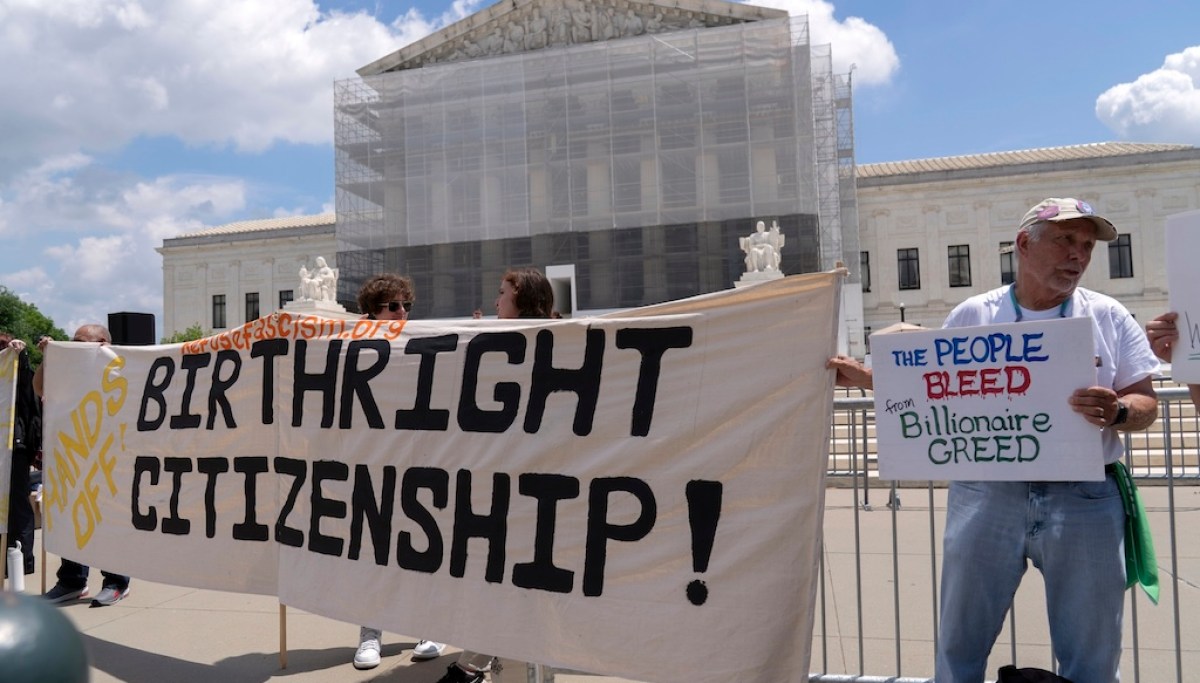
The Supreme Court will soon hear a landmark challenge over precisely who can enjoy the birthright citizenship granted under the 14th amendment, and the Trump administration and its allies are urging the high court to side with the president’s view.
President Donald Trump issued an executive order on Jan. 20, 2025, claiming that birthright citizenship under the 14th Amendment does not extend to children born on U.S. soil to parents who are in the country illegally or on a temporary basis, such as on a visa. Under the executive order, a child born on U.S. soil who has one parent who is a U.S. citizen or permanent resident would still be granted citizenship at birth. Trump’s order was challenged by numerous lawsuits, and the Supreme Court agreed to take up a class action lawsuit, titled Trump v. Barbara, in December, after the DOJ appealed multiple cases to the justices.
The Justice Department submitted its brief for arguments to the high court earlier this month, followed by multiple briefs from outside groups supporting the president’s side filed this week. In the DOJ’s brief, the administration defended the executive order as consistent with the 14th amendment’s original intention for citizenship when it was ratified in the 19th century.
“The Fourteenth Amendment’s Citizenship Clause was adopted to grant citizenship to freed slaves and their children—not to children of temporarily present aliens or illegal aliens,” the DOJ said in its brief to the Supreme Court.
“The Order advances broader efforts to combat the ‘significant threats to national security and public safety’ posed by illegal entry and birth tourism,” the brief added. “Henceforth, consistent with the Citizenship Clause’s original meaning, the Executive Branch would not treat future children of temporarily present aliens and illegal aliens as U.S. citizens.”
Various groups and lawmakers offered their friend-of-the-court briefs in favor of upholding the Trump administration’s executive order this week. The Coolidge Reagan Foundation, a right-leaning group, argued in its brief that the Supreme Court “should not allow one of the most important issues of the twenty-first century to be resolved as a matter of constitutional law by accident.”
“This Court should not construe this provision to inadvertently resolve the fundamentally different challenge of systemic illegal immigration in the face of the modern welfare state more than a century later without any public debate or deliberation,” the Coolidge Reagan Foundation’s brief said.
“The Court should not grant the millions of illegal aliens whose continued presence in this country violates federal law the constitutional power to change the American political community—the electorate—by conferring citizenship upon their children,” the brief continued.
A group of Republican-led states, led by Tennessee and Iowa, also filed a brief supporting the Trump administration’s stance, stressing that the influx of illegal immigrants into the U.S. in recent years has overwhelmed the states filing the brief – along with the rest of the country – and that the longstanding assumption that children of illegal immigrants are due birthright citizenship is “seriously mistaken.”
The coalition states argued that the text of the 14th Amendment, debate around the creation of the amendment, and the Supreme Court’s previous holdings, all favor the Trump administration’s view of birthright citizenship.
“Contra plaintiffs’ thin historical arguments, contemporaneous sources instead support what common sense suggests: Conferring United States citizenship requires a more meaningful connection than mere presence by happenstance or illegality. That connection, originalist evidence repeatedly instructs, was parental domicile,” the coalition of states said.
The briefs from group of people whose children could be affected by the order and their supporters are expected to be submitted to the high court in the coming weeks.
DOJ URGES SUPREME COURT TO BLOCK CALIFORNIA’S NEW CONGRESSIONAL MAP
The oral arguments in Trump v. Barbara are expected to be one of the most closely watched of the term, as one of the president’s signature executive orders undergoes Supreme Court scrutiny. The high court has yet to schedule oral arguments in the case, but it is expected the justices will hear the case in March or April.
A decision in Trump v. Barbara is expected by the end of June, when the high court releases its final rulings on its current term.