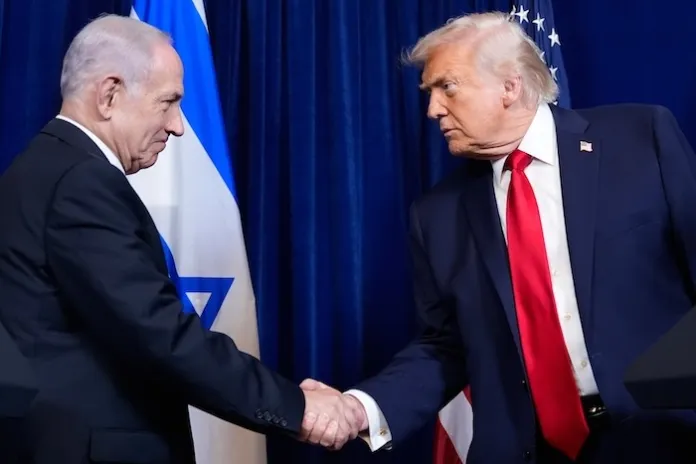
President Donald Trump announced on Monday that U.S. officials had been in indirect communication with Iranian leaders about a possible off-ramp to end the war, but it is unclear how Israel will factor into these discussions.
The president’s remarks were the first indication of a possible off-ramp to conclude the conflict, but his objectives and those of Israeli Prime Minister Benjamin Netanyahu differ, which raises the specter of whether Trump could and would agree to a deal that does not have Israeli support and whether Iran would agree to stop the conflict if Israel does not.
Netanyahu said in a Monday social media post that he had spoken with Trump about his interest in starting diplomacy.
“President Trump believes there is an opportunity to leverage the tremendous achievements we have attained with the U.S. military to realize the war’s objectives in an agreement—an agreement that will safeguard our vital interests,” Netanyahu said, though he did not acknowledge if he shared that sentiment.
A primary difference between the United States and Israel’s goals during the war has to do with the regime in Tehran. The U.S. wants to ensure Iran’s ballistic missile program is completely destroyed, including its defense industrial base that could allow it to rebuild its stockpiles; sink its navy; and prevent it from acquiring a nuclear weapon. Israel agrees with those mission sets but also wants to see the regime completely overthrown, a daunting task that could take ground forces.
Netanyahu also noted that Israeli forces continue their aerial campaigns in both Iran and Lebanon and that they will safeguard their vital interests.
Iranian officials, for their part, denied being in contact with the U.S. Mohammad Bagher Ghalibaf, the speaker of the Iranian parliament, is reportedly involved in the conversations, though he publicly disputed the claim.
With different objectives, it is unclear if there is a possible agreement to satisfy all three of the U.S., Israel, and Iran, considering the Israelis want to see the regime toppled, and the regime wants to maintain its grip on power.
Since Trump took office for his second term a little over a year ago, he has authorized U.S. forces to engage in two earlier Middle East conflicts, and they affected Israel differently.
In June 2025, Israel and Iran went to war, and the U.S. briefly got involved to bomb three of Iran’s nuclear facilities. Shortly after the U.S. bombing of the Isfahan, Natanz, and Fordow facilities, Trump announced a ceasefire agreement between Israel and Iran, which concluded the hot war between them.
US HAS ‘HIGH CONFIDENCE’ IN LOCATION OF IRAN’S ENRICHED URANIUM: GABBARD
But, a couple of months earlier, the U.S. began a bombing campaign of the Iranian-backed Houthis, who are based in Yemen. The Houthis have periodically attacked shipping vessels in the Red Sea over the past two-plus years, which, at its peak, severely limited shipping through the area. They were also firing drones and missiles at Israel.
The U.S.-Houthi conflict lasted for a little less than two months, and then Trump once again declared a ceasefire, but in this instance, the agreement did not bar the Houthis from continuing their attacks on Israel.