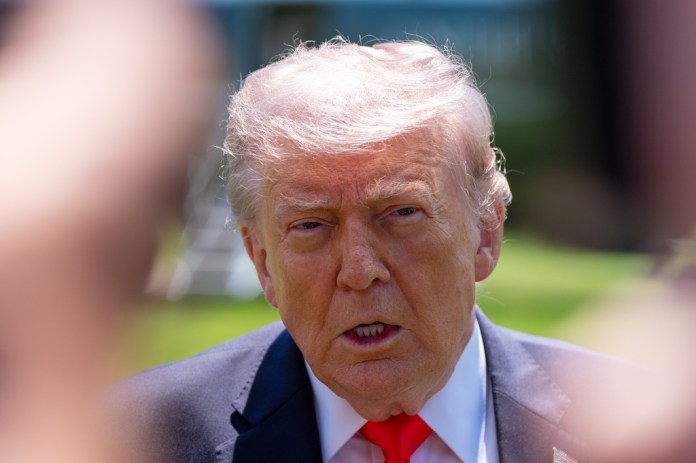
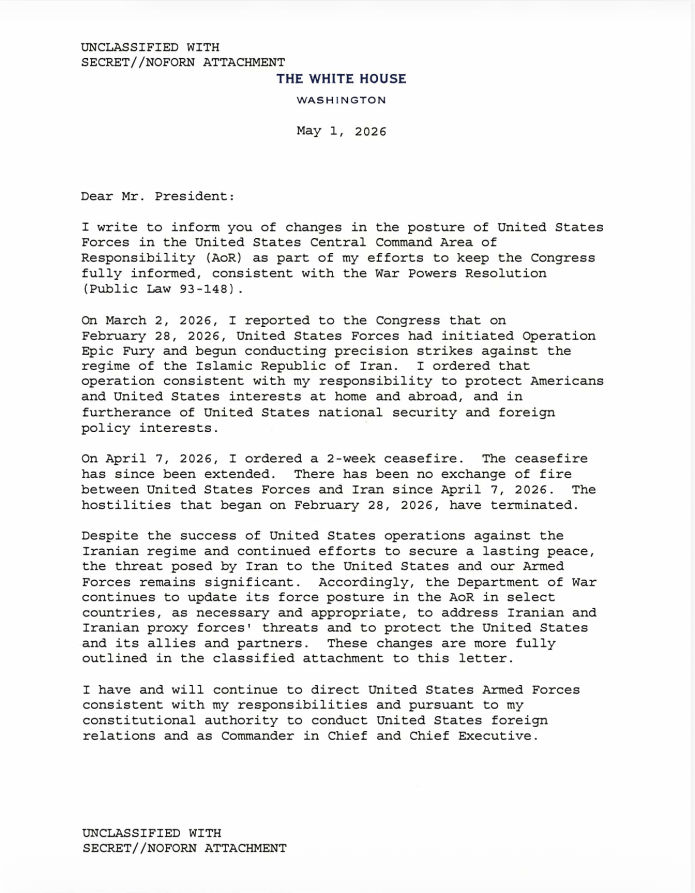
President Donald Trump has notified Congress that “hostilities” with Iran have “terminated”.
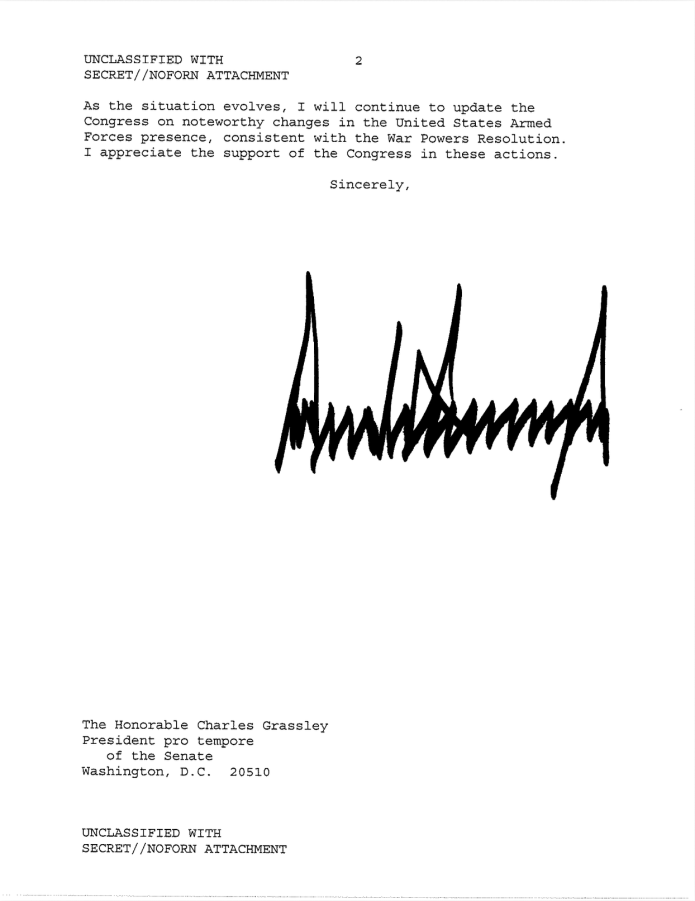
His letter to both House Speaker Mike Johnson (R-LA) and Sen. Chuck Grassley (R-IA), the Senate president pro tempore, comes 60 days after the conflict started on Feb. 28, and is designed to address a Friday legal deadline on war powers. The deadline was set to pass without any action from Congress, with both chambers now on recess.
“There has been no exchange of fire between the United States Forces and Iran since April 7, 2026,” Trump wrote. “The hostilities that began on February 28, 2026 have terminated.”
Despite this, the letter also urged vigilance, saying that the “threat posed by Iran to the United States and our Armed Forces remains significant.”
“Accordingly, the Department of War continues to update its force posture in the [Axis of Resistance] in select countries, as necessary and appropriate, to address Iranian and Iranian proxy forces’ threats and to protect the United States and its allies and partners,” Trump wrote.
“These changes are more fully outlined in the classified attachment to this letter. I have and will continue to direct United States Armed Forces consistent with my responsibilities and pursuant to my constitutional authority to conduct United States foreign relations and as Commander in Chief and Chief Executive,” he added.
War Secretary Pete Hegseth told Congress on Thursday that the ceasefire extended the 60-day deadline Trump had to get congressional approval. The War Powers Resolution of 1973 gives the president a 60-day grace period to conclude any war started without congressional approval.
Trump’s comments came after voicing frustration with the uncertain nature of Iran’s leadership earlier Friday. Speaking with reporters, he said he was “not satisfied” with Tehran’s latest peace proposal.
“One says one thing, one says another. They’re very confused,” Trump said of his counterparts in Iran. “Obviously, their country has been frankly decimated. Their navy is gone. Their air force is gone. Many of their soldiers, unfortunately, are gone. They’ve got to come up with the right deal.”
“They get close, and then a new group of people come in,” he added. “They don’t know who their leaders are. They have no idea who their leaders are, but they’re very confused.”
Different parts of Iran’s leadership have espoused radically different rhetoric toward the U.S. during negotiations. On Friday, Foreign Ministry spokesman Esmaeil Baqaei was quoted by IRNA as saying that “establishing a sustainable peace” is among “Tehran’s main priorities in negotiations with the United States.”
On Thursday, however, state media published written remarks from Iranian supreme leader Mojtaba Khamenei for the occasion of National Persian Gulf Day, which commemorates Portugal’s expulsion from the Persian Gulf.
“By God’s help and power, the bright future of the Persian Gulf region will be a future without America, one serving the progress, comfort, and prosperity of its people,” Khamenei said.
“We and our neighbors across the waters of the Persian Gulf and the [Gulf] of Oman share a common destiny. Foreigners who come from thousands of kilometers away to act with greed and malice there have no place in it — except at the bottom of its waters,” Khamenei added.
The latest Iranian peace offer was given to mediators in Islamabad, Pakistan, on Thursday evening.
TRUMP REJECTS IRAN PEACE PROPOSAL AND SAYS NEGOTIATORS ‘DON’T KNOW WHO THEIR LEADERS ARE’
Trump’s letter to Congress will put a damper on the rumors of war that have grown this week, after U.S. and Iranian negotiators ended their direct talks in Islamabad, Pakistan. The U.S. has continued its massive airlift of military supplies to the Middle East, which led up to the beginning of Operation Epic Fury.
In the meantime, the U.S. blockade of the Strait of Hormuz has wrought havoc on Iran’s economy, sending the Iranian rial tumbling by 15% over just two days this week. Over two million Iranians are estimated by Iranian officials to have been put out of work.