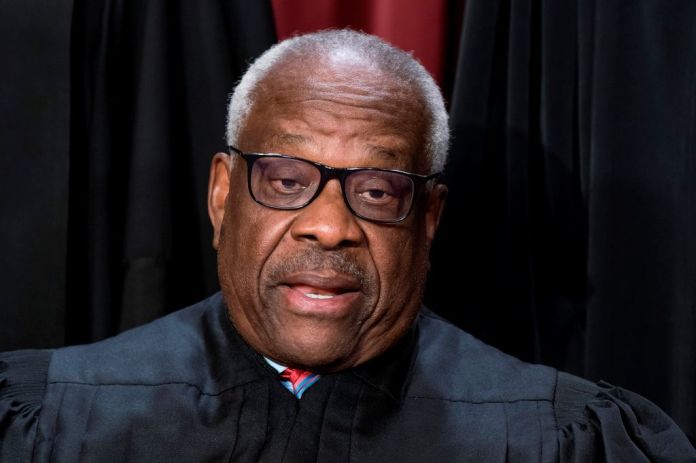
Justice Clarence Thomas urged his colleagues on the Supreme Court to “reexamine” a legal doctrine that prevents someone from taking a contrary position in a lawsuit from one they took in a previous lawsuit, questioning its foundation in law.
Thomas took aim at judicial estoppel in a separate concurring opinion published Thursday in the case Keathley v. Buddy Ayers Construction, Inc., which was a unanimous ruling in a bankruptcy case. Judicial estoppel is the principle that defenders have argued protects “the integrity of the judicial process,” and the majority opinion, penned by Justice Ketanji Brown Jackson, found the U.S. Court of Appeals for the 5th Circuit took the wrong approach when applying it. Jackson wrote that “to determine whether an omission was inadvertent or mistaken for purposes of judicial estoppel, courts should look to the totality of the circumstances surrounding the omission,” and that the appeals court’s “less holistic formulation was erroneous.”
Thomas joined Jackson’s opinion in full but also took aim at the entire judicial doctrine in his six-page concurring opinion, which was joined by Justice Neil Gorsuch.
“Judicial estoppel generally prevents a party from asserting a position in one lawsuit that contradicts its position in a previous proceeding. Lower federal courts have applied this doctrine broadly without clear authority to do so, and with only limited support from this Court’s precedents. In a future case, we should reexamine it,” Thomas wrote.
Thomas noted that the legal doctrine only entered federal courts in recent decades, but has “become commonplace in the Courts of Appeals.” He argued it has garnered widespread adoption in the lower courts despite the Supreme Court’s precedents not justifying the doctrine and it having a “questionable” legal foundation.
“It is unclear what gives federal courts the authority to bar suits based on judicial estoppel. Often, as in the case below, federal courts treat judicial estoppel as a matter of federal law and feel free to craft their own standards and extend the doctrine to new contexts. But, the doctrine appears to have no basis in any statute, any Federal Rule of Civil Procedure, or any traditional inherent power of federal courts,” Thomas wrote.
“Although the doctrine purports to punish litigants to ‘protect the integrity of the judicial process,’ the courts of appeals have not justified it as an exercise of the traditional sanctioning power that courts have been held to have in other contexts,” he added.
Thomas concluded his concurring opinion by urging the high court to take up a case that questions the validity of judicial estoppel.
Thursday’s solo concurring opinion by Thomas continues his pattern of writing his own separate opinions, which urge the high court to either rule further than the majority wanted to on a matter or urge it to challenge a long-standing precedent or legal doctrine.
SUPREME COURT RULES ON CASE OF EX-TWITTER EMPLOYEE WHO HANDED SECRETS TO SAUDI ARABIA
One of Thomas’s other recent examples of urging the high court to go further came in his concurring opinion in April’s Louisiana v. Callais decision. In his concurring opinion in Callais, he agreed with the majority opinion updating the standards for race-based redistricting claims, but went further by finding that Section 2 of the Voting Rights Act “does not regulate districting at all.” His concurring opinion in Callais was only joined by Gorsuch.
Thomas is the most senior member on the Supreme Court, nominated to the high court by former President George H.W. Bush and confirmed by the Senate in 1991. Last month, Thomas became the second-longest-serving justice in Supreme Court history, and could become the longest-serving justice in the high court’s history if he remains on the bench through May 2028.