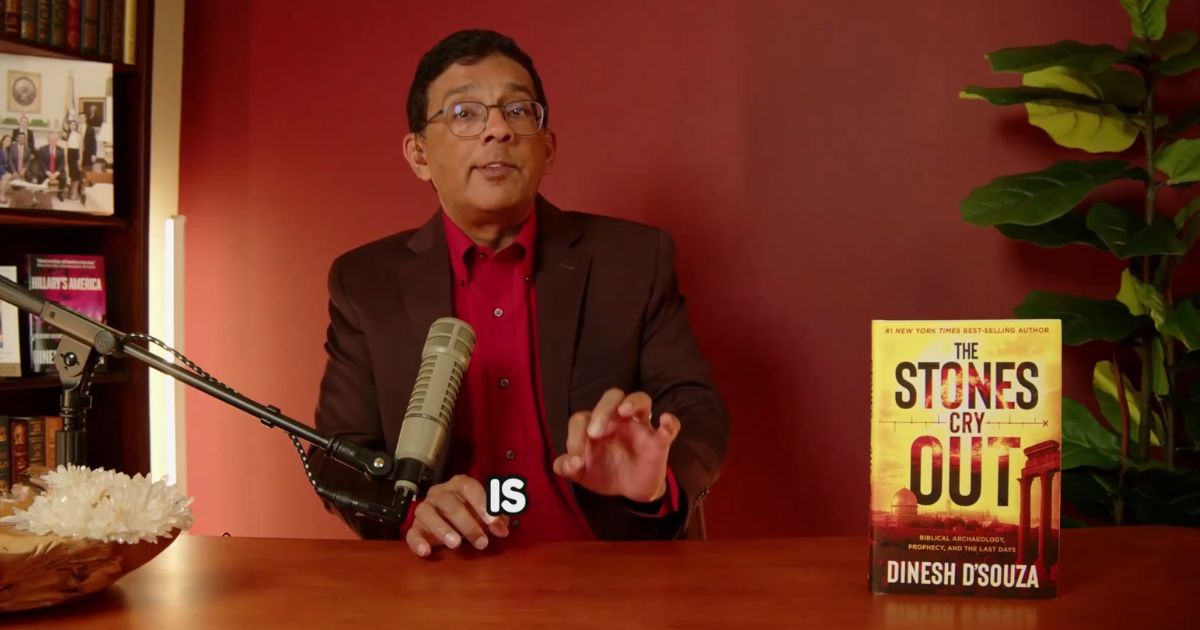
Dinesh D’Souza’s “The Stones Cry Out” lands squarely in today’s cultural tension between doubt and discovery.
At a time when skepticism toward Scripture feels almost routine, D’Souza turns to something steady and stubbornly factual: biblical archaeology.
His premise is straightforward. If the Bible is true, the physical world should testify to it — and chapter by chapter, he argues that it does.
The book walks readers through archaeological finds that align with the biblical record not vaguely, but with striking specificity. Inscriptions, artifacts, architectural remains, burial sites, and cultural evidence all echo the world Scripture describes.
Many of these items are on display in museums, cataloged by secular scholars who may not embrace the Bible but cannot dismiss the findings.
Two features make the book unusually engaging. Most chapters begin with a short video in which D’Souza introduces the theme, creating the feeling that the reader is walking through the material right beside him.
And the book is visually rich — filled with photographs of discoveries, maps, images of ancient sites, and even personal photos from his travels. The visuals don’t decorate the text; they actually ground it.
Why were the burial linens in Jesus’ empty tomb folded?
A Jewish custom may give this detail a profound meaning.
He is coming back. https://t.co/DxFCqS5ZY7 pic.twitter.com/9NfwEXinKX
— Dinesh D’Souza (@DineshDSouza) August 12, 2026
D’Souza’s firsthand experiences in Israel and surrounding areas add another layer.
Over many visits, he describes moments where geography, archaeology, and Scripture converge with a clarity that feels quite remarkable. Whether standing near the remains of David’s palace or tracing the steps of first-century Jerusalem, he writes as though the land itself still speaks.
A few themes rise quickly.
Old Testament accounts often dismissed as myth continue to be reinforced by new discoveries. The more archaeologists dig, the more the ancient world resembles the world the Bible describes.
And the New Testament, far from being a collection of spiritual stories, is rooted in real places, real people, real events — many of which can still be touched and measured.
D’Souza argues that these findings form a pattern: The Bible isn’t just spiritually true; it is historically anchored.
His tone is confident without being combative, and he avoids academic jargon, letting the evidence carry the weight.
At times, the sheer volume of discoveries can feel heavy, but that only strengthens his point — the evidence is not thin. It is overwhelming.
In the end, “The Stones Cry Out” offers a timely reminder that faith and history are not adversaries.
For readers who want to see how Scripture stands up under real-world scrutiny, D’Souza provides insight, encouragement, and a renewed confidence in the reliability of the biblical record.
It’s compelling not because it tries to prove too much, but because it simply lets the stones speak.
Dinesh D’Souza’s “The Stones Cry Out: Biblical Archaeology, Prophecy, and the Last Days,” is due out Oct. 13.
The views expressed in this opinion article are those of their author and are not necessarily either shared or endorsed by the owners of this website. If you are interested in contributing an Op-Ed to The Western Journal, you can learn about our submission guidelines and process here.
Advertise with The Western Journal and reach millions of highly engaged readers, while supporting our work. Advertise Today.